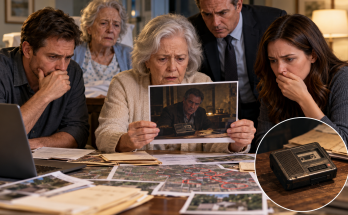
Daniel brought the document to Mr. Lawson’s office the next morning.
He did not send a scan.
He wanted us to see the original under controlled conditions.
Emily sat beside me.
Greg came because the paper concerned Walter’s estate and because, by then, none of us trusted a family document that excluded the family.
The draft deed lay inside a clear archival sleeve.
My name did not appear.
Walter Whitmore as grantor.
Victor Shaw as proposed co-owner.
Fifty percent undivided interest.
The language was formal.
Cold.
Ordinary.
That made it worse.
I stared at Walter’s signature.
“It looks like his.”
Mr. Lawson leaned closer.
“It does.”
Greg said nothing.
Emily looked at Daniel.
“Has it been authenticated?”
“Preliminary handwriting comparison is consistent. Ink dating is underway.”
“When?”
“Approximately fifteen years ago.”
The same year Walter confronted Frost.
The same year Victor’s acquisition model became something my husband tried to expose.
I wanted the paper to be fake.
That would have been easier.
Then I noticed a blank line.
“Witness.”
Mr. Lawson looked.
“Good catch.”
The document contained a notary block.
Unsigned.
No witness.
No recording stamp.
No legal completion.
“It was never effective,” he said.
“That doesn't explain why Walter signed it.”
“No.”
Greg rubbed his forehead.
“Could Victor have forced him?”
“Possibly,” Daniel said.
“Could Dad have planned to transfer?”
“Possibly.”
Emily looked at me.
“Grandma.”
“I know.”
We did not decide the answer before evidence.
That lesson had become exhausting.
Daniel produced another item recovered from the same storage box.
A handwritten note by Victor.
Whitmore signed. Refused final execution. Hold for leverage.
I stared.
“Leverage.”
That word again.
Greg leaned forward.
“So Dad signed the draft but backed out.”
“Appears so.”
“Why sign at all?”
Mr. Lawson answered softly.
“Because someone may have told him signing the draft accomplished something else.”
“What?”
“We need context.”
The context arrived in Walter’s own files.
One folder contained a letter dated two days before the deed.
Walter to Calvin Frost.
I will sign nothing affecting Eleanor’s ownership or future rights. If you need proof I understand your proposal, bring a draft. I will mark every problem in it.
But the recovered draft had no markings.
Only his signature.
“That contradicts this,” Emily said.
“Yes.”
Greg looked toward Daniel.
“Unless somebody removed pages.”
The deed packet had numbered attachments.
Exhibit A.
Exhibit B.
Only Exhibit A remained.
Exhibit B missing.
“What was Exhibit B?” I asked.
No one knew.
Then Mr. Lawson remembered something.
“Walter called me that week.”
Every head turned.
“You remember after fifteen years?”
“Not the date. The issue.”
“What issue?”
“He asked whether a person could sign a deed conditionally.”
My stomach tightened.
“What did you tell him?”
“No. A deed requires delivery and intent. If he intended conditions, they should be in the transaction documents.”
“Did he say why?”
“He said he was testing someone.”
Greg stared.
“Testing Victor?”
“Probably.”
Mr. Lawson continued.
Walter asked what would happen if he signed a document but retained every original, refused notarization, and recorded nothing.
“I told him no transfer would occur.”
“What did Walter say?”
Mr. Lawson almost smiled.
“He said, ‘Good.’”
That sounded like him.
The document suddenly looked different.
Not surrender.
Bait.
Walter wanted Victor to believe he had something.
But why?
Daniel found the answer in another recovered note.
Victor to Frost:
Whitmore may cooperate if Eleanor excluded from details. He believes partial signature gives us basis. Continue pressure.
I laughed once from disbelief.
“He tricked them.”
Mr. Lawson nodded.
“Maybe.”
Walter knew a signature without delivery and proper execution did not transfer the property.
Victor apparently believed it created useful leverage.
Walter may have been pretending to cooperate long enough to learn more.
Then the missing Exhibit B surfaced.
Not in Victor’s box.
In Secure Archive & Trust, filed under Walter’s secondary materials.
Exhibit B carried Walter’s handwriting.
PURPOSE OF SIGNING DRAFT:
To document Shaw’s request that I transfer property interest as condition for “resolution.”
No intent to convey.
No delivery.
No authorization.
Attached as evidence only.
Three copies.
One with Mr. Lawson?
No.
One with Celeste.
One with someone identified only as P.S.
“Paul Frost?” Emily asked.
Daniel shook his head.
“Initials don't match.”
“Priya Sethi?”
“She joined Westbridge years later.”
“Then who?”
Mr. Lawson studied the page.
“Patricia Greene?”
“No.”
The initials bothered me.
Then Greg noticed the date.
“Wait.”
“What?”
“Dad’s old plant supervisor.”
I looked at him.
“Who?”
“Peter Sloan.”
The name returned.
Walter mentioned him occasionally.
A supervisor who helped him after the job loss.
Daniel searched.
Peter Sloan was alive.
Eighty-two.
Retired.
Living in another county.
Police contacted him.
His response shocked us.
“I've been waiting for someone to ask.”
Daniel arranged a recorded call.
Peter’s voice sounded rough.
“I kept Walter’s envelope because he told me not to open it unless Victor came back.”
“You knew Victor?”
“Knew enough.”
“What did Walter give you?”
“A deed copy. Notes. A tape.”
Another recording.
Of course.
“What happened?”
Peter explained that Walter suspected Victor would try to use the signed draft against him.
Walter intentionally allowed Victor to see his signature.
Then he refused to complete the deed.
Victor threatened to tell me Walter had tried to sell half the house behind my back.
My chest tightened.
That would have devastated me.
Walter knew it.
“Why didn't Victor do it?”
“Because Walter recorded him.”
Peter still had the tape.
Daniel obtained it.
The conversation was short.
Victor said:
“You signed it. Eleanor will believe you meant it.”
Walter replied:
“She'll believe me over you.”
Victor laughed.
“Will she believe the paper?”
Walter answered:
“She'll believe whatever I tell her because I haven't lied to her.”
I closed my eyes.
That hurt.
Not because Victor was right.
Because Walter was wrong.
He had lied by omission.
Many times.
The tape continued.
Victor threatened to show me the deed unless Walter stopped contacting Celeste and regulators.
Walter said:
“Show her.”
Victor paused.
Walter repeated:
“Show her. Then I’ll show her everything.”
That was the point.
Victor’s leverage depended on Walter’s secrecy.
Walter had finally refused to be controlled by it.
Ironically, he still did not tell me.
He won against Victor and remained trapped by his own protectiveness.
Peter said Walter later regretted that.
“How do you know?”
“He told me.”
“What did he say?”
“That he spent so long keeping danger away from Eleanor that he forgot she might rather face it beside him.”
I could not speak.
Emily took my hand.
Greg looked away.
Peter continued.
“Walter loved you. He was also stubborn.”
“I know.”
“He thought silence was protection.”
“I know.”
“Wasn’t.”
“No.”
That simple answer settled something inside me.
I did not need to rewrite Walter into a perfect husband.
He had been brave.
He had been wrong.
Both could be true.
Daniel asked Peter why he never came forward earlier.
“I didn’t know any of this started again.”
“News reports?”
“I don't watch much.”
“Victor’s arrest?”
“My daughter told me.”
“Then why wait?”
Peter sighed.
“Walter said only release the envelope if his family found the draft deed.”
That was exactly what happened.
Walter had built evidence around the possibility Victor would use his signature after death.
Fifteen years later, Victor did.
And Walter’s answer had been waiting.
The deed no longer frightened me.
It became another example of Victor’s method.
Take something technically real.
Remove context.
Use the fragment to create a larger lie.
That afternoon, Greg’s attorney called.
His sentencing hearing on the trust charges had been scheduled.
Three weeks away.
Emily went still.
Greg nodded.
“Okay.”
He did not ask what we thought.
That mattered.
The prosecutor had agreed to recommend consideration for cooperation, restitution, and early guilty plea.
No promise of probation.
No promise of jail.
A judge would decide.
“What do you want?” I asked him later.
Greg looked surprised.
“For sentencing?”
“Yes.”
“I want whatever is fair.”
“That sounds rehearsed.”
“It probably is.”
“What do you actually want?”
He smiled sadly.
“I don't want to go to jail.”
There.
Truth.
“But?”
“But I think wanting that doesn't mean I should pretend I don't deserve consequences.”
“Good.”
He looked toward Emily.
“She shouldn't have to argue for me.”
“No.”
“And you shouldn't either.”
“No.”
“Dana?”
“No.”
He nodded.
“I told my lawyer not to ask family for character letters.”
That surprised me.
“Why?”
“Because I’ve spent years making people carry my problems.”
A sentence without Walter’s language.
His own.
“I'll submit facts. Restitution. Cooperation.”
“And remorse?”
“If the judge asks.”
“Are you sorry?”
Greg looked at me.
“Yes.”
“Then say it.”
“Not as strategy.”
“Exactly.”
He nodded.
The next morning, Daniel called with news about Natalie Mercer.
Her attorney had begun negotiating limited cooperation.
Ruth laughed when I told her.
“Everybody finds honesty when the exits close.”
That was harsh.
Accurate enough.
Natalie admitted funding acquisitions before public route announcements.
She denied ordering forged medical documents.
Denied knowing about abductions.
Denied instructing anyone to harm Ruth.
But she confirmed one thing.
Calvin Frost originally designed the cross-system model.
Victor expanded it.
Paul preserved it.
Natalie financed it.
Harlan opened legal doors.
Halpern normalized capacity language.
No single mastermind anymore.
A machine passed from person to person.
“What about the current operations chief?” I asked.
“Cooperating too.”
“Gas line?”
“Claims he told a contractor to pressure Porter.”
“Pressure how?”
“Property inspection, code complaints, negotiation.”
“Not sabotage.”
“He denies authorizing sabotage.”
“Contractor?”
“Claims he interpreted ‘solve’ as stronger action.”
Convenient layers of responsibility.
Still, phone records showed repeated calls from Mercer security to the contractor shortly before the gas line was loosened.
The case strengthened.
Ruth listened to every update.
Then she asked a question that surprised me.
“What happens to the land project?”
“Probably delayed.”
“Canceled?”
“Unknown.”
She frowned.
“I don’t want my house turned into a road.”
“I know.”
“But I also don't want people pretending every development plan is evil because Victor was.”
That was Ruth.
Precise even when angry.
A public infrastructure project could be legitimate.
The acquisition methods were not.
Those distinctions would matter later.
Then Emily found another problem.
The current title insurance on my house contained an old exception.
A reference to “unresolved equitable claim.”
“What does that mean?” I asked.
Mr. Lawson reviewed it.
A fifteen-year-old filing had flagged potential interest by Shaw Development based on the draft deed.
Never litigated.
Never enforced.
But not formally extinguished.
“Victor could still claim something?”
“Not successfully, based on what we have.”
“But the cloud remains.”
“Yes.”
Emily looked frustrated.
“So even though I own the house, the old fake leverage still contaminates the title.”
“Until resolved.”
She would need a quiet-title action.
Legal process.
More documents.
More hearings.
More cost.
Victor’s lie remained inside the record long after its power disappeared.
That seemed fitting.
And infuriating.
Emily filed.
Victor’s attorney opposed nothing.
The Shaw entities were in receivership.
Still, procedures required notice.
Weeks.
Possibly months.
I laughed.
“What?”
Emily asked.
“Walter thought land could be defended by law.”
“He was right.”
“Yes.”
“Why are you laughing?”
“He forgot to mention how much paperwork defending it requires.”
That evening, I found a small envelope among Peter Sloan’s materials.
Addressed to me.
Walter’s handwriting.
Peter said it was part of the release condition.
I opened it.
Eleanor—
If Victor ever shows you the signed deed, you will be angry with me.
Correct.
You should be.
Also correct.
I laughed through tears.
Walter explained exactly what he had done.
He signed the draft to make Victor reveal demands.
He intended to tell me afterward.
Then Celeste needed help.
Then the job disappeared.
Then the legal problem grew.
Then time passed.
He became embarrassed.
Silence became harder to break.
I stared at the page.
Walter.
Greg.
Different men.
Same mechanism.
One hidden choice.
Then another day.
Then shame.
Then years.
Walter wrote:
I want you to know the difference between protecting you and denying you the chance to stand beside me. I failed at that difference.
My chest tightened.
There it was.
Not an excuse.
An apology.
Years before I needed it.
The letter ended:
If the deed ever frightens you, remember this: I never gave Victor the house. I only gave him enough rope to show me what he intended to do.
Typical Walter.
Then:
Please do not let my secrets teach Greg that secrets are noble. Mine were expensive.
I handed the letter to Greg.
He read it.
Then again.
His face changed.
“Dad knew.”
“About you?”
“About the kind of mistake.”
“Yes.”
Greg looked toward the workshop.
“He kept things too.”
“He did.”
“But he told you eventually.”
“Only through paper after death.”
“That’s not better.”
“No.”
I smiled.
“He’d hate that we agree.”
Greg laughed.
Then his phone buzzed.
A message from his attorney.
Something had been found in Westbridge’s receivership files.
A signed agreement.
Greg’s name.
Dated eight months earlier.
He read it.
His face went white.
“What?”
He handed me the phone.
The document appeared to authorize Westbridge to collect repayment from proceeds of my house sale.
His signature was genuine.
Unlike the forged records.
Unlike Victor’s manipulations.
This one was real.
Greg stared at me.
“I signed that.”
I already knew.
The question was whether this was one more confession he had forgotten—or the final proof that, despite everything done to manipulate him, my son had willingly pledged money from a home he did not own.
Click here to continue reading: PART 30: Greg’s Genuine Signature Removed His Last Excuse, and the Truth He Finally Told Emily Cost Him More Than Any Court Sentence Could
My Son Arrived With a Suitcase for Me, Certain I Would Leave the Home His Father and I Built
Part 29 of 35