Paul Frost disappeared before police reached his office.
That did not surprise anyone.
His firm released a statement claiming he was traveling on previously scheduled business.
Daniel described the timing as “unhelpful.”
I described it as “obvious.”
We compromised by agreeing that words matter.
The private vault containing box 317 sat downtown inside a building with no visible sign beyond a brass plaque.
Secure Archive & Trust.
Walter would have liked it.
Plain.
Boring.
The sort of place nobody notices.
Daniel insisted investigators accompany us.
Mr. Lawson came.
Emily came.
Greg came.
I held the key.
Dana surrendered it voluntarily and stayed with police.
At the reception desk, an attorney representing the vault reviewed Walter’s access instructions.
He looked at me.
“Mrs. Whitmore, this container has special conditions.”
“Of course it does.”
“Your husband required two family signatures.”
“Which two?”
“He did not specify individuals.”
Greg frowned.
“Then any two?”
“Any two among the four people named.”
“Four?”
The attorney read.
Eleanor Whitmore.
Greg Whitmore.
Emily Whitmore.
And Walter Whitmore.
I almost laughed.
“One is dead.”
“Yes.”
“So three remain.”
“Yes.”
“Why list himself?”
Mr. Lawson answered.
“In case Walter accessed it while alive with one of you.”
The attorney continued.
There was another condition.
Any family member with a documented financial interest adverse to another named person could not participate unless the adversely affected person consented in writing.
Everyone looked at Greg.
He stared at the floor.
Walter had anticipated conflict.
Not necessarily theft.
Conflict.
Trustee disputes.
Inheritance fights.
Family financial problems.
Human things.
Emily was the adversely affected person.
Greg could not sign unless she consented.
I could sign with Emily and exclude him.
That would open the box.
Simple.
Greg understood immediately.
“I don't need to be part of it.”
Emily looked at him.
“You have the key.”
“Mom can use it.”
“The condition is signatures, not key ownership.”
“Yes.”
He stepped back.
“Open it.”
I studied him.
This was the moment Walter’s wording seemed designed to create.
Not legal compliance.
Choice.
If Greg demanded access, he proved he still believed inheritance created entitlement.
If he surrendered it, perhaps he finally understood.
Emily asked, “You don't want to know what's inside?”
“Of course I do.”
“Then why step out?”
“Because Grandpa made the condition for a reason.”
She watched him.
He continued.
“I already took something he meant for you.”
Her face tightened.
“I’m not taking access to this too.”
Silence.
Emily looked toward me.
I said nothing.
This belonged to her.
Finally she told the attorney, “I consent to Greg participating.”
Greg’s head lifted.
“Emily.”
“This is not forgiveness.”
“I know.”
“This is not trust.”
“I know.”
“This is because whatever Grandpa left concerns all of us.”
Greg nodded.
“Okay.”
All three of us signed.
The vault representative took the brass key.
Then required a second institutional key.
A locked archival drawer opened.
Inside sat a metal container larger than the bank box.
Walter had sealed it with tamper tape.
My name.
Greg’s.
Emily’s.
Written across the top.
Daniel photographed everything before we opened it.
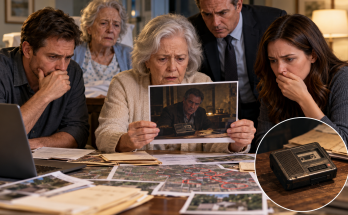
Inside were binders.
Audio cassettes.
Compact discs.
Printed emails.
Property maps.
And one thick document titled:
DISTRESSED OWNERSHIP TRANSITION MODEL — DRAFT 2.
Emily whispered, “Blueprint.”
The title sounded harmless.
Corporate.
Clean.
Inside was everything.
Target identification.
Family leverage.
Medical review.
Court intervention.
Property transfer.
Resale.
Risk management.
Narrative control.
Even contingency defense.
Not ideas assembled later.
A formal system.
Who authored it?
Calvin Frost.
Reviewers listed:
Victor Shaw.
Richard Mercer.
Thomas Harlan — legal procedure consultant.
Dr. Alan Halpern — capacity consultant.
And two additional names.
One deceased accountant.
One person still alive.
Paul Frost.
He had been junior counsel.
His signature appeared on revisions.
“He knew from the beginning,” Emily said.
“Yes.”
Not inherited ignorance.
Inherited participation.
We turned pages.
There were ethical objections.
Most written by Walter.
Some by Celeste.
One by Lydia.
That surprised us.
Lydia had seen an early draft.
Her handwriting appeared beside “family pathway.”
This turns relatives into instruments against owners.
Walter responded in margin:
Exactly.
They had been allies before either knew they would spend years hiding from the same system.
Then came appendices.
Pilot cases.
My stomach tightened.
Margaret Shaw.
Not first.
Earlier cases existed.
Samuel Greene.
Two others.
One property owner named Evelyn Marsh.
Completed.
Family dispute.
Temporary guardianship.
Sale.
Later court challenge dismissed.
We had never heard of her.
Daniel began copying names.
“More victims,” I said.
“Potentially.”
“Yes, Daniel.”
He almost smiled.
The blueprint contained outcome metrics.
Average discount from market value.
Time from “transition initiation” to property control.
Family compliance percentage.
Court success percentage.
People reduced to percentages.
I had thought the Cedar Lake files were ugly.
This was worse.
Not improvised greed.
Design.
Walter’s objections became more forceful as pages continued.
At one point he wrote:
You cannot create distress and then call the sale voluntary.
Under another:
If family receives benefit from sale, they cannot be neutral source of incapacity claims.
Under “narrative management”:
This is lying with enough paperwork to make it look official.
I touched the ink.
There he was.
Angry.
Precise.
Unwilling to accept corporate language as moral camouflage.
Then we found a letter addressed to Calvin Frost.
Walter accused him directly.
Not Victor.
Not Mercer.
Frost.
“You built the machine,” Walter wrote. “Shaw enjoys using it, Mercer enjoys funding it, and Harlan makes excuses for it. But you taught them how to make each piece look separate.”
Emily looked toward Mr. Lawson.
“Lydia was right.”
“Walter believed Frost coordinated everything.”
Yes.
Calvin was dead.
But Paul had worked beside him.
That explained why Paul wanted the box.
The documents could show that Frost Strategic Partners was not merely a consulting firm connected to unrelated clients.
It helped design the system.
Current liability could reach the firm.
Reputation.
Money.
Licenses.
Contracts.
Maybe criminal exposure for living participants.
Then Greg found something with his name.
He stopped.
“What?”
He turned the page.
A handwritten note from Walter dated five years earlier.
Greg struggling financially again. Must not let Frost/Shaw learn extent. He confuses rescue with permission.
My son sat down.
Five years earlier.
Before the restaurant disaster.
Before the trust theft.
Walter had already seen the pattern.
“What did Dad know?”
I thought back.
Greg borrowed money from us once.
Ten thousand.
Said a business deal was delayed.
Walter insisted on a repayment schedule.
Greg hated it.
At the time I thought Walter was being harsh.
Now I understood.
He was protecting Greg from becoming someone else’s leverage.
Walter’s note continued.
If Greg ever asks to borrow against Eleanor’s house, refuse. If he becomes angry, let him be angry.
Greg covered his mouth.
“I did ask him once.”
I looked at him.
“When?”
“Six years ago.”
“What did he say?”
“No.”
“Did you know why?”
“No.”
Greg laughed bitterly.
“I thought he didn't believe in me.”
“He was afraid someone would use you.”
“Yes.”
The misunderstanding had lasted years.
A father protecting a son by refusing to explain danger.
A son interpreting the refusal as rejection.
Secrecy again.
Even good intentions creating damage.
Then Emily found another envelope.
GREG — ONLY IF HE OPENS THIS WITH ELEANOR AND EMILY.
Greg stared.
“You open it,” I said.
His hands shook.
Inside was a short letter.
Walter wrote that he knew Greg’s hunger to prove himself came partly from believing his father saw him as irresponsible.
Walter admitted he had reinforced that fear by criticizing more than explaining.
Then:
I trust you with people more than I trust you with money when you’re scared. Learn the difference.
Greg stopped reading.
Emily finished quietly.
If you ever have to choose between looking successful and telling your family you failed, choose failure. Pride recovers faster than trust.
Greg pressed the letter flat against the table.
For a long time he said nothing.
Daniel respectfully looked elsewhere.
I appreciated that.
Then Greg said, “He knew exactly what I would do.”
“No.”
He looked at me.
“He knew what you might do.”
“What's the difference?”
“Choice.”
He stared.
“Your father spent years trying to design protections because he knew people fail.”
I pointed toward the blueprint.
“Frost designed a system assuming people could be manipulated.”
Then Walter’s letter.
“Your father designed safeguards assuming people could still choose differently.”
Greg nodded slowly.
That mattered.
The box also contained a directory of original evidence locations.
Most had already been found.
One had not.
Vault 317B.
A secondary container.
“Same facility?” Daniel asked.
The representative checked.
“Yes.”
“Why didn't we get it?”
“Different access condition.”
Of course.
Walter had turned estate planning into a puzzle.
“What condition?”
The representative read.
Release only upon confirmation of active legal proceedings involving Frost Strategic Partners or successor entity.
Those proceedings now existed.
The container could open.
Inside was much smaller material.
One folder.
One audio disc.
And a sealed letter addressed not to us.
To Paul Frost.
Daniel photographed it.
“Can we open this?”
The vault attorney reviewed instructions.
Walter had authorized release to Paul or, if Paul was unavailable, to investigators upon evidence of related wrongdoing.
Paul was missing.
Investigators qualified.
Daniel opened it.
Walter’s letter was simple.
Paul—
You were young when your father brought you into this. Young is not innocent, but it is not the same as being trapped forever.
I saw you object twice. I also saw you sign anyway.
If Calvin is gone and you are still protecting this system, then you chose it.
If you want out, the enclosed recording is your chance.
The disc contained a conversation.
Paul Frost.
Walter.
Fifteen years earlier.
Paul sounded young.
Nervous.
He told Walter his father planned to destroy records.
He said Mercer and Victor wanted to continue.
He said Harlan was “handled.”
Walter asked what that meant.
Paul did not know.
Then Paul said:
“If anything happens, Frost Strategic has copies offsite.”
“Where?” Walter asked.
“My father’s retreat.”
“Location?”
Paul gave an address.
Daniel immediately searched.
The property still belonged to Frost Strategic Partners.
A remote lodge two counties away.
Paul Frost had disappeared.
The old offsite archive might still exist.
Police sought a warrant.
Hours later, they entered.
The lodge was empty.
Recently occupied.
Food warm.
Laptop missing.
Paul had been there.
But beneath a floor panel investigators found fireproof document boxes.
Records.
Old and new.
Enough to connect Frost Strategic Partners to recent referrals, planning data, and corporate structures.
Paul had not destroyed everything.
Maybe fear.
Maybe hesitation.
Maybe he left it deliberately.
Then Daniel’s phone rang.
His expression changed.
“Where?”
Pause.
“No, keep him there.”
He ended the call.
“Paul?”
“Yes.”
“Found?”
“He walked into a state police station.”
Everyone went still.
“Why?”
Daniel looked at Walter’s letter still on the table.
“He says he wants to cooperate.”
Greg exhaled.
Another person reaching the same edge.
Tell the truth.
Or continue protecting the lie.
“Did he say why now?” Emily asked.
Daniel nodded.
“Because someone tried to kill him last night.”
The room changed.
“Who?”
“He says Natalie Mercer.”
If Paul was telling the truth, the last active branch of the original network was no longer trying to save itself through lawyers.
It was trying to remove witnesses.
Click here to continue reading: PART 27: Paul Frost Finally Described How the Network Survived His Father’s Death, and Natalie Mercer’s Last Move Put Ruth Porter Back in Danger
My Son Arrived With a Suitcase for Me, Certain I Would Leave the Home His Father and I Built
Part 26 of 35