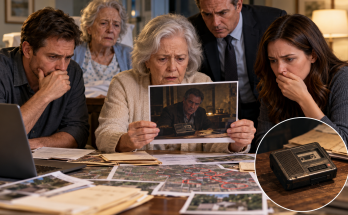
Daniel did not wait for the court to discover its mistake.
He called Margaret’s attorney before we left the bank.
By the time Emily, Greg, and I reached Mr. Lawson’s office, the afternoon evaluation had been suspended.
Dr. Halpern was informed that another physician would conduct any competency examination.
Not chosen by Margaret.
Not chosen by Victor.
Not chosen by any company connected to the case.
Independent.
I had grown suspicious of that word because so many supposedly independent people had eventually turned out to be tied to someone else.
Still, it was better than Halpern.
Margaret called me within minutes.
“What happened?”
“Walter knew him.”
Silence.
“Knew Halpern?”
“Fifteen years ago.”
“How?”
“He attended meetings with Victor, Frost, Mercer, and Harlan.”
Margaret said nothing for several seconds.
Then she asked one question.
“Was he already doing evaluations?”
“Yes.”
Her breathing changed.
“I knew it.”
“What?”
“I knew Victor didn’t simply find Halpern later.”
“Why?”
“Because when he first brought Halpern to see me, they spoke like men who had known each other for years.”
My stomach tightened.
“You never told Daniel?”
“I thought it was only business familiarity.”
“Nothing is only business familiarity anymore.”
That earned a dry laugh.
Then Margaret’s voice hardened.
“If he evaluated me knowing Victor wanted my property—”
“He had a conflict from the beginning.”
“Yes.”
Not necessarily proof that every conclusion was false.
But proof that the process was contaminated.
That mattered.
By evening, Daniel had obtained authorization to question Halpern.
Not arrest him.
Question him.
The distinction disappointed Greg.
“He was in the room fifteen years ago.”
“That alone isn't a crime,” Daniel said.
“He participated in capacity planning.”
“Potentially.”
“You love that word.”
“Because criminal cases collapse when investigators replace ‘potentially’ with ‘definitely’ too early.”
Greg looked toward me.
“I see why you yell at him.”
“I don't yell.”
Emily said, “You absolutely yell.”
I ignored her.
Halpern arrived with counsel.
We did not watch the full interview.
Daniel later summarized what mattered.
At first Halpern claimed the meeting fifteen years ago concerned “elder transition standards.”
When confronted with Walter’s recording, he revised that.
He admitted Frost asked him to explain how cognitive assessments could be used when owners resisted family-supported relocation.
“Used,” I repeated.
“Yes.”
“Not conducted.”
“That distinction was also discussed.”
“Meaning?”
“Halpern claims he only explained lawful standards and never agreed to manipulate results.”
“Do the recordings support that?”
“Not completely.”
“What do they support?”
“Ambiguity.”
I hated ambiguity almost as much as Victor loved it.
Daniel continued.
Walter’s complete recording from the bank box contained more than the microcassette Victor kept.
There were additional minutes.
Halpern spoke about the importance of documenting “functional decline.”
Frost asked what kinds of family observations mattered.
Halpern listed medication mistakes, wandering, unpaid bills, falls, repeated questions.
The exact categories later used against me.
Greg went pale.
“He gave them the template.”
Daniel nodded slightly.
“That is one interpretation.”
“What’s another?”
“That he described ordinary clinical indicators and other people weaponized them.”
I understood.
Words can be innocent in one room and dangerous in another.
“What did Halpern say when Frost asked whether families could document those things before a formal assessment?”
Daniel checked his notes.
“He said family reports were commonly considered.”
“Did he say to make them up?”
“No.”
“Did he tell them not to?”
“No.”
There it was.
The space where conscience should have interrupted.
Maybe that was Halpern’s role.
Not necessarily forging every diagnosis.
Making harmful conduct sound professionally respectable.
Emily asked, “Did he receive payments?”
“His practice received consulting fees.”
“From Frost?”
“Initially.”
“Later Northline?”
“Yes.”
“Related to Dennis Vale’s sister?”
“Yes.”
“So he benefited financially from the same system.”
“Correct.”
Greg said, “And kept doing evaluations.”
“Correct.”
That was enough to destroy the illusion of independence even if prosecutors still needed more for criminal charges.
Then came the first genuine surprise.
Halpern produced something voluntarily.
A notebook.
Old.
Handwritten.
He claimed he kept private notes because, by the third year of working with Frost’s clients, he became uncomfortable.
“Why keep working with them?” I asked.
Daniel’s expression told me he had asked the same thing.
Money.
Prestige.
Referrals.
Professional inertia.
Halpern gave several answers.
None flattering.
The notebook contained names.
Dates.
Cases.
Some assessments Halpern believed were legitimate.
Others where he felt family pressure had influenced conclusions.
Several properties later appeared in Victor’s files.
“He knew,” Emily said.
Daniel corrected her.
“He suspected patterns.”
“Enough to write them down.”
“Yes.”
“Not enough to stop.”
“No.”
That distinction mattered morally, even if law treated it differently.
Then Daniel showed us one scanned page.
Margaret Shaw.
Halpern’s handwriting.
Mild memory impairment. Retains financial understanding. Son pressing for broader incapacity finding than examination supports.
Margaret had not been imagining it.
Halpern’s own original note contradicted the stronger court document later used to transfer control.
“Who changed it?” I asked.
“We’re investigating.”
“Was Halpern’s signature on the altered version?”
“Yes.”
“Did he sign it?”
“He says no.”
Another forged signature.
Another person who had allowed a corrupt system close enough to use his identity.
“How many people does Victor frame?” Greg asked.
“As many as necessary,” Emily said.
Daniel continued.
Halpern’s notebook also contained my name.
My heart jumped.
“When?”
“About eleven months ago.”
“But he never examined me.”
“No.”
“What does it say?”
Daniel read.
Whitmore, Eleanor. Bennett referral. Family requesting capacity consultation. No evaluation unless patient consents or court orders.
I stared at Greg.
He looked sick.
“You asked for Halpern?”
“Chuck did.”
“You knew?”
“I knew there was a doctor.”
“Name?”
“Not then.”
Halpern had apparently refused to evaluate me without direct consent.
That explained why my own doctor’s signature was forged instead.
A corrupt system still contained limits.
Sometimes even compromised people drew lines.
Too late.
Not enough.
But real.
Then Halpern’s notebook revealed another person.
Someone named Laura Kendricks.
Not a homeowner.
A social worker.
“She appears in six cases,” Daniel said.
“What did she do?”
“Capacity-placement recommendations.”
“Silver Pines?”
“Three.”
“Others?”
“Other facilities.”
“Where is she now?”
“Still practicing.”
Of course.
The machinery did not stop because Victor had been arrested.
People remained.
Institutions remained.
Files remained.
That frightened me more than one man.
Victor could be handcuffed.
A process could continue without him.
Daniel contacted Laura Kendricks.
She agreed to speak.
Her interview became the next turn.
Laura had worked as an independent geriatric case manager.
Families hired her.
Facilities referred her.
Law firms referred her.
Frost Strategic Partners referred her.
She claimed she never knew Frost also represented developers.
“Did she recommend Silver Pines?”
“Yes.”
“Based on what?”
“Family reports, medical records, home-safety evaluations.”
“Home evaluations by whom?”
“Contractors.”
“What contractors?”
One name appeared repeatedly.
SafeStep Aging Services.
Emily searched public registrations.
SafeStep shared an accountant with Westbridge.
The network widened again.
Greg stared.
“Everything fed itself.”
Yes.
A lender generated distressed relatives.
Case managers generated care concerns.
Contractors generated home-safety concerns.
Doctors generated assessments.
Facilities created placement.
Realtors handled property.
Lawyers handled authority.
Developers acquired land.
Each person could claim they only performed their own job.
That was the genius and ugliness of it.
Responsibility was divided until nobody felt entirely responsible.
Walter had seen it.
That was what he meant when he told Victor people were not numbers on paper.
Systems allow people to forget the person at the center.
Laura’s files included photographs of homes.
Staircases.
Loose rugs.
Medication shelves.
Kitchens.
Bathrooms.
Mine among them.
“How did she photograph my house?” I asked.
Greg closed his eyes.
“Dana.”
I turned.
He looked at me.
“She sent photos.”
“When?”
“While you were grocery shopping.”
My stomach turned.
Another truth.
Not a dramatic crime.
A quieter violation.
My bathroom.
My stairs.
My kitchen.
Turned into evidence.
“Did you know?”
“Yes.”
Emily looked at him.
“You really did keep everything in installments.”
He accepted it.
“Yes.”
I was too tired to be surprised.
“What did they identify as hazards?”
Greg said nothing.
Daniel read from Laura’s report.
Steep stairs.
Older electrical outlets.
Loose bathroom mat.
Medication stored without organizer.
I laughed bitterly.
“Walter hated pill organizers.”
Emily almost smiled.
The report recommended “transition planning.”
Not immediate placement.
Not incapacity.
But enough language to support the next layer.
I understood how narratives are built.
No single page said: steal her house.
Each page said something smaller.
A concern.
A possibility.
A recommendation.
Together, the stack pointed in one direction.
Laura insisted she did not know the eventual property sales.
Maybe true.
Maybe not.
Investigators would decide.
Then she gave them one critical item.
A referral spreadsheet from Frost Strategic Partners.
It contained dozens of names.
Some crossed out.
Some marked active.
Some marked completed.
Beside each were codes.
Greg recognized one immediately.
“FP.”
“What?”
“Family pathway.”
The code from Priya’s report.
Another: CI.
Capacity intervention.
Another: DR.
Debt resolution.
Another: DA.
Direct acquisition.
Victor’s entire decision tree.
Not hidden in a secret cabin.
Inside an ordinary case-management spreadsheet.
Walter had been right again.
Sometimes the most important things sit where everyone can see them.
Then I saw my entry.
WHITMORE, ELEANOR.
FP active.
CI backup.
Obstacle E.W. granddaughter.
Property conversion priority: HIGH.
Completed?
No.
A red mark beside it.
FAILED.
For the first time, I saw myself in their system after I had defeated it.
Not as owner.
Not as mother.
Not as widow.
Failed acquisition.
I should have felt triumphant.
Instead I felt sad.
Because beneath mine were other names.
Some marked completed.
We knew what that could mean.
Ruth.
Mrs. Alvarez.
Margaret.
People transformed into successful outcomes.
Daniel said state investigators would begin contacting every identifiable person.
“Can they undo the sales?”
“Some.”
“Not all.”
“No.”
“Can people return home?”
“Some.”
“Not all.”
“No.”
Justice would not rewind everything.
That was difficult to accept.
That evening I went into Walter’s damaged workshop.
The smoke smell remained.
Greg stood outside.
He did not enter.
“Come in.”
He looked surprised.
“Are you sure?”
“For five minutes.”
He stepped through the doorway.
The burned wall had been covered temporarily.
Tools lay in boxes.
The workbench remained scorched.
Greg touched nothing.
“I’m sorry.”
“For the fire?”
“For all of it.”
I sat on Walter’s stool.
“Your father’s letter gave you one chance.”
“I know.”
“Stop saying that.”
He almost smiled.
I continued.
“You told the truth when it hurt your legal defense.”
“Yes.”
“You gave up assets.”
“Yes.”
“You cooperated.”
“Yes.”
“You also still hide things until somebody else reveals them.”
His smile disappeared.
“Yes.”
“That has to stop.”
“It will.”
“No promises.”
He swallowed.
“What do you want?”
“Practice.”
“How?”
“Every time you’re tempted to protect how you look, tell the part that makes you look worse.”
Greg looked toward the burned wall.
“That sounds miserable.”
“It probably is.”
He nodded.
“I can try.”
That was better than I will.
Then his phone rang.
Dana.
He answered on speaker.
She sounded frightened.
“Greg, someone came to my sister’s house.”
“Who?”
“I don't know.”
“What did they want?”
“They asked for the envelope.”
My stomach tightened.
“The signature documents?”
“Yes.”
“Police have them.”
“I told him.”
“Him?”
“A man.”
“Did you recognize him?”
“No.”
“What did he say?”
Dana began crying.
“He said I had something else.”
Daniel was called immediately.
Officers went to Dana’s sister’s house.
The stranger had left.
Security camera footage captured him.
Older.
Gray beard.
Cap.
No clear face.
Then Dana remembered what he had asked for.
Not my signatures.
A key.
“What key?” Emily asked.
Dana did not know.
Greg did.
His face changed.
“Dad’s bank box.”
I stared.
“What?”
“Years ago Dad gave me a small brass key.”
“When?”
“Before he died.”
“Why?”
“He told me to keep it safe.”
The room went silent.
“The safe-deposit box we opened?”
Greg shook his head.
“No.”
“That box used a bank access key plus customer key.”
“Yes.”
“Emily had the customer key.”
“Yes.”
“Then what was yours?”
“I don't know.”
“Where is it?”
Greg’s face went pale.
“I gave it to Dana.”
My anger rose instantly.
“Why?”
“She kept our important documents.”
“Where is it now?”
Dana answered through the phone.
“I have it.”
“Did you show anyone?”
“No.”
“Does it have markings?”
“Yes.”
She described a tiny metal tag.
Number 317.
Mr. Lawson looked stunned.
“What?”
He walked to Walter’s old file and pulled out a note.
Three boxes.
One Emily.
One Greg.
One inaccessible unless family reconciled.
I stared.
Walter had created another safeguard.
Emily’s box held the complete evidence and family letter.
Greg’s key opened something else.
Something Walter intended to remain unavailable unless the family reached a point where Greg could be trusted with it.
“What bank?” Greg asked.
Mr. Lawson checked the note.
“Not a bank.”
“Then what?”
“A private records vault.”
Daniel began searching.
The company still existed.
Secure Archive & Trust.
Box 317.
Registered by Walter.
Access instructions required:
Original key.
Identity verification.
And two Whitmore family signatures.
“Which two?” I asked.
The record did not say.
Greg stared at the key in Dana’s hand through the video call.
Someone else knew the box existed.
Someone wanted it.
Victor was in custody.
Halpern exposed.
Harlan arrested.
Frost dead.
Mercer dead.
Natalie under investigation.
Who remained desperate enough to seek Walter’s last hidden archive?
Daniel zoomed in on the security footage from Dana’s sister’s house.
The man turned slightly as he left.
Mr. Lawson leaned toward the screen.
His face changed.
“You know him.”
He nodded slowly.
“His name is Paul Frost.”
I stared.
“Calvin’s son?”
“Yes.”
Frost Strategic Partners had not merely continued after Calvin died.
His son had inherited it.
And if Paul knew about box 317, then Walter’s last archive contained something the Frost family had feared for fifteen years.
Click here to continue reading: PART 26: Walter’s Second Hidden Box Contained the Original Blueprint of the Scheme, but Greg Had to Decide Whether He Deserved to Open It
My Son Arrived With a Suitcase for Me, Certain I Would Leave the Home His Father and I Built
Part 25 of 35