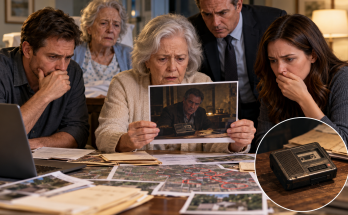
I did not invite Greg to sit.
For several seconds neither of us moved.
The wooden box remained between us on the kitchen table, its lid open, Walter's handwriting visible across the envelopes.
Two years.
For two years those letters had existed somewhere inside my own property while I learned how to sleep alone, eat alone, and wake each morning without the man who had shared my life for half a century.
Greg had known.
"Start talking."
He lowered himself into a chair.
"Dad called me into the workshop a few weeks before he died."
I sat opposite him.
Walter had been weak by then.
He tried to hide it.
He would spend twenty minutes repairing something and an hour pretending he wasn't exhausted afterward.
"What did he want?"
Greg rubbed his palms together.
"He knew he didn't have much time."
"We all knew."
"He knew you wouldn't admit it."
That sounded like Walter.
Even while dying, he worried about my denial more than his fear.
Greg looked toward the box.
"He wrote letters because he thought there would be things he couldn't say while you were watching him get sick."
"Why give them to you?"
His eyes filled.
"Because he trusted me."
The answer hurt both of us.
Greg continued.
"He said you would spend the rest of your life worrying about everyone except yourself."
I looked down.
"He told me that after he was gone, I had one responsibility that mattered more than money."
"What?"
"To make sure nobody used your kindness against you."
My throat tightened.
Greg wiped his face.
"He said you weren't just my mother. You were a person who had spent decades taking care of other people, and sooner or later somebody might mistake that for weakness."
I looked at him.
"And you remembered this while packing my suitcase?"
His face twisted.
"Yes."
The honesty was brutal.
"Then explain it."
"I can't."
"Try."
He stared at Walter's mug on the counter.
"I kept telling myself I was solving problems."
"What problems?"
"Money."
There it was again.
"Whose money?"
"Mine."
I waited.
He finally looked at me.
"Things have been bad for longer than Dana knows."
"How bad?"
"Bad enough."
"That's not an answer."
"I made investments."
"What kind?"
"Business deals. Property. Some private loans."
"And?"
"I lost money."
"How much?"
He closed his eyes.
"Most of what I had."
I leaned back.
Greg had always liked appearing successful.
The truck.
The clothes.
Restaurants he could not afford.
Walter used to say our son wanted people to see the harvest without ever watching him plant anything.
"Does Dana know?"
"Some."
"Not all."
"No."
"And Chuck?"
Greg hesitated.
"Chuck knew."
That name sharpened my attention.
"The realtor."
"He's known me for years."
"Apparently not well enough to stop you."
Greg gave a bitter laugh.
"He encouraged me."
"To sell my house?"
"He said it made sense."
"For whom?"
He did not answer.
I reached into the wooden box.
The first envelope was addressed simply:
My Eleanor.
I traced Walter's handwriting.
Greg looked toward the window.
"You should read it."
"I intend to."
"Maybe I should leave."
"No."
He looked at me.
"You kept this from me for two years. You'll stay while I read it."
My fingers trembled as I opened the envelope.
The paper carried no magic.
No scent of him remained.
It was only paper and ink.
Yet the shape of every letter returned his hands to me.
Walter wrote that if I was reading his words, he was probably no longer sitting across from me in our kitchen. He knew I would keep caring for everyone else because that was how I had lived, but he wanted me to remember that generosity did not require surrender.
I stopped.
Greg stared at the table.
I continued reading.
Walter wrote about the house.
Not its value.
The mornings we spent painting bedrooms.
The winter the furnace failed and all three of us slept beside the fireplace.
The tree Greg fell from at eleven.
The marks in the pantry showing his height.
Then came the line that broke me.
Walter wrote that the home had never mattered because of the land beneath it.
It mattered because I was there.
I pressed the page against my chest.
For a while, neither of us spoke.
Greg wiped his eyes.
"I should've listened."
"Yes."
"I know."
"No, Greg."
I folded the letter carefully.
"You knew."
He looked at me.
"Knowing and listening aren't the same."
His voice was barely audible.
"Apparently not."
I opened another envelope but could not bring myself to read it yet.
"Why didn't you give these to me after the funeral?"
"At first, I thought it would hurt too much."
"That was not your decision."
"I know."
"Then?"
He rubbed his forehead.
"Months passed."
"And?"
"I was ashamed."
"Of what?"
"Not being here."
I understood.
Emily had not been the only person Greg neglected.
After Walter's funeral, my son called frequently for perhaps two months.
Then weekly.
Then monthly.
Eventually, mostly when he needed something.
He had always found reasons.
Work.
Traffic.
Dana's plans.
A vacation.
An appointment.
"I would remember the box," he said, "and every time I thought about bringing it to you, I remembered what Dad asked me to promise."
"What promise?"
His voice cracked.
"That I'd protect you."
I stared at him.
"And then I did the opposite."
He nodded.
"Yes."
For the first time since this began, he offered no excuse.
No concern about my stairs.
No speeches about property taxes.
No claim that Silver Pines was safer.
Just the truth.
"I became desperate," he said.
"So you decided I was expendable."
He flinched.
"I never thought of it that way."
"That doesn't mean you didn't act that way."
He nodded.
"I know."
I looked at my son's face and saw age I had not noticed before.
Gray near his temples.
Lines around his mouth.
For months I had been the old person in every conversation.
Now I saw a fifty-one-year-old man frightened by consequences of his own making.
I loved him.
That remained true.
But love was not acquittal.
"What does being sorry change?"
"Nothing yet."
That answer surprised me.
Greg continued.
"I can't ask you to trust me."
"No."
"I can't ask Emily to forgive me."
"No."
"I can't undo what I did."
"No."
He breathed deeply.
"But I can stop lying."
I waited.
He reached into his jacket.
"That's why I brought this."
He placed a bank envelope beside Walter's letters.
I recognized Greg's name through the plastic address window.
"What is it?"
"The part I didn't tell you."
I opened it.
The first page contained figures I did not understand immediately.
Loan amount.
Interest.
Payment schedule.
Collateral assumptions.
Projected property proceeds.
Then I saw my address.
I looked up.
"Why is my house listed here?"
Greg's face went pale.
"I borrowed money."
"Against a house you didn't own?"
"Not exactly."
"Then explain exactly."
"The loan wasn't secured directly by your house. Chuck helped structure it around expected proceeds from a future property transaction."
I read the page again.
"You promised money from the sale."
"I expected you would agree."
"No."
His shoulders sagged.
"You expected to make me agree."
He did not deny it.
"How much?"
He told me.
The number made my stomach tighten.
"Greg."
"I know."
"What happens when you can't pay?"
"I lose almost everything."
"And that's why you needed me out."
"Yes."
The answer came without decoration.
I stood and walked to the window.
Walter's workshop sat behind the garden.
Its roof needed repair.
I had been meaning to call someone.
For fifty years, that little building had been where broken things went.
Chairs.
Lamps.
Toys.
A bicycle.
Once, a neighbor's lawn mower.
Walter believed most things deserved one serious attempt at repair before being discarded.
People were different.
People had to want repair.
"Was Dana involved in the loan?"
"No."
"Did she know you planned to use the house?"
"Yes."
"Did she know how desperate you were?"
"Not completely."
"And Chuck?"
"Everything."
I turned.
"Why?"
Greg frowned.
"What?"
"Why would a realtor care about your debt?"
"He said he could help."
"Nobody helps that much for free."
"I know that now."
"Do you?"
He looked uncomfortable.
"Chuck wanted the listing."
"For four hundred thousand?"
"That's what he estimated."
"Estimated?"
"He said older homes here aren't worth what people think."
Something about the statement bothered me.
Emily had mentioned developers.
Nearby houses.
Companies connected to Chuck's office.
"Did he ever tell you who the buyer would be?"
"No."
"Did he have one?"
Greg hesitated.
"He said he probably could."
"Probably?"
"He told me once you were in care, everything would move quickly."
My skin prickled.
"Once I was in care."
Greg realized what he had said.
"He meant after you moved."
"I heard you."
I returned to the table.
"Did Chuck ever ask you for my signature?"
Greg looked away.
That was enough.
"What did you give him?"
"Nothing."
"Greg."
"Copies."
"Of what?"
"Some documents."
"What documents?"
"Old tax records. Insurance papers."
My heartbeat quickened.
"Anything with my signature?"
He did not answer.
I gripped the chair.
"Anything with my signature?"
"Possibly."
"Why?"
"He said he needed examples for paperwork."
I stared at him.
"Examples."
Greg looked sick.
"I didn't understand."
"No. You didn't want to understand."
A knock sounded at the front door.
Both of us turned.
I expected Emily.
Instead, through the frosted glass, I saw a man in a dark suit holding a black briefcase.
I opened the door only halfway.
"Mrs. Eleanor Whitmore?"
"Yes."
He showed identification.
"Daniel Harris. County property fraud division."
Every muscle in my body tightened.
Behind me, Greg stood.
Daniel noticed him.
"Mr. Greg Whitmore?"
Greg's voice changed.
"Why are you here?"
Daniel looked from him to me.
"That's what we need to discuss."
I let him inside.
He placed his briefcase on the table beside Walter's letters and Greg's bank documents.
The sight of all three together felt like three versions of my family colliding.
Love.
Betrayal.
Consequence.
Daniel opened a folder.
"Mrs. Whitmore, did you authorize anyone to represent you in the sale, transfer, or refinancing of this property?"
"No."
"Did you sign a power of attorney giving your son or anyone else authority over the property?"
"No."
He removed a document.
"Have you seen this before?"
I took it.
My name appeared at the bottom.
So did something resembling my signature.
For one strange second, I doubted myself.
Then I looked closer.
The first letter of Eleanor was wrong.
Walter used to tease me about the way I looped it.
Whoever had copied my signature had missed that loop.
"This isn't mine."
Daniel nodded.
"We don't believe it is."
Greg stepped forward.
"I never saw that."
Daniel looked at him.
"Your name appears in communications connected with the real estate office involved."
"I talked to Chuck."
"Charles Bennett?"
Greg stopped.
"Yes."
Daniel removed several more pages.
"We're investigating Mr. Bennett and related parties concerning suspected fraudulent property transactions."
I felt the room tilt.
"What transactions?"
"Primarily properties belonging to older residents."
Greg sank into his chair.
"No."
Daniel continued.
"In several cases, relatives were persuaded that owners needed assisted living. Authorization documents then appeared, and properties were transferred or sold under questionable circumstances."
I looked at my son.
His face had gone gray.
"He told me it was normal."
Daniel's expression remained controlled.
"What did he tell you was normal?"
Greg covered his mouth.
"That older owners forget things. That once Mom moved into care, the paperwork could be handled."
Daniel stared at him.
"That isn't a normal real estate process."
Greg said nothing.
"It can be exploitation."
The word settled heavily.
I looked at the forged signature again.
Someone had practiced my name.
Someone had planned beyond persuasion.
"Why my house?"
Daniel removed another report.
"Because your son appears to have been given misleading information about its value."
Greg looked up.
"What do you mean?"
"You mentioned approximately four hundred thousand dollars?"
"Yes."
Daniel slid the report across the table.
"This property and the surrounding lots have appreciated substantially. A development group has been acquiring parcels throughout the neighborhood."
I read the figure.
My breath caught.
"That's impossible."
Daniel shook his head.
"The land is now potentially worth close to one million dollars, depending on the combined development plan."
Greg stared at him.
"A million?"
I thought of Chuck walking through my living room.
His eyes on the windows.
The lot.
The backyard.
Walter's workshop.
He had not been evaluating my home.
He had been calculating what could replace it.
Daniel continued.
"We believe Mr. Bennett may have expected to obtain this property below market value and transfer it through affiliated buyers."
Greg looked physically ill.
"He told me he was helping."
"He may have been helping himself."
I sat down.
For months I had believed my son was the architect of my removal.
Now I saw something uglier.
Greg had betrayed me.
That remained his responsibility.
But somebody had recognized his greed and desperation and used both.
Daniel asked, "Who currently owns the property?"
Greg looked toward me.
I almost smiled.
"My granddaughter."
Daniel blinked.
"Your granddaughter?"
"Six months ago I sold the house to her under a properly recorded transaction. I retained lifetime occupancy rights."
His eyebrows rose.
"Who prepared it?"
"Mr. Lawson."
Daniel nodded slowly.
"That may have prevented the fraudulent transaction from progressing."
Greg covered his face.
I looked at Walter's letters.
The timing struck me.
Walter had tried to protect me with words.
Emily had protected me with action.
And Greg, despite everything he had done, had finally brought me the evidence that might expose a larger scheme.
Daniel gathered several documents.
"I'll need copies of these."
He indicated the bank letter.
Greg nodded.
"Take whatever you need."
Then Daniel pointed toward Walter's box.
"Those are personal. I don't need them."
I pulled the box closer.
"No. You don't."
After he left, the kitchen remained silent.
Greg sat across from me.
"What happens now?"
"I don't know."
"Mom."
I looked at him.
"I'm sorry."
"I heard you."
"I mean it."
"I believe you."
Hope appeared in his face.
I stopped it before it could become expectation.
"Believing an apology is not the same as restoring trust."
His eyes lowered.
"I understand."
"Do you?"
"I'm trying to."
The front door opened.
Emily entered.
She saw Greg.
Then the bank papers.
Then my face.
"What happened?"
I told her.
By the time I finished, her expression had gone cold.
"Chuck forged your signature?"
"Someone did."
"And Dad gave him documents."
Greg nodded.
"I did."
Emily stared at him.
"Do you understand what could have happened?"
"Yes."
"No, Dad. Grandma could have lost everything."
"I know."
"Stop saying you know."
He flinched.
Emily's anger reminded me of Walter—not because Walter shouted, but because he had always demanded precision.
Greg looked at his daughter.
"You're right."
That stopped her.
He continued.
"I don't know what it would've cost her. I don't know what I've done to you. I don't know whether either of you will ever trust me again."
His voice shook.
"But I'm going to cooperate with the investigation."
Emily studied him.
"Why?"
"Because it's the first useful thing I can still do."
Nobody answered.
Late that afternoon, Dana returned.
She entered cautiously and stopped when she saw the documents covering the table.
"What happened?"
Greg looked at her.
"The house was worth almost a million."
Her mouth opened.
"What?"
"Chuck knew."
The color left her face.
Greg continued.
"There was a forged authorization."
Dana gripped the back of a chair.
"I didn't know."
Emily watched her.
"About which part?"
"The forgery."
"Did you know about the plan to move Grandma?"
Dana said nothing.
"Did you know Dad expected to sell afterward?"
Still nothing.
Emily nodded.
"That's what I thought."
Dana looked at Greg.
"What are we going to do?"
He gave a tired laugh.
"There is no we in this."
Her expression sharpened.
"What does that mean?"
"It means I took out a loan."
She stared at him.
"What loan?"
"A large one."
"How large?"
He told her.
Dana stepped backward.
"You said things were under control."
"I lied."
"You risked everything?"
"I thought the house would cover it."
"The house wasn't yours!"
"I know."
Her voice rose.
"You let me plan our future around property you didn't own?"
Greg looked at her.
Something passed between them.
Recognition, perhaps.
They had each been willing to build a future from something that belonged to someone else.
Now each was angry that the other had done the same.
Dana grabbed her purse.
"I'm leaving."
Greg did not stop her.
After she was gone, Emily stayed for dinner.
Greg remained in the living room, looking through old photographs.
Near ten, I noticed he was missing.
The back door stood slightly open.
I knew where he had gone.
Walter's workshop.
I found Greg sitting at the old workbench with his father's toolbox open before him.
He looked up.
"I found something else."
My heart tightened.
He reached beneath the toolbox tray.
A small envelope had been taped underneath.
My name was written across it.
Walter's handwriting again.
"Where was that?"
"Hidden under the tray."
I sat beside him.
The workshop smelled faintly of wood and machine oil.
For a moment I could almost hear Walter sanding a chair in the corner.
I opened the envelope.
The first sentence stopped me.
Walter had written it for a future he hoped would never arrive.
A future in which our son forgot what family meant.
Greg read over my shoulder.
His breathing changed.
I looked at him.
Neither of us spoke.
Walter had somehow understood the danger long before either of us did.
Not the realtor.
Not the forged document.
Something more ordinary and more dangerous.
He understood that money, fear, and pride could make a decent person abandon what mattered.
I unfolded the rest of the letter.
Greg pulled a second chair beside mine.
Outside, the house stood beneath the dark trees, legally protected from the people who had tried to claim it.
But Walter's final letter was not about protecting a building.
It was about whether anything inside our family could still be repaired.
And before I read another word, I knew the answer would require far more than forgiveness.
Click here to continue reading: PART 5: Walter’s Last Letter Asked Me to Judge Greg by What He Did Next, Not by the Son I Remembered
My Son Arrived With a Suitcase for Me, Certain I Would Leave the Home His Father and I Built
Part 4 of 35