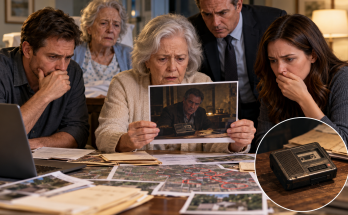
I listened to Greg’s voicemail three times.
Not because I doubted the words.
Because memory is strange.
Once someone names a forgotten detail, surrounding images return.
Walter’s visitation.
The funeral home.
Flowers.
Coffee no one drank.
Hands touching mine.
Faces I barely registered.
Men from Walter’s old jobs.
Neighbors.
Distant relatives.
Was Chuck there?
I closed my eyes.
A dark suit.
Silver tie.
A man speaking quietly to Greg near the hallway.
Maybe.
Grief had made everyone blur.
I called Emily.
She arrived twenty minutes later.
We listened together.
“Do you believe him?”
“I believe we should verify.”
She nodded.
Walter’s funeral home kept digital guest records.
Mr. Lawson helped obtain them the next morning.
Charles Bennett had signed in.
So had Victor Shaw.
I stared at the screen.
“Victor was there too.”
Emily whispered, “Did you see him?”
“No.”
“Did Dad?”
We called Greg.
He went silent.
“I remember Chuck.”
“Victor?”
“No.”
“Think.”
“I am.”
His breathing changed.
“Maybe.”
“That isn't enough.”
“I know.”
We obtained archived security video from the funeral home.
The owner warned us most footage had long been deleted.
But insurance backups from an unrelated incident preserved portions of that week.
Daniel acquired them formally.
The image quality was poor.
Still, faces were visible.
There.
Chuck entering at 6:14 p.m.
Victor at 6:41.
They did not enter together.
They did not speak inside.
At least not on camera.
Victor stood near the rear wall for seven minutes.
He never approached me.
He never signed a condolence card.
Then he left.
Why attend?
Not grief.
Not respect.
Observation.
Daniel froze one frame.
Victor was looking toward Greg.
My son stood with Dana near Walter’s photograph.
“He came to see who remained,” I said.
Daniel nodded.
“Possibly.”
Always careful.
Emily leaned closer.
“Can we tell whether he talked to anyone?”
Another camera showed the parking lot.
Victor stood beside Chuck’s car.
Three minutes.
Then they separated.
Proof of contact.
Not yet proof of conspiracy.
But another line.
Daniel said Chuck would be questioned about it.
Chuck’s answer arrived that afternoon.
He admitted Victor sent him to the funeral.
The reason?
“To assess succession.”
I hated the phrase.
Succession.
A human death translated into property opportunity.
Walter’s body had not yet been buried.
Victor was already calculating what changed.
Chuck told investigators that Victor wanted to know three things:
Whether I intended to remain in the house.
Whether Greg appeared financially stable.
Whether Emily remained close to the family.
A checklist.
My grief had been market research.
Emily went pale.
“How did Chuck determine any of that?”
Daniel answered.
“Conversation.”
People talk at funerals.
They ask what comes next.
Where someone will live.
How family is doing.
Ordinary sympathy becomes intelligence if the listener has another purpose.
Chuck spoke with Greg.
Asked how I was coping.
Asked whether the house would be too large.
Asked whether Greg planned to help.
Nothing overt.
Nothing memorable.
Then, according to Chuck, he reported back.
Widow emotionally attached.
Son uncertain.
Granddaughter absent.
I looked at Emily.
She had been overseas for work during Walter’s funeral.
She returned two days later.
Victor interpreted absence as estrangement.
Potential vulnerability.
“He got it wrong,” Emily said.
“Yes.”
“But close enough.”
Yes.
Then Chuck admitted something else.
Walter’s death had not reopened the file.
It had triggered a scheduled review.
The family profile contained event flags.
Death.
Divorce.
Business distress.
Medical crisis.
Property tax delinquency.
Anything that could make an owner easier to approach.
Victor’s companies used data services to monitor public and commercial information.
Not secret intelligence.
Mostly ordinary records connected in predatory ways.
People advertise vulnerability without knowing it.
A probate filing.
A business lawsuit.
A foreclosure notice.
An obituary.
To most people, separate facts.
To Victor, a map.
“What triggered Greg?” I asked.
Daniel checked his notes.
“Two events.”
“Which?”
“Walter’s death.”
“And?”
“Greg’s restaurant investment lawsuit.”
Greg closed his eyes.
The lawsuit had been public.
The failed business exposed his financial distress.
That was when Westbridge appeared.
Not coincidence.
Selection.
The revelation changed how I saw Greg’s first meeting with Chuck.
He had believed he attended a networking event.
In reality, someone built the room around him.
Still, he chose every step afterward.
That distinction remained fixed.
Daniel received a call.
Chuck had provided another name.
A woman named Priya Sethi.
Former Westbridge compliance officer.
“She objected to the borrower profiling,” Daniel said.
“Where is she?”
“Local.”
“Why haven't we heard of her?”
“She resigned six months ago.”
“Did she report anything?”
“Yes.”
“To whom?”
“Internal legal.”
“And?”
“Her complaint disappeared.”
Of course.
“Will she talk?”
“She already agreed.”
Priya arrived that evening.
Not at my house.
Daniel arranged a formal interview.
I watched remotely with Emily and Greg.
Priya was in her forties.
Precise.
Calm.
She brought her own records.
Not stolen originals.
Personal notes.
Dates.
Meeting summaries.
Enough to guide investigators toward company systems.
She described Westbridge as legitimate at first.
High-risk loans.
Aggressive terms.
Nothing inherently criminal.
Then Victor began using borrower data to identify “relationship collateral.”
“What is relationship collateral?” Daniel asked.
Priya looked disgusted.
“Assets borrowers don't own but might influence.”
Parents’ homes.
Grandparents’ land.
Family businesses.
Future inheritances.
“What made that useful?”
“Borrowers under stress become motivated to accelerate access.”
Greg looked away.
Priya continued.
At first Westbridge merely considered expected inheritance during risk evaluation.
Then Victor formalized it.
Borrowers were scored.
Financial pressure.
Family access.
Owner age.
Property value.
Likelihood of inheritance.
Likelihood of resistance.
Emily whispered, “They turned families into credit models.”
Exactly.
Priya objected.
“Why?”
“Because you cannot treat another person’s property as unofficial collateral.”
“Did Victor agree?”
“No.”
“What did he say?”
“That family assets are economic realities whether lawyers like it or not.”
I thought of Walter.
My family isn’t a financing instrument.
The two men had been arguing the same principle for years.
People as assets.
Or people as people.
Priya’s testimony deepened.
When a borrower tied to valuable property entered severe distress, the profile moved to a special group.
Strategic Resolution.
“What did that group do?”
“Created pathways.”
“What pathways?”
“Family refinancing. Property sale. Assisted-living transition. Guardianship support.”
The euphemisms made my skin crawl.
“Who ran it?”
“Dennis Vale financially.”
“And operationally?”
“Chuck Bennett handled property.”
“Medical?”
“Northline Clinical Assessments.”
“Victor?”
Priya paused.
“He approved targets.”
Directly.
The center.
Finally.
“Did you see Eleanor Whitmore’s file?”
“Yes.”
My throat tightened.
“When?”
“Seven months ago.”
“What did it say?”
Priya looked toward Daniel.
“Do I have to read everything?”
“Relevant parts.”
She opened her notes.
Property value: high.
Owner resistance: high.
Family leverage: medium-high.
Primary pathway: son debt pressure.
Secondary pathway: age-related capacity challenge.
My stomach turned.
There I was.
Reduced again.
“What did you do?”
“I objected.”
“Why?”
“No evidence Mrs. Whitmore lacked capacity.”
“Response?”
“Dennis said capacity wasn’t the question.”
“What was?”
“Whether a capacity narrative could be supported.”
Emily swore under her breath.
Greg covered his face.
Priya continued.
I wanted to hear it all.
Painful truth still belonged to me.
“Did Greg know he was part of a target strategy?” Daniel asked.
“No.”
Greg looked up.
“Did he knowingly provide false information?”
“Yes.”
His face dropped again.
There it was.
Both truths.
He was targeted.
He also participated.
Priya explained that Greg submitted statements about my supposed decline.
Some appeared written by him.
Others by Dana.
Some language matched templates Westbridge provided.
Greg whispered, “Templates.”
I looked at him.
“You used them?”
He nodded.
“I thought they were examples.”
Emily’s face hardened.
“You still copied them.”
“Yes.”
Priya continued.
“What happened after you objected?” Daniel asked.
“I was removed from the account.”
“Then?”
“My performance reviews changed.”
“Pressure.”
“Yes.”
“Why resign?”
“I found a directive authorizing access to borrower communications.”
Emily leaned forward.
“Access how?”
“Loan-management software.”
“Installed where?”
“Business computers and mobile devices.”
Greg turned white.
“I installed their app.”
Priya nodded.
“Permissions were excessive.”
“Could they read messages?”
“Certain synced data.”
“Emails?”
“Depending on settings.”
“Contacts?”
“Yes.”
“Calendar?”
“Yes.”
“Texts?”
“Possibly through backup integrations.”
Greg looked sick.
“That’s how they knew Emily called.”
Priya continued.
She discovered monitoring logs.
Greg’s account had been flagged whenever he communicated with me or Emily.
Victor’s team used timing strategically.
If Emily contacted Greg, Chuck pushed harder.
If I scheduled a doctor appointment, they tried to influence it.
If Greg expressed doubt, debt reminders followed.
A feedback loop.
Pressure adjusted based on private behavior.
That was why everything had felt so perfectly timed.
Because it was.
Daniel asked the obvious question.
“Did you preserve any proof?”
Priya nodded.
“One report.”
She opened a file.
My name appeared.
TIMING RECOMMENDATION:
Increase family pressure following owner resistance.
Avoid direct contact during granddaughter engagement.
Use debt escalation if son hesitates.
Every line was a strategy.
Greg stared.
“They were controlling me.”
Priya looked at him carefully.
“They were influencing you.”
He nodded.
“Right.”
That correction mattered.
Control would excuse too much.
Influence did not.
Priya continued.
The final line on my report read:
If Whitmore son fails to execute transition by Q4, replace family pathway with direct legal-capacity intervention.
I went cold.
Even if Greg refused, Victor intended to continue.
My son was useful.
Not essential.
That changed something in me.
For months I believed Greg’s betrayal created the danger.
Now I understood the danger existed independently.
Greg opened the door.
Victor would have tried another entrance.
Daniel asked Priya why she waited six months to speak.
She looked ashamed.
“Fear.”
“Of Victor?”
“Yes.”
“What changed?”
“Margaret.”
The room quieted.
“When I saw news that she had disappeared, I realized silence was no longer neutral.”
That sentence stayed with me.
Silence was no longer neutral.
Perhaps it never had been.
After the interview, Daniel told us Priya’s records could support warrants for Westbridge’s internal systems.
“That could prove target selection.”
“And monitoring,” Emily said.
“Yes.”
“And Victor’s approvals?”
“Possibly.”
“What about the original documents Dana brought?”
“Strong physical evidence.”
“Chuck’s directives?”
“Strong.”
“Dennis?”
“Cooperating.”
“Marlene?”
“Cooperating.”
“Celeste?”
“Cooperating.”
The walls around Victor were closing.
Then Daniel’s phone rang.
He answered.
His expression changed.
“Where?”
Pause.
“Secure the scene.”
Another pause.
“Do not move anything.”
He ended the call.
“What?” I asked.
“Victor’s attorney reported him missing.”
Emily frowned.
“Again?”
“This time there’s blood in his office.”
Greg stood.
“What?”
“Not much.”
“Whose?”
“Unknown.”
“Do you think he's hurt?”
Daniel grabbed his coat.
“We don't know.”
“Or staging something,” Emily said.
“Possible.”
I looked toward the documents covering the table.
Victor had built his life around creating appearances.
If there was blood in his office, I would not assume the obvious.
Daniel left.
An hour later, police confirmed the blood belonged to Victor.
Small amount.
No body.
His car remained.
Phone gone.
Computer missing.
Then another discovery.
A note.
Handwritten.
I asked Daniel to read it.
He refused at first.
Then summarized.
Victor claimed he was being framed by disgruntled employees, manipulative family members, and corrupt investigators.
“He wrote that?”
“Yes.”
“Does he mention Margaret?”
“Yes.”
“What does he say?”
“That his mother’s illness has been exploited.”
Of course.
“What else?”
Daniel hesitated.
“He says he has evidence proving who really designed the property-acquisition system.”
Every person in my kitchen went still.
“Who?”
Daniel answered carefully.
“The note names Walter.”
I stopped breathing.
My husband.
Dead two years.
The man who tried to expose Victor.
Now Victor was attempting the oldest defense he had left.
Blame someone who could no longer answer.
Click here to continue reading: PART 17: Victor Blamed Walter for the Entire Scheme, but the Evidence He Left Behind Contained One Detail a Dead Man Could Still Disprove
My Son Arrived With a Suitcase for Me, Certain I Would Leave the Home His Father and I Built
Part 16 of 35