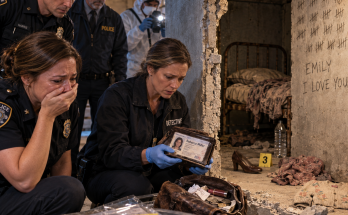
The photograph of Samuel Vale remained beneath the evidence light while everyone in the underground room tried to understand what it meant.
The boy looked no older than six.
He stood beside a wooden fence, one hand resting on the top rail, his face turned slightly away from whoever held the camera. His hair was light brown and badly cut around the ears. He wore jeans that were too long and a green sweatshirt with no visible logo.
Nothing about the image identified a location.
Nothing except the boy himself.
Carter pulled on fresh gloves and lifted the evidence sleeve.
“Photograph both sides again.”
The technician obeyed.
Daniel crouched near the mattress where it had been discovered.
The little room beneath Gerald’s well contained few possessions, but every object now mattered. Two shirts. Child-sized socks. A toothbrush. Canned food. A plastic cup. Three paperback books intended for beginning readers.
Mary stood beneath the red-crayon drawing.
DADDY.
ME.
MARCUS.
She studied the three figures.
“Samuel thought one of them was his father.”
Daniel looked up.
“Which one?”
“That’s the problem.”
Gerald had written SAMUEL VALE on the photograph, giving the child Marcus’s surname. But the drawing placed Daddy and Marcus as separate people.
Carter heard the observation.
“So Daddy wasn’t Marcus.”
“Unless the child used two names for him.”
“Possible.”
Daniel stood.
“Gerald?”
Mary looked at the crude figure labeled DADDY.
“If Gerald made him call him that, why draw Marcus separately?”
Carter stared at the picture.
There was another possibility.
Someone they had not identified yet.
The investigation had already expanded from Thomas to Marcus, then backward to Gerald. Each discovery had revealed another layer beneath the previous one.
Carter no longer assumed the family tree ended where official records did.
“Get DNA from everything Samuel used,” she said. “Toothbrush first.”
The technician nodded.
“And compare against Thomas, Marcus, Gerald, every known victim, and missing-child family samples.”
Daniel looked again at the photograph.
“Six years old means he could have been born after some of these abductions started.”
“Exactly.”
Mary understood what Carter was thinking.
Samuel might not have been kidnapped at six.
He might have spent his entire life inside Gerald’s system.
That possibility was somehow worse.
At the hospital, Rebecca was told only that investigators had discovered evidence of another child.
She sat beside Emily when Carter called.
“What child?”
“A boy. Approximately six.”
Rebecca became very still.
“Name?”
“Samuel Vale.”
Silence.
Carter waited.
“Rebecca?”
“I’ve heard Samuel.”
“From whom?”
“Marcus.”
“When?”
Rebecca looked toward Emily, then stood and walked into the hallway before continuing.
“Years ago.”
“How many?”
“I don’t know. Two, maybe three.”
“What did he say?”
Rebecca pressed her fingers against her forehead.
“He and Thomas were arguing. Thomas said something about Gerald keeping what belonged to him. Marcus said Samuel was safe.”
Carter wrote the words exactly.
“Did Thomas say Samuel’s name?”
“Yes.”
“Did you ever see him?”
“No.”
“Did you know he was a child?”
Rebecca hesitated.
“I assumed Samuel was an adult.”
“Why?”
“Because of how they talked about him.”
Carter leaned back.
“How?”
“Like he was a problem between them.”
That mattered.
“Did Thomas ever call Samuel his son?”
“No.”
“Did Marcus?”
“No.”
“Did Gerald?”
“I never met Gerald.”
Carter glanced toward the well chamber.
“What did Thomas mean by ‘what belonged to him’?”
“I don’t know.”
Rebecca’s voice tightened.
“I wish I did.”
“You’ve already given us more than you realize.”
After the call, Carter returned to the photograph.
The forensic photographer had enlarged the image.
A technician pointed toward the lower right corner.
“There’s something here.”
At first Carter saw only grass.
Then the enlargement sharpened.
Behind Samuel’s left shoe was a small white object.
A rectangular marker.
Daniel leaned closer.
“Utility marker?”
“Maybe.”
The technician enlarged it again.
Faded black lettering appeared.
Not enough to read completely.
But three characters were visible.
C-17.
Carter requested every property record connected to Gerald, Marcus, Thomas, their businesses, relatives, aliases, and former construction contracts.
Nothing immediately matched.
Then Daniel remembered the cabin records.
Marcus had used numbered construction sites rather than addresses in several old invoices.
The records recovered from his storage unit were brought back out.
C-11.
C-14.
C-16.
And C-17.
Daniel stopped.
“Here.”
Carter took the document.
SITE C-17 — NORTH RIDGE PUMP STATION.
The property had been abandoned twelve years earlier after the county replaced its water system.
Marcus’s construction company had performed demolition work there.
“Distance?”
“Forty-two miles.”
Carter was already reaching for her radio.
The first units arrived at North Ridge shortly before sunset.
The property sat beyond an overgrown service road surrounded by pine and scrub oak.
A rusted chain blocked the entrance.
Beyond it stood a low concrete building with boarded windows.
No vehicles.
No lights.
No obvious movement.
Daniel arrived with Carter and Mary several minutes later.
The utility marker beside the fence matched the photograph.
C-17.
Samuel had been there.
Carter ordered the perimeter secured.
They entered carefully.
The pump station smelled of rust, standing water, and old machinery.
Graffiti covered the upper walls.
Broken glass crunched beneath boots.
Nothing suggested recent occupation.
Then Mary noticed the dust.
A wide section of floor near an old control cabinet had been swept.
Daniel knelt.
“Tire tracks.”
Not vehicle tires.
Something smaller.
A cart.
They followed the faint parallel marks toward the rear wall.
There was no visible door.
But the cabinet beside it had scratches around its base.
Daniel and another officer moved it.
Behind it appeared a steel hatch.
Carter looked at Mary.
“Again.”
The hatch opened onto stairs.
Cold air rose from below.
Daniel descended first.
The underground chamber was larger than the one beneath Gerald’s well.
Two rooms.
A narrow bathroom.
A small generator.
Food.
Water.
Children’s clothing.
But no Samuel.
Mary touched the edge of a table.
“Still warm.”
Everyone froze.
A battery-powered lamp beside it had been switched off recently.
Daniel moved into the second room.
The bed was empty.
Blanket thrown aside.
A bowl sat on the floor.
Inside it, oatmeal had begun drying around the edges.
“He was here today.”
Carter immediately expanded the perimeter.
Nobody had seen a vehicle leave.
Officers searched the surrounding woods.
Then Mary found writing beneath the bed.
Not words.
Numbers.
A child had drawn the same sequence repeatedly.
2.
3.
4.
5.
6.
7.
Beside the numbers was a picture of a truck.
Daniel stared.
“Two-four?”
Carter’s expression changed.
“Highway 24.”
The nearest access point was less than three miles away.
State police received the alert.
Road cameras were checked.
At 4:18 that afternoon, a white delivery van had entered Highway 24 from North Ridge Road.
Its plate was partially obscured by mud.
The registered owner had reported it stolen that morning.
Carter watched the footage.
“Driver?”
“Male.”
“Passenger?”
“Can’t tell.”
A second camera caught the van eleven miles east.
This time the passenger window was visible.
A small hand rested against the glass.
Mary whispered, “Samuel.”
The next camera should have recorded the van seven minutes later.
It never appeared.
Daniel studied the map.
“There are only three exits.”
One led toward town.
One toward farmland.
The third led to an abandoned freight corridor.
Carter pointed.
“That one.”
Police reached the corridor after dark.
They found the stolen van behind a collapsed warehouse.
Empty.
The passenger seat contained a green sweatshirt.
The same one Samuel wore in the photograph.
On the dashboard someone had placed a folded piece of paper.
Carter opened it after technicians documented it.
One sentence had been written in block letters.
STOP LOOKING FOR THE BOY.
Daniel stared at it.
“Gerald and Marcus are both locked up.”
Mary looked toward the darkness beyond the warehouse.
“Then somebody else is moving Samuel.”
Carter remembered the drawing beneath the well.
DADDY.
ME.
MARCUS.
The unidentified father figure was no longer an abstract possibility.
Someone outside Gerald’s farm had known Samuel existed.
Someone had access to Marcus’s locations.
Someone had moved the boy before police reached him.
And that person had just sent investigators a message.
The handwriting was photographed.
Then Carter noticed something on the reverse side.
The paper had been torn from a larger sheet.
Across the back remained half of a printed logo.
A circle surrounding the outline of a tree.
Daniel recognized it first.
“I’ve seen that.”
“Where?”
He searched the evidence photographs on his tablet.
Then stopped.
The same logo appeared on boxes recovered from Marcus’s underground storage room.
A charitable organization.
FAMILY BRIDGE OUTREACH.
Carter read the name twice.
The organization provided temporary housing, transportation, food, and counseling referrals for families in crisis.
Exactly the kind of families Thomas and Marcus had targeted.
Mary felt the implication immediately.
“They didn’t just watch playgrounds.”
“No.”
“They had access to vulnerable families.”
Carter looked at the empty van.
“And somebody from that network may still have Samuel.”
The search had begun with a frightened child calling 911 from her bedroom.
It had uncovered Thomas.
Then Marcus.
Then Gerald.
Now, for the first time, investigators understood that the Vale family had not created its system entirely alone.
Someone outside the family had helped them find children.
And that person still had one.
Click here to continue reading: PART 18: Family Bridge’s Records Reveal Samuel’s Real Mother, and Claire Recognizes the Voice of the Man Who Helped Thomas Hide Behind Ordinary Life
A Frightened Child Calls 911 With Three Strange Words That Make an Experienced Dispatcher Refuse to Hang Up
Part 17 of 20