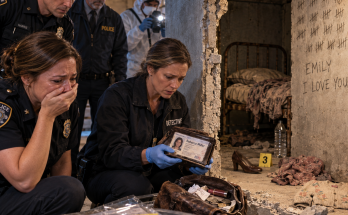
Marcus fought until three officers pinned him into the wet grass.
He did not shout.
He did not plead.
He simply fought with the cold determination of someone who had spent days imagining this possibility and had decided resistance was preferable to surrender.
The cuffs finally closed.
One officer searched him.
Two phones.
Folding knife.
Cash.
Keys.
No firearm.
Marcus turned his face toward the farmhouse.
“Don’t let him talk.”
The officer ignored him.
Inside, the elderly man calling himself George Vail sat in a kitchen chair under guard.
He had produced identification under that name.
Carter watched through a secure video connection while local detectives compared fingerprints against archived records.
The result came back twenty-seven minutes later.
George Vail was Gerald Vale.
The father Thomas believed dead.
The father Daniel had fled.
The husband whose wife had been buried beside missing children.
The man connected to Evelyn Marsh’s imprisonment.
Alive at seventy-eight.
Daniel Ward received the news with no visible reaction at first.
Then he walked into the bathroom of the police facility where he had been waiting and vomited.
Laura remained beside him afterward.
“He was dead,” Daniel whispered.
“No,” Carter said.
“Marcus told me he died.”
“Marcus helped create that story.”
Daniel stared at the wall.
“All these years.”
Thomas’s reaction was different.
When his attorney told him Gerald was alive, Thomas laughed.
It was a short, broken sound.
Then he asked, “Does he know about Mom?”
Nobody answered.
Thomas repeated the question.
“Does he know you found her?”
Carter eventually met with Marcus after he was transported under heavy security.
His lawyer arrived before questioning began.
Marcus sat with his wrists secured to a ring beneath the table.
He looked tired.
Not defeated.
Carter disliked the difference.
“You found him,” Marcus said.
His attorney immediately advised him not to speak.
Marcus smiled faintly.
“I’m allowed to observe.”
Carter placed no evidence on the table.
“You are under arrest in connection with multiple kidnappings, unlawful confinement, conspiracy, identity fraud, and other offenses under investigation.”
Marcus looked bored.
“Long list.”
His attorney touched his sleeve.
“Marcus.”
He stopped.
Carter ended the substantive interaction.
She did not need a confession.
The archive, survivors, properties, records, accomplices, and physical evidence were building a case far stronger than anything Marcus might perform across an interview table.
Gerald’s farmhouse mattered more.
A warrant was obtained.
The search began before dawn.
At first investigators found little.
Gerald lived sparsely.
One bedroom.
Kitchen.
Living room.
Locked office.
The office contained old photographs and boxes of documents.
Several belonged to Gerald’s construction years.
Others concerned missing women.
Newspaper clippings.
Maps.
Polaroids.
Carter arrived after sunrise.
She put on gloves and stood inside the office.
A photograph of Evelyn Marsh lay inside a drawer.
Not the missing-person photograph.
A private image.
Evelyn sitting in the basement room.
Alive.
Terrified.
The date on the back was six days after Gerald told police he did not know her.
Daniel Harris stared.
“That puts him with her.”
“Yes.”
Another photograph showed Margaret.
Her lip split.
One eye swollen.
Gerald had photographed his own violence.
Carter felt disgust rather than surprise.
The box also contained a letter in Margaret’s handwriting.
She had addressed it to a sister named Anna.
The same Anna mentioned on Evelyn’s basement wall.
The letter had never been mailed.
Gerald,
I know what you did to Evelyn. I know there were others. If anything happens to me or the boys, Anna knows enough to keep looking.
Carter stopped.
“Anna.”
Records identified Anna Marsh.
Evelyn’s older sister.
Margaret had apparently contacted the missing woman’s family.
That connection may have helped trigger her attempted escape.
But Anna Marsh had died years earlier.
Her archived correspondence was requested.
The farmhouse search continued.
Dogs alerted near a detached workshop.
The concrete floor had been poured in sections of different ages.
Radar showed no burial cavity.
Instead it revealed a tunnel.
Carter looked at Daniel.
“Again.”
Gerald had preserved the method his sons later copied.
The tunnel led from the workshop to a storm cellar beneath a hill.
The first chamber contained canned food.
Water.
Fuel.
Tools.
The second contained a cot.
Recent bedding.
Medication.
Someone had been there.
Carter’s pulse quickened.
“Clear every room.”
A third chamber was locked.
Officers called out.
No answer.
The door was breached.
Empty.
But warm.
A cup of tea sat on a table.
Steam no longer rose from it, but the liquid remained above room temperature.
Daniel touched nothing.
“Somebody was here when police arrived.”
Carter remembered the footsteps from the farmhouse.
Marcus had run out the back.
Had someone else escaped another way?
They examined the tunnel.
A narrow second passage led toward the woods.
Search teams were deployed.
Dogs picked up a scent.
The trail crossed a creek.
Then split.
One path followed the water.
The other climbed toward an abandoned hunting shed.
Officers surrounded the shed.
“Police! Come out with your hands visible!”
Nothing.
Again.
Movement inside.
A woman’s voice.
“Don’t shoot.”
The door opened slowly.
An elderly woman stepped outside.
Gray hair.
Thin face.
Oversized coat.
Hands raised.
She looked close to Gerald’s age.
Officers approached carefully.
“What’s your name?”
She hesitated.
“Anna.”
Carter, listening remotely, stood.
Anna Marsh was supposed to be dead.
“Anna what?”
The woman looked toward the farmhouse.
“Anna Marsh.”
Carter immediately checked records.
Anna Marsh’s death certificate stated she had died eighteen years earlier in a boating accident.
Body unrecovered.
Declared dead later.
Another disappearance without a body.
Another false ending.
The woman was taken to a safe location and medically evaluated.
Fingerprints from old employment records and later DNA confirmed her identity.
Anna Marsh.
Evelyn’s sister.
Alive.
She had been living under Gerald’s control for nearly two decades.
Mary joined Carter for the first formal interview after doctors cleared Anna to speak.
Anna’s voice was weak but precise.
“Gerald found me because Margaret wrote.”
“When?”
“After Evelyn disappeared.”
“Did Margaret tell you Gerald took her?”
“Not directly.”
“Why?”
“She was scared he read her mail.”
“What did she say?”
“That Evelyn had been in her house.”
Anna closed her eyes.
“I went to police.”
“What happened?”
“They said there wasn’t enough.”
“Did Gerald know?”
“Eventually.”
“What did he do?”
“Watched me.”
“For years?”
Anna nodded.
“He liked waiting.”
Carter thought of Marcus.
Watching escape attempts.
Following victims to discover whom they trusted.
The method had not merely been inherited.
It had been studied.
“When did Gerald abduct you?”
“Eighteen years ago.”
“The boating accident?”
“Staged.”
“How?”
“My car was left near the lake. My boat was found drifting.”
“Who helped him?”
Anna looked at Carter.
“Marcus.”
The room became still.
“How old was Marcus?”
“Thirty-three.”
Fully adult.
No ambiguity.
No frightened child under Gerald’s authority.
Marcus had voluntarily helped his father erase Anna.
“Why?”
“Gerald promised him answers.”
“About Margaret?”
“Yes.”
“What answers?”
“Where she was buried.”
Carter leaned forward.
“Did Gerald tell him?”
“Eventually.”
“Why were Margaret’s remains found beside the missing children?”
Anna’s face changed.
“Marcus moved her.”
“When?”
“Years ago.”
“Why?”
“He wanted her away from Gerald.”
That was grotesque in its own way.
Marcus had rescued his mother’s remains while continuing his father’s crimes against living people.
“Did Marcus ever try to free you?”
Anna laughed bitterly.
“No.”
“Did he hurt you?”
“He mostly asked questions.”
“What questions?”
“About Evelyn. Margaret. Daniel.”
“Why Daniel?”
“Marcus blamed him.”
“For leaving?”
“Yes.”
Anna looked at her hands.
“Gerald encouraged it.”
“Gerald blamed an eleven-year-old for Margaret’s death?”
“Gerald blamed everyone except Gerald.”
Mary asked, “Did Thomas know you were here?”
“No.”
“Rebecca?”
“No.”
“Any children brought here?”
Anna’s face tightened.
“One.”
Carter became still.
“When?”
“Years ago.”
“Name?”
“I don’t know the real one.”
“What did they call the child?”
“Caleb.”
The missing boy.
Rachel had remembered Caleb fighting Marcus.
Rebecca had never seen him again.
His file was marked RETURNED.
“Was Caleb alive when you saw him?”
“Yes.”
“How old?”
“Maybe eleven.”
“What happened?”
“He escaped the cellar.”
Carter’s pulse quickened.
“Where did he go?”
“Into the woods.”
“Did Gerald catch him?”
“No.”
“Marcus?”
“No.”
“Then Caleb escaped?”
Anna nodded.
“I think so.”
“Why was he never found?”
“He was terrified of police.”
“Why?”
“Gerald told him police returned runaway children to their owners.”
The phrase was monstrous because it exploited the very institution that might have saved him.
“Did you see where Caleb went?”
“Toward the highway.”
“When?”
Anna gave an approximate year.
Six years earlier.
Carter immediately reopened Caleb Turner’s disappearance timeline.
If Caleb escaped Gerald’s farm six years ago, he would now be approximately seventeen.
Searches of unidentified juveniles, shelters, arrests, foster placements, emergency rooms, and school enrollments began.
One record stood out.
Six years earlier, a boy estimated to be eleven had been found sleeping behind a truck stop seventy miles from Gerald’s property.
He refused to give his real name.
Called himself Ben.
No matching missing-child connection had been made.
He entered temporary foster care.
Then ran away.
Three years later, a teenager using the name Benjamin Cross was arrested for shoplifting in another state.
Fingerprints were taken.
Those prints remained in a juvenile database.
Carter requested comparison against a partial fingerprint recovered from Caleb Turner’s childhood belongings preserved by his parents.
Not enough for certainty.
DNA would be needed.
But facial comparison was compelling.
Current records showed Benjamin Cross living in a youth transitional program.
Alive.
Carter contacted the program.
A seventeen-year-old boy entered a private office.
He had dark hair and a thin scar along his right hand.
Caleb Turner’s mother had described that scar in the original missing report.
He had cut himself on broken glass at age seven.
Carter spoke to him by video.
“My name is Susan Carter.”
The boy looked suspicious.
“Am I in trouble?”
“No.”
“Then why are cops here?”
“We think we may know who you are.”
“I know who I am.”
“What name were you born with?”
“Ben.”
“Do you remember before you were eleven?”
His expression hardened.
“No.”
“Do you remember Marcus?”
The boy went completely still.
Carter knew.
“Gerald?”
His chair scraped backward.
“No.”
“You’re safe.”
“Don’t say that.”
Carter stopped.
He looked toward the door.
“Where are they?”
“Both in custody.”
The boy laughed nervously.
“Gerald doesn’t get caught.”
“He did.”
“And Marcus?”
“Yes.”
Benjamin stared at her.
Then he whispered, “What about Thomas?”
“In custody too.”
The boy sat down again.
Carter placed an old photograph on camera.
Caleb Turner, age ten.
The boy stared.
“No.”
“Do you recognize him?”
“No.”
But tears appeared.
“That’s not me.”
“We think it might be.”
“No.”
“His name was Caleb Turner.”
The boy covered his ears.
“No.”
Carter waited.
He eventually lowered his hands.
“My mother didn’t want me.”
“Who told you that?”
“Marcus.”
“Your mother reported you missing.”
The boy stared.
“She looked for you.”
“No.”
“For years.”
“No.”
“She is alive.”
Benjamin began crying.
Carter did not continue until he was ready.
DNA later confirmed it.
Benjamin Cross was Caleb Turner.
Another child had survived.
Not because Marcus released him.
Not because Gerald changed.
Because an eleven-year-old boy had run through the woods and kept running.
The discovery brought relief to Rachel, who remembered Caleb fighting back.
It brought hope to Rebecca.
It brought another family toward a reunion nobody knew how to navigate.
But Anna Marsh was not finished.
During a second interview, she asked Carter a question.
“Did you find the little room?”
“Which one?”
“At Gerald’s farm.”
“We found three underground chambers.”
Anna shook her head.
“There’s another.”
“Where?”
“Under the old well.”
Carter felt cold.
“What’s inside?”
“I don’t know.”
“Why do you know about it?”
“Gerald went there every Sunday.”
“For how long?”
“Years.”
“Did Marcus?”
“Once that I saw.”
Carter dispatched a forensic team.
The old well stood fifty yards behind the farmhouse.
It had been capped with concrete.
Radar detected a side chamber below ground.
Excavation exposed a narrow steel hatch.
The hatch was opened.
Inside was not a burial room.
It was a living space.
Small.
Ventilated.
Recently stocked.
A mattress.
Food.
Children’s books.
A battery lantern.
And on the wall, a fresh drawing made in red crayon.
Three people holding hands.
Beneath them were three names.
DADDY.
ME.
MARCUS.
Daniel stared at the drawing.
A child had been there recently.
Perhaps days ago.
Carter turned toward the evidence technician.
“Search every inch.”
Behind the mattress they found a photograph.
A boy approximately six years old.
The photograph had been taken within the last year.
On the back Gerald had written:
SAMUEL VALE.
Carter stared.
No Samuel Vale existed in any family record.
No missing child in their known files had that assigned name.
Gerald had been hiding one more child.
And with Gerald and Marcus both captured, nobody yet knew where Samuel had been moved.
Click here to continue reading: PART 17: The Search for Samuel Begins With a Red-Crayon Drawing, but a Hidden Mark on the Photograph Points Police Toward a Place Gerald Never Mentioned
A Frightened Child Calls 911 With Three Strange Words That Make an Experienced Dispatcher Refuse to Hang Up
Part 16 of 20