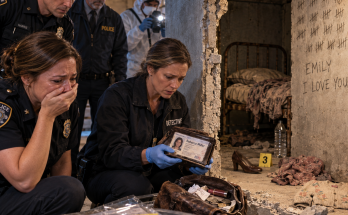
The address in Sophie Reynolds’s file belonged to a house nobody would have noticed twice.
Two stories.
Beige siding.
Basketball hoop over the garage.
A vegetable garden behind a white fence.
The property sat in a middle-class neighborhood sixty miles from Springfield.
The registered owners were Paul and Denise Harper.
No criminal records.
Married eighteen years.
One daughter.
Sarah Harper, age fourteen.
Carter stared at the family photograph attached to a school athletics page.
Sarah had brown hair.
The same narrow face as Sophie Reynolds.
The missing front tooth from childhood had long since been replaced by an adult tooth, but the shape of her eyes was unmistakable.
Daniel stood behind Carter.
“Sophie would be fourteen now.”
“Yes.”
“Sarah Harper appeared in school records four years ago.”
“The same year Sophie vanished.”
Carter ordered surveillance before contact.
They needed to know whether Marcus might be nearby.
He was not.
Paul Harper left for work at seven.
Denise drove Sarah to school.
Normal routines.
Normal clothes.
Normal affection.
Nothing looked like imprisonment.
That made the situation more complicated, not less.
Carter contacted Sophie’s biological parents privately.
Mark and Jennifer Reynolds had spent four years searching.
They had followed false sightings across three states.
They had paid private investigators.
They had kept Sophie’s bedroom almost unchanged.
When Carter told them there was a strong possibility their daughter was alive, Jennifer stopped speaking.
Mark asked the same question three times.
“Are you sure?”
Carter gave the only responsible answer.
“We need DNA confirmation.”
The Harpers were approached after Sarah entered school.
Paul was brought from work.
Denise was stopped at home.
Both were interviewed separately.
Denise broke first.
“We didn’t take her.”
Carter stared across the table.
“What was her name when she came to you?”
“Sarah.”
“Her name was Sophie Reynolds.”
Denise began crying.
“We didn’t know.”
“Who brought her?”
“Marcus.”
“When?”
“Four years ago.”
“What did he tell you?”
“That her mother was dead and her father was in prison.”
“Did you ask for documentation?”
“Yes.”
“He had documents.”
“What documents?”
“Birth certificate. Guardianship order. Social worker paperwork.”
All forged.
“Why would Marcus give you a child?”
Denise covered her face.
“We couldn’t have children.”
“That doesn’t answer my question.”
“My husband did construction work with him.”
“What did Marcus ask in return?”
“Nothing.”
Carter waited.
Denise’s eyes moved away.
“Nothing?”
“He said Paul had helped him.”
“How?”
Denise whispered, “A building permit.”
Paul Harper worked for the county inspections department.
Daniel, observing, immediately began checking permits.
Carter continued.
“What did Sarah remember when she arrived?”
“Almost nothing.”
“Did she ask for her parents?”
“At first.”
“What did you tell her?”
“What Marcus told us.”
“That her mother was dead?”
Denise nodded.
“And her father was in prison?”
“Yes.”
“You never checked?”
“We believed him.”
Carter’s voice hardened.
“A traumatized nine-year-old appeared in your home with a man who was not a social worker, and you never contacted child services?”
Denise cried harder.
“We wanted her.”
There it was.
Want had defeated every warning sign.
“What happened when she remembered things?”
“We told her they were dreams.”
Carter looked at Denise for a long time.
“You helped erase her.”
Denise whispered, “We loved her.”
Carter thought of Thomas saying the same thing.
Love, used as permission.
Love, stripped of the other person’s freedom.
Love, repeated until it became an excuse for possession.
Paul Harper’s interview was worse.
He admitted knowing the guardianship papers were questionable.
He admitted approving construction permits for Marcus without required inspections.
He admitted receiving Sarah shortly afterward.
“Did you know she was kidnapped?”
“No.”
“Did you suspect?”
Paul stared at the table.
“Yes.”
“Why didn’t you report it?”
“Because by then she was ours.”
Carter’s jaw tightened.
“She was never yours.”
Paul closed his eyes.
Police and child specialists approached Sarah at school.
She reacted with disbelief.
Then anger.
“My parents are Paul and Denise.”
The specialist said, “The people who raised you are Paul and Denise.”
“They’re my parents.”
“We’re not asking you to decide what words to use right now.”
Sarah stared at Carter.
“You arrested them?”
“They’re being questioned.”
“For what?”
Carter explained only what was necessary.
There was evidence Sarah might have been taken from another family when she was nine.
Sarah laughed.
Not because it was funny.
Because it was impossible.
“I would remember.”
“Trauma can affect memory.”
“Don’t tell me what I remember.”
“You’re right.”
Carter stopped.
“Tell me what you remember.”
Sarah folded her arms.
“My mom homeschooled me until fifth grade.”
“Which mom?”
“Denise.”
“Do you remember lessons?”
Sarah opened her mouth.
Nothing.
“Do you remember your bedroom before this house?”
“I…”
She stopped.
A small crack appeared.
The specialist moved gently.
“Do you remember a stuffed animal?”
Sarah’s eyes shifted.
“A rabbit.”
Carter felt her pulse change.
“What did you call it?”
Sarah stared at the floor.
“I don’t know.”
The specialist waited.
Sarah whispered, “Buttons.”
Carter did not move.
“Mr. Buttons?”
Sarah looked up sharply.
“How do you know that?”
Nobody answered too quickly.
Sarah stood.
“Where is he?”
Carter said, “We found a stuffed rabbit at another house.”
Sarah’s face drained.
Images seemed to move behind her eyes.
“I had a friend.”
“Who?”
“A little girl.”
“Name?”
Sarah squeezed her eyes shut.
“Emily.”
Carter felt the room tilt toward certainty.
Sophie Reynolds had been found.
DNA would confirm what memory already had.
Sarah began shaking.
“Emily was little.”
“Yes.”
“Her mom…”
She pressed both hands against her head.
“Her mom told me not to listen to him.”
“Rebecca?”
“I don’t know.”
Carter remained quiet.
Sarah suddenly whispered, “Thomas.”
The name came from somewhere buried.
She looked terrified.
“Why do I know that name?”
Carter answered softly.
“Because you knew him.”
Sarah began crying.
“I want my mom.”
The specialist asked, “Denise?”
“Yes.”
That answer was painful but unsurprising.
Four years of daily life could not be erased simply because it began with a crime.
Sarah loved the woman who had helped conceal her identity.
That love was real even if the circumstances were not.
Carter understood that the law could identify victims and offenders.
It could not dictate what a fourteen-year-old was supposed to feel.
Sophie’s biological parents were not brought into the room immediately.
DNA confirmation came first.
The result was conclusive.
Sarah Harper was Sophie Reynolds.
When Jennifer Reynolds heard, she collapsed against her husband.
Their daughter was alive.
But reunion was not simple.
Sophie did not remember them clearly.
She remembered fragments.
A blue kitchen.
A dog named Pepper.
Her mother singing while washing dishes.
Her father carrying her upstairs after she pretended to fall asleep on the couch.
Each memory arrived like a photograph pulled from muddy water.
The first meeting lasted less than ten minutes.
Jennifer did not touch Sophie until Sophie reached for her.
Mark barely spoke.
He cried openly.
Sophie stared at both of them.
Then she noticed Jennifer’s necklace.
A silver bird.
Sophie whispered, “You used to let me hold that.”
Jennifer covered her mouth.
“Yes.”
Sophie began crying.
“I thought you died.”
Jennifer shook her head.
“I looked for you every day.”
The reunion did not repair four stolen years.
Nothing could.
But it established something Marcus and Thomas had worked desperately to destroy.
Sophie had not been abandoned.
Neither had Megan.
Neither had Aaron.
Their families had searched.
The lie at the center of the network began collapsing child by child.
Meanwhile, Carter’s team examined the remaining REPLACEMENTS files.
Seven active placements were identified.
Some addresses were outdated.
Some names appeared false.
One child was located that afternoon with a couple in Indiana.
Another was found the next morning living under a false identity with a single man in Missouri.
Each discovery produced arrests, records, and new leads.
But three files marked RETURNED troubled Carter.
“What does returned mean?”
Nathan Cole claimed he did not know.
Rebecca did.
“They were sent back to Marcus.”
“Why?”
“Because the people who took them changed their minds.”
Mary stared.
“They returned children like property?”
Rebecca looked sick.
“Yes.”
“What happened afterward?”
“I don’t know.”
One returned file belonged to Hannah Price.
Another to Caleb Turner.
The third belonged to a child named Olivia Grant, missing six years.
Carter searched Marcus’s archive for their names.
Caleb appeared in footage at Site Four.
Hannah appeared briefly at the veterinary clinic.
Olivia appeared nowhere investigators had yet identified.
Then the digital team discovered encrypted GPS logs.
Marcus had carried a tracker during many construction jobs.
Historical coordinates showed repeated visits to an isolated parcel of land owned by an old company dissolved twelve years earlier.
The location did not appear on Rebecca’s seven-circle map.
Carter studied it.
“Why wouldn’t Rebecca know this place?”
Daniel answered.
“Because Marcus never took her there.”
The parcel lay beyond the quarry, deep in wooded hills.
There were no registered buildings.
Satellite imagery showed only an old access road.
Officers entered on foot.
Half a mile from the road, they found a collapsed barn.
Behind it was a concrete hatch covered with leaves.
The hatch opened onto stairs.
The underground chamber below was empty.
No beds.
No food.
No cameras.
Just shelves.
Boxes.
And a large chest freezer that had not been connected to power in years.
Forensic teams entered.
Daniel stood outside until Carter called him down.
She was staring at a wall.
Children’s heights had been marked there.
Names beside each line.
Caleb.
Hannah.
Olivia.
Several unknown names.
The final height beside Caleb was dated six years earlier.
Hannah’s was dated three years earlier.
Olivia’s dated five years earlier.
Daniel asked, “What was this place?”
Carter looked around.
“Not a residence.”
They found medical supplies.
Sedatives.
Old restraints.
Clothing bags labeled by name.
The implications darkened.
Then a technician opened a metal cabinet.
Inside were envelopes.
Each carried a child’s name.
Hair.
Baby teeth.
Small personal objects.
A bracelet.
A shoelace.
A school badge.
Carter ordered immediate forensic processing.
“Could be trophies.”
“Or identification records,” Daniel said.
Neither possibility was good.
At the back of the chamber was another door.
Unlike the others, it had no lock.
It opened into a narrow tunnel.
The tunnel ended at a vertical shaft.
Above it was an old drainage outlet near a creek.
Daniel shone his light downward.
Something lay caught beneath debris.
Fabric.
Forensic specialists carefully removed branches and mud.
A child’s jacket emerged.
The label inside contained handwritten initials.
H.P.
Hannah Price.
Carter closed her eyes.
“Search the entire drainage area.”
Dogs were brought in.
Ground teams spread through the woods.
Hours passed.
At sunset, one dog alerted near the creek bank.
Excavation began.
The first remains recovered were small.
Carter stood behind the forensic perimeter.
Nobody needed to say what that meant.
Additional remains were found nearby.
More than one individual.
The hope created by Aaron and Sophie’s survival collided with the reality everyone had feared.
Not every child had been placed elsewhere.
Some had died.
Whether through abuse, neglect, illness, or deliberate killing remained unknown.
Rebecca received the news carefully.
She asked only one question.
“Hannah?”
“Possibly.”
Rebecca cried quietly.
“She was sick.”
Mary sat beside her.
“I know.”
“I begged Thomas to take her to a hospital.”
“What did he say?”
“That hospitals ask questions.”
The same phrase Rachel had remembered.
Rebecca stared through the hospital window.
“They could have saved her.”
Mary did not offer false comfort.
“Maybe.”
Rebecca looked toward Emily’s room.
“Promise me something.”
“What?”
“Don’t let them turn this into a story where Thomas was sick and Marcus was evil and everybody else was confused.”
Mary waited.
Rebecca’s voice hardened.
“They chose this.”
That distinction mattered.
Trauma might explain Thomas’s obsession.
It did not excuse kidnapping.
Fear might explain why some accomplices hesitated.
It did not excuse years of silence.
Desire for a child might explain why the Harpers wanted Sophie.
It did not give them ownership of her.
Choices remained choices.
Late that night Carter received a call from the forensic site.
“We have preliminary identification from dental comparison.”
“Hannah?”
“Yes.”
Carter closed her eyes.
“And the second remains?”
“Unknown female child. Estimated age six to eight.”
“Olivia?”
“Too early.”
“Anything else?”
“There’s a third burial.”
Carter gripped the phone.
“Child?”
“No.”
“What?”
“Adult female.”
Carter immediately thought of the unknown woman Megan remembered at Site Four.
“Age?”
“Estimated thirty to forty-five.”
“Identification?”
“Nothing yet.”
The technician continued.
“But we found jewelry.”
“What kind?”
“A wedding ring.”
Carter waited.
“And an engraved pendant.”
“What does it say?”
The technician read the inscription.
Carter went still.
The pendant contained two names.
Thomas.
Marcus.
And beneath them, one word.
Mom.
The adult woman buried beside the missing children might be Margaret Vale—the mother Thomas and Marcus had been told abandoned them decades earlier.
If that was true, the story that shaped Thomas’s entire life had itself been a lie.
Click here to continue reading: PART 12: The Grave of Thomas’s Mother Reveals the First Family Secret, and Marcus Finally Contacts Rebecca With an Offer She Cannot Ignore
A Frightened Child Calls 911 With Three Strange Words That Make an Experienced Dispatcher Refuse to Hang Up
Part 11 of 20