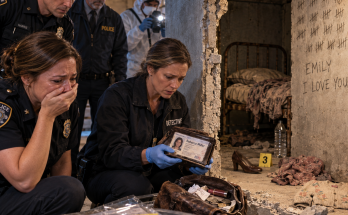
The first section of concrete came away in fragments.
Nobody spoke while the demolition specialist worked. The basement had grown colder with the arrival of morning, though the furnace clicked on somewhere behind the utility shelves. Dust hung beneath the bare bulbs and settled over uniforms, evidence markers, and the plastic sheeting forensic technicians had spread across the floor.
Daniel stood near the stairwell with his arms folded, watching the opening widen by inches.
Mary remained beside Sergeant Brooks.
Detective Susan Carter stood closest to the wall.
She had asked everyone unnecessary to the work to leave the basement. Too many people would contaminate the scene, and whatever waited behind the concrete deserved more care than curiosity.
The technician stopped after exposing a narrow black gap.
Air moved through it.
Not fresh air.
Something sealed for years had been released.
Carter lifted one hand.
“Everybody back.”
The technician stepped away.
A forensic specialist approached in protective gear and shone a light through the opening.
For several seconds she said nothing.
Carter’s voice was quiet.
“What do you see?”
The specialist moved the beam slowly.
“Looks like another space. Maybe an older storage room.”
“Any person?”
“I can’t tell yet.”
Daniel watched the woman’s shoulders tighten.
Then she leaned closer.
“There’s fabric.”
Brooks looked at Carter.
Carter nodded once.
“Enlarge the opening.”
The demolition work resumed, slower now.
Every section was photographed before removal.
Behind the newer concrete was older framing, partly rotted, with remnants of drywall clinging to the studs. Whoever had sealed the room had not merely bricked up a doorway. They had built a complete false wall several feet in front of the original structure.
The cavity beyond was deeper than the scan had suggested.
When enough concrete had been removed, Carter stepped forward with a flashlight.
Daniel heard her breathing change.
“What is it?”
She did not answer immediately.
Her light moved across the hidden room.
A rusted metal bed frame stood against one wall.
A blanket lay collapsed over it.
There was a plastic water bottle on the floor, flattened by time.
Beside the bed sat a woman’s shoe.
Only one.
Brown leather, narrow heel.
The dust around it had not been disturbed in years.
Mary whispered, “Rebecca?”
Carter glanced back.
“Don’t assume.”
They entered one at a time.
The room smelled of dry concrete and decay, but not strongly enough to answer the question everyone was afraid to ask.
Carter swept her flashlight along the floor.
More clothing appeared.
A torn blouse.
A belt.
A child’s cardigan.
Then she found a purse wedged beneath the bed frame.
The leather had cracked with age.
A technician photographed it before opening it.
Inside were receipts, a lipstick tube, several old coins, and a driver’s license.
Carter stared at the photograph.
Rebecca Miller.
Mary closed her eyes.
Daniel looked toward the bed.
Rebecca had not simply vanished from the house.
At minimum, her belongings had been sealed inside a hidden room.
Carter carefully read the expiration date.
The license had been valid when Rebecca disappeared.
“She never took her purse,” Mary said.
“No.”
Daniel added, “And Thomas claimed somebody picked her up.”
Carter nodded.
“Which means he lied about at least one important part of her departure.”
Brooks examined the room.
“There’s still no body.”
“Not yet.”
A technician working near the far wall called out.
“Detective.”
Carter moved toward him.
He pointed at scratches in the plaster.
Tallies.
Dozens of them.
Five vertical marks, crossed by a sixth.
Again.
Again.
Rows stretching almost to the corner.
Beside them, at shoulder height, someone had written a date using the edge of a hard object.
Three years earlier.
Two days after Thomas claimed Rebecca had left.
Mary stared at it.
“She was alive after he said she was gone.”
Carter looked carefully at the markings.
“Maybe.”
She would not allow certainty before evidence.
“Photograph everything.”
The technician continued scanning the wall.
Another scratched message appeared beneath the tallies.
The letters were uneven.
EMILY I LOVE YOU.
Mary turned away.
For several seconds she stared at the floor.
Daniel saw her hands close into fists.
He understood.
Emily had spent three years believing her mother had simply disappeared.
But Rebecca had apparently been somewhere inside the same house.
Close enough, perhaps, to hear footsteps above her.
Close enough to know her daughter was growing up only yards away.
Carter pointed toward the writing.
“No one tells Emily until a child specialist is involved.”
Mary nodded.
The order was necessary.
That did not make it easier.
Another officer entered the basement.
“Detective Carter?”
“Yes?”
“We got a preliminary response on Rebecca Miller.”
Carter stepped out of the hidden room.
“Go.”
“No formal missing-person report was ever filed.”
That was expected.
“Any records after the date Thomas says she left?”
“Driver’s license never renewed. No credit activity after that month. No medical visits, no employment record, no tax filing under her Social Security number.”
Carter looked back toward the purse.
“Bank?”
“Joint account continued under Thomas’s access. Rebecca’s individual account was drained two weeks before the supposed departure.”
“By whom?”
“Still checking.”
Daniel said, “What about phone records?”
“Old enough that the carrier archive is limited, but we’re requesting everything available.”
Carter nodded.
“Good.”
Then another technician spoke from inside the hidden room.
“We found something under the floor.”
Everyone turned.
One floor panel sounded different when tapped.
The technician knelt beside it.
A rectangular section of plywood had been screwed into the concrete beneath the bed.
The screws were newer than the surrounding construction.
Carter’s expression hardened.
“Document before opening.”
Photographs were taken.
Measurements recorded.
The screws were removed individually.
Daniel felt the basement change around him.
Even the people who worked these scenes for a living became still.
The plywood lifted.
Beneath it was a shallow cavity.
Inside lay several plastic bags.
The first contained papers.
The second contained jewelry.
The third held photographs.
Carter exhaled through her nose.
“Bring an evidence table down.”
The photographs were removed one by one.
Many showed children.
Different ages.
Different years.
Some were smiling at parks, playgrounds, school events.
Others appeared to have been taken inside the Miller house.
One image showed Sophie.
Mary recognized the stuffed rabbit in her arms.
Sophie was perhaps nine years old.
Brown hair.
Missing front tooth.
Bright yellow sweater.
On the back, someone had written SOPHIE—SUMMER.
No year.
Another photograph showed Lily younger, sitting on the basement steps.
Another showed Emily as a toddler beside Rebecca.
Then Carter found a photograph of a boy nobody recognized.
He looked about ten.
Blue shirt.
Baseball cap.
His expression was guarded.
On the back was one word.
CALEB.
Daniel remembered the neighbor mentioning a boy.
Carter placed the photograph aside.
“Run the name against missing children within a hundred-mile radius first. Then widen.”
The jewelry bag contained rings, bracelets, hair clips, and several small necklaces.
One necklace had a heart-shaped pendant.
Mary picked up the evidence tag, not the item.
“There could be identifiers in these.”
Carter agreed.
“Every piece gets photographed and checked against missing-person records.”
Then the paper bag was opened.
Inside were handwritten notes.
Most were short.
Names.
Dates.
Locations.
Some pages appeared to be schedules.
Others looked like lists.
Carter read silently.
Daniel watched her face.
“What?”
She handed him one sheet.
There were six first names.
Sophie.
Hannah.
Caleb.
Lily.
Megan.
Aaron.
Beside each name was a date.
And beside each date was a location.
A school.
A park.
A recreation center.
A church.
Daniel’s stomach turned.
“This looks like selection.”
Carter took the sheet back.
“Or surveillance.”
Mary asked, “Do any dates match disappearances?”
“We’ll know soon.”
Brooks looked toward the ceiling.
“Thomas didn’t do this alone.”
Everyone remembered Lily’s words.
The other man.
The one who visited after Emily was sent to her room.
The one who had helped Thomas use loud machines before the wall appeared.
Carter immediately ordered every device in the house seized.
Computers.
Phones.
External drives.
Cameras.
Routers.
Anything that could store messages or images.
Upstairs, Thomas sat in a patrol vehicle saying nothing.
He had asked for a lawyer shortly after Carter mentioned the hidden room.
No one questioned him further.
By midmorning, the Miller house no longer resembled a quiet suburban home.
Crime-scene vehicles lined Maplewood Drive.
Neighbors watched from behind barricades.
News vans had begun gathering two streets away.
Carter hated that part.
The moment cameras arrived, witnesses sometimes started remembering details they had never actually seen.
She ordered officers not to confirm identities beyond what the department was prepared to release.
At the hospital, Emily and Lily were being examined in separate rooms.
Child Protective Services had assigned workers to both girls.
Mary arrived after completing her initial statement at the scene.
She found Emily sitting upright in bed with a paper cup of apple juice.
The child looked smaller beneath the hospital blanket.
When she saw Mary, she asked one question.
“Did you find Mommy?”
Mary stopped beside the bed.
She had known the question would come.
“We found some of your mother’s things.”
Emily stared at her.
“Where?”
“In the house.”
“Downstairs?”
Mary did not lie.
“Yes.”
Emily lowered her cup.
“Is she coming?”
“We don’t know where she is yet.”
The girl thought about that.
Then she asked, “Did Daddy hide her?”
Mary pulled a chair closer.
“We’re still finding out what happened.”
Emily looked toward the door.
“Lily said Mommy cried.”
Mary’s chest tightened.
“Did Lily hear your mother?”
“Maybe.”
“Did she ever tell you before?”
Emily shook her head.
“Daddy said we weren’t supposed to talk through the wall.”
That sentence made Mary sit straighter.
“What wall?”
“The basement room.”
“You and Lily talked through it?”
Emily nodded.
“When Daddy went upstairs.”
“Could you hear other people too?”
Emily stared at the juice cup.
“Sometimes.”
Mary kept her voice gentle.
“Who?”
“I don’t know.”
“Children?”
A nod.
“Adults?”
Another nod.
“Your mother?”
Emily’s eyes filled.
“One time.”
Mary waited.
“What did she say?”
Emily covered her mouth.
For several seconds nothing came.
Then she whispered, “She told me to run.”
Mary felt the words hit like physical force.
“How old were you?”
“I don’t know.”
“Do you remember what happened after?”
Emily nodded.
“Daddy found me near the front door.”
She touched her arm.
Not the recent bruises.
Higher.
Near the shoulder.
“He said Mommy made me bad.”
Mary looked toward the child-protection worker standing quietly near the doorway.
They both understood the importance of what Emily had just disclosed.
“Did you see your mom again?”
“No.”
“Did you hear her?”
Emily’s voice dropped.
“For a little while.”
Then she stopped.
Mary did not rush her.
Children often shut down when adults pushed hardest for details.
Emily eventually continued on her own.
“There was banging.”
“What kind?”
“Like this.”
She struck the mattress weakly with her fist.
Three times.
Pause.
Three times.
Pause.
Three times.
Mary remembered Lily tapping from behind the reinforced door.
“Did your mom do that?”
“I think.”
“For how long?”
“A lot.”
“And then?”
Emily looked toward the window.
“The loud machine came.”
Mary’s throat tightened.
“The night the wall was built?”
Emily nodded.
That aligned with Lily’s account.
Mary asked no more.
Not because she did not want answers.
Because enough had surfaced for one morning.
In the next hospital room, Lily slept while doctors evaluated the effects of prolonged confinement and malnutrition.
The preliminary medical assessment suggested she had not been kept entirely without food or movement, but her growth and muscle development were significantly delayed.
She had bruises too.
Older than Emily’s.
Some had healed badly.
A social worker found Mary in the hallway.
“She keeps asking whether Emily can stay with her.”
“Can they see each other?”
“For a little while later. We’re trying not to overwhelm either one.”
Mary nodded.
“Good.”
Her phone buzzed.
Daniel.
She stepped away from the nurses’ station.
“What happened?”
“We got a hit on Sophie.”
Mary leaned against the wall.
“Missing child?”
“Yes.”
Daniel’s voice changed.
“Sophie Reynolds. Nine years old. Reported missing four years ago from a playground thirty-eight miles away.”
Mary closed her eyes.
“Parents?”
“Still alive.”
“Have they been notified?”
“Detectives are on the way.”
“And the others?”
“Caleb Turner disappeared five years ago. Hannah Price disappeared three and a half years ago.”
Mary gripped the phone tighter.
Three names.
Three real missing children.
“What about Megan and Aaron?”
“Still working.”
“Lily?”
“No matching missing report under Lily. We don’t know her legal identity yet.”
Mary looked through the hospital-room window.
Lily slept curled beneath a blanket.
“How does a child disappear without anyone reporting her?”
Daniel was silent for a moment.
“That may be one of the worst questions we have.”
Back at Maplewood Drive, Carter received another update.
The home-surveillance system had been found.
Most recent footage had been automatically overwritten.
But Thomas had maintained an external archive.
Technicians were beginning extraction.
Carter entered the garage.
Boxes lined one wall.
Tools hung in clean rows.
Everything was organized.
Too organized.
One workbench drawer contained receipts for building supplies purchased around the time the hidden basement wall appeared.
Concrete mix.
Framing timber.
Insulation.
Industrial screws.
A second receipt listed cash payment for a rental concrete saw.
The customer signature belonged to Thomas.
But the rental form contained another name under “additional authorized user.”
Marcus Vale.
Carter stared at it.
“Run him.”
Twenty minutes later, the result came back.
Marcus Vale, forty-three.
Construction contractor.
No felony convictions.
Several old complaints involving aggressive behavior, none resulting in charges.
Address twelve miles away.
And one more fact.
He was Thomas Miller’s older half brother.
Carter immediately requested officers locate him.
No lights.
No confrontation until they knew whether he was home.
Daniel returned from the basement just as the call went out.
“Marcus?”
Carter handed him the rental form.
“Maybe Lily’s other man.”
Daniel read it.
“Brother explains access.”
“And loyalty.”
“Or partnership.”
Carter looked toward the hidden room.
“We’ll let evidence tell us which.”
A technician hurried from the house.
“Detective.”
Carter turned.
“What?”
“We recovered one video file from an old external drive.”
“What’s on it?”
The technician looked uncomfortable.
“Basement footage.”
“Children?”
“Yes.”
“How many?”
“At least four visible in the segment.”
Carter’s jaw tightened.
“Any adults?”
“Thomas.”
“And someone else.”
“Marcus?”
“We’re comparing.”
Carter took a breath.
“What happens in the video?”
The technician hesitated.
“It looks like Thomas is giving instructions.”
“What instructions?”
“To the children.”
“About what?”
The man glanced toward the house before answering.
“About what they’re supposed to say if anyone finds them.”
Carter stared at him.
“What were they told?”
“That Thomas rescued them.”
Daniel swore under his breath.
The technician continued.
“He tells them their real families didn’t want them. He makes them repeat new names.”
Carter’s expression hardened.
“Lily’s name may not be Lily.”
“No.”
“And Thomas may have created an entire history for her.”
“That’s what it looks like.”
Carter looked toward the patrol car where Thomas had been taken away hours earlier.
This was not simply confinement.
It was reconstruction.
Erase the old family.
Replace the name.
Control every memory until the child no longer knew which life was real.
Her phone rang.
An officer at Marcus Vale’s address.
Carter answered.
“Yes?”
“We’re at the property.”
“Is he there?”
“No.”
“Vehicle?”
“Gone.”
Carter closed her eyes briefly.
“When was he last seen?”
“Neighbor says early this morning.”
“What time?”
“About thirty minutes after police arrived at Miller’s place.”
Daniel heard enough from her expression.
“He knows.”
Carter nodded.
“Probably.”
The officer continued through the phone.
“There’s something else.”
“What?”
“Garage door was open.”
“And?”
“There’s fresh concrete dust on the floor.”
Carter straightened.
“Do not enter without legal authority unless you have exigent circumstances.”
“We know.”
“Secure the property.”
“Yes, ma’am.”
Carter disconnected.
Daniel looked at her.
“Another wall?”
“Maybe.”
She turned toward Brooks.
“Get a warrant application moving on Marcus Vale’s house.”
Brooks nodded and stepped away.
Carter stared at the rental form again.
Thomas had been arrested.
Emily and Lily were safe.
But Marcus Vale had vanished before dawn.
And if the concrete dust in his garage meant what Carter feared, Maplewood Drive might not have been the only place where children disappeared behind walls.
Click here to continue reading: PART 6: A Missing Brother, an Archived Basement Video, and One Child’s Forgotten Name Reveal That Thomas’s House Was Never the Only Place
A Frightened Child Calls 911 With Three Strange Words That Make an Experienced Dispatcher Refuse to Hang Up
Part 5 of 20