
On the first anniversary of Evelyn Bell’s death, Mara unlocked her mother’s house shortly after sunrise.
The property had been empty for six weeks.
Furniture was gone.
Pictures had been divided.
Boxes had been donated.
Robert had taken the old green mixing bowl.
Daniel claimed the battered waffle iron.
James asked for the wooden clock.
Mara gave it to him without hesitation.
The clock had hidden Joseph’s key for years.
In Seattle, James intended to let it become only a clock.
Mara carried the blue flour tin into the kitchen.
The pantry shelves were bare.
Without jars, bags, canned goods, and Evelyn’s handwritten labels, the room looked smaller.
Mara placed the tin on the counter.
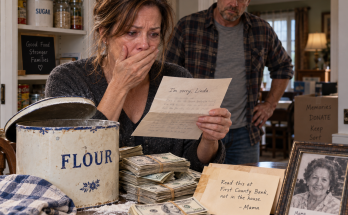
One year earlier, she had opened it expecting flour.
Instead she found $18,940 and a note directing her toward a man everyone believed had vanished.
The money was gone now.
Transferred into the restitution trust.
The first grants from the medical-legal fund had already been approved.
One helped a grandmother correct fraudulent guardianship documents for two children.
Another paid for legal representation for a young accident victim whose settlement had been mishandled.
Mara liked that.
Not because it redeemed Evelyn.
Money could not redeem people.
But money could stop being evidence and become useful.
She opened the tin.
Empty.
No envelope.
No key.
No photograph.
No instructions.
She smiled.
For once, an empty container meant exactly what it appeared to mean.
Footsteps sounded behind her.
Daniel entered carrying coffee.
“You started without me.”
“I unlocked a door.”
“Major ceremony.”
He handed her a cup.
His life had changed in visible and invisible ways.
Legally, he remained Daniel Bell.
After months of consideration, he added Nathan as a middle name.
Daniel Nathan Bell.
Margaret cried when he told her.
Evelyn’s name remained absent from that decision.
So did Samuel’s.
Daniel had decided his identity did not need to function as a verdict on any parent.
“How’s Margaret?” Mara asked.
“Bossy.”
“So good?”
“Very.”
He smiled.
“She’s coming for Thanksgiving.”
“And Samuel?”
Daniel looked into his coffee.
Samuel had been sentenced three months earlier.
His cooperation reduced the penalty but did not erase it.
Daniel had visited him once before sentencing.
The meeting lasted twenty minutes.
“What did you talk about?” Mara had asked afterward.
“Nothing that fixed anything.”
That was all he said.
Now Daniel shrugged.
“He wrote.”
“You answering?”
“Maybe.”
Mara did not advise him.
Some relationships required decisions nobody else could make.
James arrived next.
He carried the wooden clock.
Mara laughed.
“You brought it back?”
“Temporarily.”
“Why?”
“Dad wants a picture.”
Robert came through the front door behind him.
He walked with a cane.
His shoulder had healed, though his range of motion remained limited.
He stopped in the hallway.
For a moment the house visibly struck him.
Evelyn’s house.
Their house.
A marriage reduced to empty rooms and memories that had finally stopped changing shape.
Mara approached.
“You okay?”
Robert nodded.
“No.”
She smiled.
“Better answer.”
Thomas arrived with Margaret.
The relationship between Robert and Thomas had settled into something strange and unexpectedly gentle.
They argued about construction.
Baseball.
Cars.
They did not argue about Mara.
Robert had made his position clear.
“I’m her father.”
Thomas had answered:
“I know.”
Then Robert added:
“So are you, if she wants that.”
Mara had heard about the exchange from Daniel.
Neither man knew she knew.
She let them keep it.
Ruth came last.
She stood outside for several minutes before entering.
Mara opened the door.
“You can come in.”
Ruth looked past her.
“I wasn’t sure.”
“It was your sister’s house too.”
“No.”
Ruth shook her head.
“It was always Evelyn’s.”
Mara stepped aside.
Ruth entered.
Nobody pretended the past year had erased her lies.
She had participated in the switch.
Accepted Samuel’s money for relocation expenses.
Kept James in Oregon.
Hidden evidence.
Allowed Mara and Daniel to grow up inside false histories.
She had also saved Nathan from Samuel.
Protected James from Joseph.
Preserved records.
Risked herself when Caleb returned.
People were inconveniently whole.
Mara had stopped trying to divide them into innocent and guilty columns.
They gathered in the kitchen.
James hung the clock temporarily above the pantry.
Daniel put the flour tin on the shelf.
Robert looked at it.
“That’s where Evelyn kept it?”
“Yes.”
Thomas frowned.
“I remember that tin.”
Mara looked at him.
“From when?”
“Before you were born.”
Robert laughed.
“She told me she bought it after Mara was born.”
Everyone turned toward him.
For half a second the old instinct returned.
Another contradiction.
Another secret.
Mara stared at the tin.
Then Thomas laughed.
“I might be wrong.”
Robert looked offended.
“You?”
“Yes, Robert. Age occasionally damages memory.”
Daniel began laughing.
James joined.
Mara felt the tension leave the room.
A year earlier, a disagreement about the age of a flour tin would have sent them searching for receipts, photographs, hidden compartments, and witnesses.
Now it could simply be two old men remembering badly.
That felt like freedom.
They took the photograph Robert wanted.
All of them in Evelyn’s kitchen.
Robert seated.
Thomas beside him.
Margaret near Daniel.
James holding the clock.
Ruth at the edge until Mara pulled her closer.
The blue flour tin sat on the pantry shelf behind them.
No one smiled perfectly.
The photograph was better for it.
Afterward, Robert asked for a few minutes alone.
Everyone went outside except Mara.
“You too,” he said.
She raised an eyebrow.
“My own daughter ignores me in my old age.”
“You’ve had eleven bonus years. Don’t complain.”
He laughed.
Then his expression softened.
“Mara.”
“Yes?”
“Thank you for opening it.”
She looked toward the tin.
“I almost didn’t.”
“I know.”
“How?”
“Your mother knew you.”
Mara leaned against the counter.
“Did she think I’d forgive her?”
Robert considered.
“No.”
That surprised her.
“What did she think?”
“That you would understand her.”
“Did she?”
“Eventually she learned those were different things.”
Mara looked through the kitchen window.
Daniel and James stood beside each other in the yard.
Not replacements.
Not interchangeable children.
Not entries in Joseph’s ledger.
Two men whose lives had crossed through an act of fear and then continued beyond it.
Margaret spoke with Ruth.
Thomas inspected the porch railing as though evaluating work done forty years ago.
Robert followed Mara’s gaze.
“Family looks different.”
“Yes.”
“Better?”
She thought about it.
“More accurate.”
Robert smiled.
“I’ll take that.”
He went outside.
Mara remained alone.
She opened the pantry.
For years Evelyn had stocked it with ordinary things.
Flour.
Sugar.
Tea.
Rice.
Canned peaches.
And one extraordinary secret disguised as another ordinary object.
Mara reached for the tin.
She considered taking it with her.
Instead she left it.
The new owners would arrive the following week.
They might throw it away.
Use it for flour.
Put dog treats inside.
Sell it at another yard sale for fifty cents.
That seemed right.
Objects did not owe families permanent service as memorials.
Mara closed the pantry door.
Before leaving, she walked through the house one final time.
Her childhood bedroom.
Daniel’s room.
The dining room where Robert once helped with homework.
The hallway where Evelyn measured children whose names were changing faster than their heights.
The garage where Robert hid the map.
The kitchen where arguments, bargains, meals, lies, and apologies had accumulated over decades.
She did not feel Evelyn everywhere.
That surprised her.
She felt herself.
The child she had been.
The woman who returned for a funeral.
The daughter who opened a tin.
Outside, James waited beside his rental car.
“I’m taking Sophie to meet Robert tomorrow.”
Mara smiled.
“How does she feel about discovering an entire extra family?”
“She said it explains why I’m weird.”
“Smart woman.”
“She wants to meet you.”
“I’d like that.”
James hesitated.
Then hugged her.
It was their first real embrace.
Not dramatic.
Not long.
When they separated, he said, “See you at Thanksgiving.”
Not maybe.
Not if.
At Thanksgiving.
Mara liked the certainty.
Daniel drove Margaret home.
Ruth left with Thomas.
Robert rode with Mara.
As they pulled away, he looked back at the house.
“Your mother hated leaving places.”
“She spent her whole life leaving things behind.”
Robert nodded.
“Maybe that’s why.”
Mara drove toward the river.
A week later, the house sold.
Months later, the final restitution claims were approved.
Families received payments that could not return lost land but could at least acknowledge how it had been taken.
The medical-legal fund retained the flour-tin amount as its symbolic founding contribution.
$18,940.
On its annual report, however, Mara insisted another number appear beside it.
$1,060.
Not as an expense.
As a warning.
The amount once used to carry a five-year-old boy away under a false name.
A reminder that numbers could conceal human costs when nobody asked what they represented.
Caleb was convicted.
Owen was sentenced with his cooperation and history considered.
Samuel remained incarcerated.
Joseph Bell’s remaining shell network was dissolved.
The Bell-Wynn holdings ceased to exist.
Vale-Bell Construction’s name was formally cleared of the theft attributed to Thomas and Robert, though the company’s role in Joseph’s land purchases remained part of the public record.
No clean mythology replaced the old one.
Mara insisted on that too.
Years later, when people asked how she discovered the truth, they usually expected a dramatic answer.
A deathbed confession.
A detective.
A hidden vault.
She told them it began with cleaning her mother’s pantry.
Sometimes they asked whether she regretted opening the tin.
Never.
Did she wish Evelyn had told the truth sooner?
Every day.
Had she forgiven her?
That answer changed depending on the morning.
Mara eventually understood that forgiveness was not a door one walked through once.
Some days she remembered Evelyn as frightened.
Some days selfish.
Some days brave.
Some days all three.
Robert lived long enough to know Sophie.
Thomas became part of Mara’s life without replacing anyone.
Margaret and Daniel developed the relationship stolen from them without pretending they could recover his infancy.
James remained James Bellamy.
Daniel remained Daniel Nathan Bell.
Mara remained Mara Bell.
The names mattered because they had finally chosen them.
On Evelyn’s birthday several years later, Mara received a photograph from the couple who had bought the old house.
They had remodeled the kitchen.
New cabinets.
New counters.
Different paint.
But on one pantry shelf sat a dented blue tin decorated with a faded wheat stalk.
The message beneath the photograph read:
Found this when we moved in. Too charming to throw away. We use it for flour.
Mara laughed until she cried.
She sent the photograph to Daniel and James.
Daniel replied first.
CHECK IT FOR CASH.
James answered:
Absolutely not. We are done opening containers.
Mara typed:
It’s just flour.
Then she looked at the picture again.
For the first time in her life, she was perfectly content not to check.
The End
Read more original stories on Feel Every Story.
Three Days After the Funeral, Mara Opened Her Mother’s Flour Tin and Found Money Wrapped Around a Name She Knew
Part 20 of 20

One Comment on “PART 20 – One Year After Opening the Flour Tin, Mara Returned It to Evelyn’s Pantry Empty and Chose What the Family Would Carry Forward”