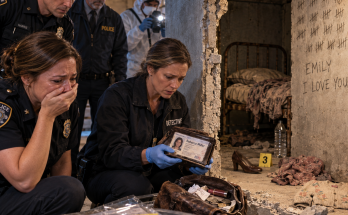
Rebecca recognized the woman in the photograph immediately.
“Elaine.”
Carter sat across from her in a private hospital consultation room.
“Full name?”
“Elaine Porter.”
“Who is she?”
Rebecca stared at the photograph.
“Thomas’s cousin.”
Daniel checked the background file.
Elaine Porter, forty-six.
Elementary-school administrative assistant.
Divorced.
No criminal history.
Employed for eighteen years by Springfield Unified School District.
Mary felt cold.
“She works in schools?”
Rebecca nodded.
“She always has.”
Carter asked, “What was her relationship with Thomas?”
“Close when they were young. Less obvious after we married.”
“Why less obvious?”
“Thomas said Elaine talked too much.”
“Did she visit your house?”
“Sometimes.”
“Did she know about the basement?”
Rebecca looked at Carter as if the answer should have been obvious.
“She brought children information.”
Silence settled over the room.
“What information?”
“School schedules. Emergency contacts. Custody arrangements.”
Daniel looked at Mary.
The surveillance notes suddenly made more sense.
No siblings.
Parent works late.
Unstable home.
Children were not chosen only from casual observation.
Someone had access to records.
“Did Elaine know they were being abducted?” Carter asked.
Rebecca hesitated.
“I never heard Thomas tell her directly.”
“That isn’t what I asked.”
Rebecca looked down.
“I think she knew.”
“Why?”
“Because once she brought a folder and told Thomas, ‘This one won’t be missed until Monday.’”
Carter wrote the sentence exactly.
“Did you see who the folder concerned?”
“No.”
“When?”
“Before I was locked downstairs. Maybe four years ago.”
That could place Elaine directly inside the conspiracy.
Carter immediately ordered surveillance rather than an arrest.
If Elaine was part of the network, she might lead them to Marcus.
“What about the other man in the photograph?” Daniel asked.
Rebecca studied him.
“I’ve seen him.”
“Name?”
“I don’t know.”
“Where?”
“At Marcus’s cabin once.”
“What did he do?”
“Brought medical supplies.”
“Doctor?”
“Maybe.”
Mary remembered the children’s untreated injuries.
“Did he treat captives?”
“I saw him examine Rachel once.”
Carter looked up.
“Rachel Palmer?”
“Yes.”
“What was wrong?”
“She had a fever.”
“Did he ask why she was there?”
“No.”
“Did he behave like he knew?”
Rebecca nodded.
“He called her Lily before Thomas introduced her.”
Another participant.
Perhaps someone responsible for keeping captives alive without hospitals.
Facial-recognition work returned a probable identity later that morning.
Dr. Victor Hale.
Fifty-eight.
Urgent-care physician.
Former emergency-room doctor.
No criminal history.
His clinic had treated Marcus Vale Construction employees repeatedly over the years.
Carter stared at the profile.
“Do not contact him yet.”
Daniel understood.
“Watch him.”
“Yes.”
Elaine Porter left her home at 7:12 that morning.
Surveillance officers followed.
She drove normally.
Coffee shop.
Gas station.
Then the district administration building.
Nothing suspicious.
At 10:40 she left unexpectedly.
She drove north.
Carter watched her route on a live map.
“Where’s she going?”
An analyst overlaid known sites.
The vehicle passed the road toward Marcus’s cabin.
Continued.
Turned east.
Then stopped at a cemetery.
Elaine exited carrying flowers.
She walked to a grave.
Surveillance photographed the marker.
Margaret Vale.
Thomas and Marcus’s mother.
Elaine stood there for twelve minutes.
Then she removed something from beneath the flowers already resting against the stone.
A small envelope.
Daniel leaned toward the monitor.
“Dead drop.”
Elaine returned to her vehicle.
She drove away.
Officers followed.
Carter had to decide whether to stop her immediately or continue surveillance.
“Stay with her.”
Elaine drove another thirty miles.
Then turned onto a rural highway.
Her behavior changed.
She checked mirrors repeatedly.
Slowed unexpectedly.
Made two unnecessary turns.
“She’s checking for a tail,” Daniel said.
The surveillance team widened distance.
Elaine eventually entered a small town and parked behind a laundromat.
She remained in the car.
Five minutes.
Ten.
Then another vehicle arrived.
White pickup.
The driver stayed inside.
Elaine walked over.
Passed him the envelope.
The pickup left.
“Follow the truck. Keep a second team on Elaine.”
Registration came back to a shell company.
The same company had rented a warehouse eighteen months earlier.
The driver’s photograph was unknown.
Carter ordered no stop yet.
The pickup traveled south toward an industrial district.
Then entered a fenced property containing old refrigerated warehouses.
Police established discreet perimeter positions.
The driver entered Building C.
He did not emerge.
Carter obtained emergency authorization based on the ongoing kidnapping investigation and evidence connecting the location to the network.
The raid occurred twenty-three minutes later.
No children were found.
No Marcus.
But the pickup driver was arrested.
His name was Nathan Cole.
Forty-one.
Electrician.
Subcontractor for Marcus.
Inside Building C, investigators discovered equipment used to maintain the hidden rooms.
Locks.
Cameras.
Ventilation parts.
Portable generators.
Disposable phones.
False identification documents.
Carter entered the office.
A large map covered one wall.
Several locations were crossed out.
Maplewood Drive.
Marcus’s house.
The veterinary clinic.
The pumping station.
The cabin.
They knew police were discovering the network.
Other locations remained uncrossed.
One was marked FIVE.
Another SIX.
Another with a simple R.
Daniel stared.
“R could be Rebecca.”
“She’s already safe.”
“Then maybe R means something else.”
Carter photographed the map.
A desk drawer contained cash and a notebook.
The notebook listed payments.
Initials only.
M.V.
T.M.
E.P.
V.H.
W.D.
N.C.
And several unidentified sets.
The conspiracy now had financial records.
Carter ordered Elaine Porter and Victor Hale detained before either could disappear.
Elaine was arrested leaving the district office.
Hale was stopped at his clinic.
Both requested lawyers.
Neither answered substantive questions.
Nathan Cole did.
Not immediately.
For six hours he said nothing.
Then he learned Megan had been recovered alive.
Something changed.
“I never touched the kids.”
His attorney looked at him sharply.
Carter remained still.
Cole continued.
“I installed equipment.”
“On advice of counsel—” his lawyer began.
Cole interrupted.
“I’m talking.”
Carter started the recorder.
“What equipment?”
“Cameras. Locks. Ventilation.”
“Where?”
“Places Marcus gave me.”
“Did you know children were confined there?”
Cole stared at the table.
“Eventually.”
“When?”
“Five years ago.”
“And you continued?”
He nodded.
“Why?”
“Marcus had things on me.”
“What things?”
“Money. Fraud. Drugs.”
Carter did not soften.
“So you helped imprison children to protect yourself from financial and drug charges?”
Cole closed his eyes.
“I told myself they were being taken care of.”
“Did the locks open from inside?”
“No.”
“Then you knew.”
“Yes.”
That admission mattered.
Carter showed him the map.
“What is Site Five?”
Cole looked at his attorney.
Then at the map.
“Old storm shelter beneath a farm.”
“Children there?”
“Not anymore.”
“Site Six?”
“Cold-storage facility.”
“Occupied?”
“I don’t know.”
“What does R mean?”
Cole’s face changed.
“I don’t know.”
Carter knew he was lying.
“What does R mean?”
“I said I don’t know.”
She slid Rebecca’s photograph across the table.
“Rose?”
Cole stared.
“No.”
“What then?”
Silence.
Carter leaned forward.
“A child may be inside whatever R represents.”
Cole’s jaw tightened.
“It’s not a place.”
“What is it?”
He looked toward his lawyer.
His lawyer said nothing.
Cole whispered, “Replacement.”
Carter felt the room become still.
“Explain.”
“When somebody was lost.”
“Lost how?”
“Arrested. Died. Ran. Became unusable.”
“What happened?”
“Marcus replaced them.”
“With another conspirator?”
Cole shook his head.
“With another family.”
Carter stared.
“What does that mean?”
“I don’t know the whole system.”
“Tell me what you know.”
Cole swallowed.
“Thomas wasn’t the only one who wanted children.”
The meaning arrived slowly and horribly.
Other adults had received abducted children.
Children whose names had been changed.
Children trained to believe their families abandoned them.
Daniel, watching through the observation glass, felt sick.
Carter asked, “How many replacement families?”
“I don’t know.”
“Marcus arranged them?”
“Yes.”
“For money?”
“Sometimes.”
“Sometimes?”
“Sometimes people helped him first.”
“What kind of help?”
“Properties. Vehicles. records. Places to hide.”
“And he gave them children?”
Cole nodded.
The seventeen names on the pumping-station wall suddenly represented something even larger.
Not every missing child had remained with Thomas or Marcus.
Some might be living under false identities in ordinary homes.
Carter placed the photograph of Aaron Wells on the table.
“Where is Aaron?”
Cole stared.
“I thought he was dead.”
Carter’s eyes narrowed.
“This was taken three weeks ago.”
Cole looked genuinely shocked.
“That can’t be.”
“Why?”
“Marcus said Aaron died years ago.”
“Marcus lies.”
Cole looked at the photograph again.
Then his face changed.
“That isn’t Aaron.”
Carter stopped.
“What?”
“That’s not Aaron.”
“The photograph is labeled Aaron.”
Cole shook his head.
“I met Aaron.”
“When?”
“Six years ago.”
“Describe him.”
“Brown hair. Scar on his forehead. He was taller.”
Carter pushed the photograph closer.
The young man had no visible scar.
“Then who is this?”
Cole stared.
“I don’t know.”
Carter remembered the renaming ledger.
Names were reusable.
Identities were tools.
Perhaps the photograph was not of Aaron Wells.
Perhaps Marcus had assigned Aaron’s name to another captive.
“Where did the real Aaron go?”
Cole hesitated.
“Site Five.”
The farm.
Teams were dispatched immediately.
The property belonged to a retired couple named Robert and Diane Mercer.
Both claimed they knew nothing about Marcus Vale.
Records contradicted them.
Marcus’s company had renovated their barn and storm shelter seven years earlier.
Police searched under warrant.
The shelter was empty.
But one bedroom in the farmhouse contained something strange.
Photographs of a boy growing older.
Age twelve.
Thirteen.
Fourteen.
Fifteen.
The same boy.
Brown hair.
A scar across his forehead.
In every photograph, Robert and Diane Mercer stood beside him.
The most recent image was less than a year old.
On the mantel was a graduation announcement.
JACOB MERCER.
Carter received the photograph electronically.
She compared it with Aaron Wells’s missing-person image.
Age progression software had already been prepared.
The similarities were striking.
Same ears.
Same eyes.
Same scar.
Carter called the farm team.
“Where is Jacob Mercer?”
Robert Mercer claimed their son was away at college.
“What college?”
He refused to answer.
Investigators found enrollment records.
Jacob Mercer attended a community college forty miles away.
Officers located him leaving an afternoon class.
He was nineteen.
He believed Robert and Diane Mercer were his biological parents.
When officers called him Aaron Wells, he laughed.
“That’s not my name.”
They showed him the childhood photograph.
His expression changed.
“That could be anybody.”
Then they showed him the original missing-person poster.
Aaron Wells, eleven.
The boy’s face.
The scar.
The date.
Jacob stopped breathing normally.
“No.”
An officer asked whether he remembered his early childhood.
“Of course.”
“Where did you attend elementary school?”
Jacob opened his mouth.
Nothing came.
“Before age twelve?”
“I was homeschooled.”
“By whom?”
“My mom.”
“Do you remember it?”
His face tightened.
“I remember…”
He stopped.
Memory had been constructed around him.
Years of repeated stories had filled gaps captivity created.
Carter drove to the college personally.
Jacob sat in a private office with a victim advocate.
He looked angry rather than frightened.
“My parents aren’t kidnappers.”
“We’re investigating evidence.”
“They raised me.”
“From what age?”
“All my life.”
“Do you remember being five?”
“Not really.”
“Seven?”
He looked away.
“Eight?”
Nothing.
Carter placed a photograph of Aaron’s biological family on the desk.
His mother.
Father.
Older sister.
Jacob stared.
His face went pale.
“That woman.”
Carter waited.
“What about her?”
“I dream about her.”
His voice cracked.
“She’s always standing by a blue door.”
Carter checked the old case file.
The Wells family home had had a blue front door.
Jacob pushed the photograph away.
“No.”
Carter did not force it back.
“We can confirm identity scientifically.”
“How?”
“DNA.”
Jacob looked toward the window.
“My parents told me I was sick when I was little. They said that’s why I don’t remember.”
Carter asked quietly, “Did they ever tell you your name was Aaron?”
“No.”
“Did Marcus Vale ever visit?”
Jacob froze.
That was the answer.
“How do you know Marcus?”
“My uncle.”
“He isn’t your uncle.”
Jacob stood abruptly.
“I’m done.”
Carter let him leave with the advocate.
She already had enough for a warrant.
Robert and Diane Mercer were arrested that evening.
DNA testing was expedited.
Preliminary genetic comparison produced a result before midnight.
Jacob Mercer was Aaron Wells.
Nine years after disappearing, Aaron had been found alive.
Mary delivered the news to Rebecca.
Rebecca cried.
“Then maybe others survived.”
“Maybe.”
It was the first time hope had entered the investigation without immediately being crushed.
But Carter received another call before dawn.
Digital analysts had broken another layer of Marcus’s archive.
They found a folder labeled REPLACEMENTS.
Inside were twenty-three files.
Not seventeen.
Twenty-three.
Each contained photographs, identity documents, and placement notes.
Some children were marked ACTIVE.
Others CLOSED.
Three were marked RETURNED.
One file contained Sophie Reynolds.
Her status was not closed.
Not returned.
Not deceased.
Beside her name was a single word.
TRANSFERRED.
And the destination field contained an address.
Click here to continue reading: PART 11: Sophie’s File Leads Police to a Quiet Family Home, but the Girl They Find There Has Spent Years Believing Another Name
A Frightened Child Calls 911 With Three Strange Words That Make an Experienced Dispatcher Refuse to Hang Up
Part 10 of 20