Marcus Vale’s truck was found three hours later.
It sat behind an abandoned garden center near the interstate, angled beside a row of dead shrubs and collapsed plastic planters.
The driver’s door was unlocked.
The keys were gone.
So was Marcus.
Detective Carter stood beside the truck while crime-scene technicians photographed the interior.
There was no blood.
No sign of a struggle.
The cab contained fast-food wrappers, work gloves, a flashlight, and a half-empty bottle of water.
Daniel examined the ground.
“He switched vehicles.”
“Probably.”
“Or somebody picked him up.”
Carter looked toward the highway.
“Either way, he planned enough to leave the truck somewhere it wouldn’t be noticed immediately.”
Mary arrived from the hospital shortly afterward.
“How are the girls?” Daniel asked.
“Emily’s medically stable. Lily needs longer observation.”
Carter turned.
“Anything useful from either?”
Mary hesitated.
“Emily remembers talking through the basement wall. She heard Rebecca telling her to run.”
Carter’s face tightened.
“And?”
“Emily says there were other voices. Children and adults. She can’t identify them.”
“That matters.”
“She also remembers the loud machinery from the night Thomas built the false wall.”
Daniel looked toward Carter.
“Corroborates Lily.”
“Yes.”
Mary lowered her voice.
“Emily asked whether we found her mother.”
Carter did not answer immediately.
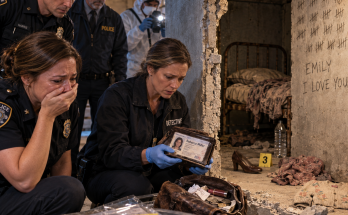
They had found Rebecca’s purse.
Her belongings.
Her writing.
But not Rebecca.
“We keep looking.”
Mary nodded.
A technician called from the truck.
“We found a phone.”
Carter approached.
The device was wedged beneath the passenger seat.
“Burner?”
“Looks like it.”
“Bag it. Isolate it.”
The phone was taken for forensic extraction.
By then the warrant for Marcus Vale’s house had been signed.
Carter, Daniel, and a tactical team arrived before noon.
The property sat at the edge of an older subdivision, larger than Thomas’s home but poorly maintained.
Peeling paint.
Overgrown shrubs.
A sagging fence.
From outside, nothing suggested children had ever lived there.
The garage told a different story.
Concrete dust covered the floor exactly as the first officers had reported.
A masonry saw sat on a workbench.
Its blade had been cleaned recently.
Daniel pointed toward several bags of quick-setting cement.
“Fresh.”
Carter studied the garage wall.
“Scan it.”
The same equipment used at Maplewood Drive was brought in.
Within twenty minutes, the technicians identified an irregular cavity behind a section of drywall.
But when officers carefully opened it, they found no room.
Only a narrow storage space containing plastic bins.
The first bin held clothing.
Children’s clothing.
The second held shoes.
The third contained photographs.
Mary arrived while Carter was examining them.
“How many?”
“Too many.”
The photographs were not posed family pictures.
Most appeared taken from a distance.
Children at school pickup.
Children at playgrounds.
Children entering grocery stores with parents.
Some photographs had circles drawn around specific faces.
Others included handwritten notes.
AGES 7–10.
QUIET.
NO SIBLINGS.
PARENT WORKS LATE.
Mary looked away.
“He was scouting them.”
Carter nodded.
“Or helping Thomas scout them.”
Daniel opened another bin.
Inside were newspaper clippings about missing children.
Some names matched the paper list found beneath Rebecca’s floor.
Sophie Reynolds.
Caleb Turner.
Hannah Price.
Others were unfamiliar.
Carter read one clipping twice.
A six-year-old girl named Megan Foster.
Missing eight years.
Never recovered.
Another clipping described Aaron Wells, age eleven, who vanished walking home from summer camp.
The date matched the handwritten list.
Every name was real.
Every child had disappeared.
Mary whispered, “How many?”
Carter counted the clippings.
“Twelve.”
Daniel looked at her.
“We only had six names.”
“Now we have twelve.”
A technician called from the basement.
“Detective, you need to see this.”
They followed him downstairs.
Marcus’s basement was unfinished.
Concrete floor.
Exposed beams.
Tools and construction materials.
No obvious bedrooms.
No reinforced door.
At first glance, it looked ordinary.
Then the technician pointed toward the foundation.
A section had been painted more recently than the rest.
Ground-penetrating radar revealed something beyond it.
Not a room.
A tunnel.
Daniel stared at the scan.
“Where does it go?”
The technician studied the reading.
“Maybe twenty feet. Then downward.”
Carter looked around.
“Into what?”
“We won’t know until we open it.”
The wall was breached carefully.
Behind it was an older concrete stairwell descending below the basement foundation.
Someone had built over the original entrance.
A heavy steel door waited at the bottom.
Carter looked at Daniel.
“Different house. Same method.”
The lock was cut.
When the door opened, they found a large underground space.
Not improvised.
Constructed.
Electrical wiring ran along the ceiling.
Two vents connected to the house.
There were four small rooms.
Three stood open.
One was locked.
The first contained a mattress and children’s books.
The second was empty except for plastic restraints attached to the wall.
The third contained shelves filled with canned food and bottled water.
Mary’s face hardened.
“This wasn’t temporary.”
“No.”
Daniel approached the locked room.
He knocked.
“Police.”
Nothing.
Again.
“Police department. If anyone’s inside, answer me.”
Silence.
The door was forced.
The room beyond was empty.
But someone had been there recently.
An open water bottle sat on the floor.
A blanket remained rumpled.
A paper plate contained a piece of bread that had not yet gone stale.
Carter touched nothing.
“How recent?”
A forensic specialist leaned close.
“Could be hours.”
Daniel looked toward the stairs.
“Marcus moved someone.”
Mary’s expression changed.
“After learning Thomas was arrested.”
Carter immediately issued another update.
They were no longer searching only for a fleeing suspect.
Marcus Vale might have a captive with him.
Every regional agency received the alert.
Marcus’s photograph.
Vehicle descriptions.
Known addresses.
Family contacts.
Construction clients.
Storage units.
Properties he had worked on.
Anyone helping him could be prosecuted.
Any sighting was to be treated as urgent.
The burner phone recovered from Marcus’s truck produced its first useful evidence late that afternoon.
A forensic analyst called Carter.
“We restored deleted messages.”
“Who with?”
“Several numbers. One belongs to Thomas.”
“What do they say?”
“Mostly coded.”
“Examples?”
“‘Package ready.’ ‘Room cleaned.’ ‘Pickup Friday.’”
Carter’s jaw tightened.
“Dates?”
“Some line up with missing-child cases.”
Mary sat across the temporary command table.
“Anything from today?”
The analyst paused.
“Yes.”
Carter put the call on speaker.
“Read it.”
“A message from Thomas’s number at 4:17 this morning.”
Everyone in the room looked up.
Thomas had been in custody then.
The analyst continued.
“Message says: ‘Police here. Burn everything. Move R.’”
Carter stood.
“Thomas’s physical phone was seized before four.”
“Correct.”
“So either he had another device, or the message was scheduled.”
“Or someone else used his account.”
Daniel asked, “What time did Marcus leave his house?”
“Neighbor estimates around four thirty.”
Mary looked at Carter.
“He got the warning.”
“Yes.”
“Who sent it?”
“We’ll find out.”
The analyst continued.
“There’s another message from Marcus at 4:26.”
“What?”
“‘Already moving her.’”
Silence.
Carter’s eyes narrowed.
“Her.”
Daniel leaned over the table.
“Who is R?”
Rebecca was the obvious answer.
No one wanted to say it too quickly.
Mary did anyway.
“Could Rebecca still be alive?”
Carter looked at her.
“Three years after being sealed behind a wall?”
“Unless she wasn’t sealed there permanently.”
Daniel thought of the hidden room.
“No body.”
Carter nodded slowly.
“The room may have been used to hold her before she was moved.”
Mary stared at the message.
MOVE R.
“If Marcus had her…”
Carter finished the thought.
“Then Thomas’s story about her leaving was partly true. She left the house. Just not freely.”
The possibility changed the investigation instantly.
Rebecca was no longer only a presumed deceased victim.
She became a potentially living hostage.
A regional alert was issued under her name.
Hospitals were contacted.
Shelters.
Bus stations.
Airports.
Traffic cameras began scanning for Marcus.
The girls remained at the hospital.
That evening, Lily woke from a long sleep and asked to see Emily.
The staff allowed them twenty supervised minutes together in a family room.
They sat side by side beneath a mural of cartoon clouds.
Emily held a coloring book without coloring.
Lily stared at the crayons.
Mary sat nearby with a child specialist.
The girls said very little at first.
Then Emily whispered, “They found your room.”
Lily nodded.
“Did they find the other place?”
Mary looked up.
The child specialist leaned forward slightly.
“What other place, Lily?”
Lily seemed surprised they did not know.
“The red house.”
Emily’s eyes widened.
“You remember?”
Lily nodded.
Mary kept her voice calm.
“What red house?”
“Before Daddy’s house.”
“Thomas’s house?”
Lily shook her head.
“The other daddy.”
The room became very quiet.
Mary asked, “Who is the other daddy?”
Lily frowned as though searching for a word she had not used in years.
“Mister Mark.”
Marcus.
Mary’s pulse quickened.
“Did Mister Mark keep you in a red house?”
“Yes.”
“For how long?”
“I don’t know.”
“What happened there?”
Lily looked down at the crayons.
“Kids came and went.”
Emily stared at her.
Mary asked, “Do you remember any names?”
Lily touched the blue crayon.
“One boy was Caleb.”
Mary exchanged a glance with the child specialist.
“Caleb Turner?”
“I don’t know his other name.”
“What happened to Caleb?”
Lily’s face changed.
“He fought.”
“Who?”
“Mister Mark.”
“What happened then?”
“He went away.”
“Did you see where?”
Lily shook her head.
“Did you see Caleb again?”
“No.”
Mary waited.
“Anyone else?”
“There was Hannah.”
Another confirmed missing child.
“What happened to Hannah?”
“She got sick.”
“What kind of sick?”
“She coughed.”
“Then?”
“Mister Mark said Daddy was taking her somewhere better.”
“Thomas?”
Lily nodded.
“She cried.”
“Did she come back?”
“No.”
Emily began rubbing her hands together.
The child specialist noticed and redirected briefly, asking whether they wanted water.
Emily shook her head.
Then she whispered, “Sophie was at the red house too.”
Lily looked at her.
“You knew Sophie?”
“She was at our house.”
Lily’s eyes filled.
“No. She was there first.”
Mary realized the implications.
Children were being moved between locations.
Thomas’s house.
Marcus’s house.
Possibly others.
The system had existed longer and was more organized than investigators believed.
“Lily,” Mary asked carefully, “do you remember your name before Thomas called you Lily?”
The girl froze.
Emily looked toward her.
Mary immediately softened her voice.
“You don’t have to answer.”
Lily’s face tightened with concentration.
“My name is Lily.”
“That may be the name you use now. I’m asking whether anyone called you something else when you were very little.”
The girl closed her eyes.
Minutes passed.
Then she whispered, “Rae.”
Mary leaned forward.
“Rae?”
“Maybe.”
“Was that your whole name?”
Lily shook her head.
“Someone said Rachel.”
The child specialist wrote nothing until Lily had finished.
“Rachel what?”
Lily pressed her palms to her temples.
“I don’t know.”
Mary did not push.
Later that night, investigators ran Rachel against missing-child databases, filtered by age and approximate disappearance window.
Three possible matches appeared.
One stood out.
Rachel Ann Palmer.
Missing at age four.
Disappeared from a county fair nearly five years earlier.
Blond hair.
Blue eyes.
A distinctive birthmark near the left shoulder.
Mary returned to Lily’s medical file.
A birthmark had been documented.
Left shoulder.
She called Carter.
“I think we found Lily.”
Carter listened.
“Name?”
“Rachel Palmer.”
Carter opened the case record on her laptop.
She read silently.
Then stopped.
“What?”
Mary heard keyboard clicks.
“The Palmer case has something strange.”
“What?”
“Rachel’s mother died two years after she disappeared.”
Mary’s stomach tightened.
“And father?”
Carter was silent.
“Carter?”
“Father is alive.”
“Where?”
“Not far.”
“Has he been contacted?”
“Not yet.”
Mary waited.
Carter continued slowly.
“There’s another reason we need to be careful.”
“What?”
“The original investigation considered the father a suspect.”
Mary straightened.
“Why?”
“Conflicting timeline. Financial problems. Witness claimed he argued with Rachel’s mother before the disappearance.”
“Was he charged?”
“No.”
“Cleared?”
“Not formally.”
Mary looked through the glass toward Lily—Rachel—sleeping in the hospital bed.
“Then we verify before telling anyone.”
“Yes.”
At Marcus Vale’s property, meanwhile, Daniel and the forensic team continued searching the underground rooms.
Near midnight, an evidence technician found a loose floor tile beneath a metal shelving unit.
Under it was a sealed envelope.
Inside were photocopies of birth certificates.
Not one.
Seven.
Some belonged to missing children.
Sophie Reynolds.
Caleb Turner.
Hannah Price.
Megan Foster.
Aaron Wells.
Two others.
One certificate belonged to Rachel Ann Palmer.
Daniel called Carter immediately.
“These weren’t random children.”
Carter listened.
“What do you mean?”
“He collected their identities.”
“For what purpose?”
“I don’t know yet.”
Then Daniel noticed something else inside the envelope.
A handwritten ledger.
Each child’s real name had a second name written beside it.
Sophie became Sarah.
Caleb became Noah.
Hannah became Grace.
Rachel became Lily.
Megan became Claire.
Aaron became Lucas.
Daniel stared.
“They renamed all of them.”
Carter was silent.
Then Daniel reached the last page.
One adult name appeared there.
Rebecca Miller.
Beside it was another name.
Rose.
Daniel felt his pulse jump.
“Carter.”
“What?”
“Rebecca’s in the ledger.”
“And?”
“They gave her a new name too.”
Carter understood immediately.
Thomas and Marcus did not only erase children.
They erased adults.
The burner-phone message returned to her mind.
MOVE R.
Maybe R did not mean Rebecca.
Maybe it meant Rose.
And if Marcus was still moving Rose, then Emily’s mother might not be hidden beneath concrete.
She might be alive somewhere outside, traveling beside the man who had helped imprison her for three years.
Click here to continue reading: PART 7: Lily Remembers Her Real Name While a Highway Camera Captures Marcus Traveling With a Woman Who Should Have Disappeared Three Years Ago
A Frightened Child Calls 911 With Three Strange Words That Make an Experienced Dispatcher Refuse to Hang Up
Part 6 of 20