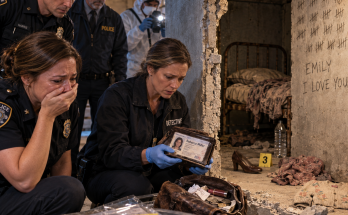
The photograph eventually went into a frame at The Second Chapter.
Not in my house.
Not hidden in a box.
In the hallway outside the counseling rooms.
Most people walking past it never knew who the men were.
That was fine.
The sentence on the back mattered more than their names.
Good people can lose years when pride speaks louder than love.
I never turned it into a slogan.
Life was more complicated than slogans.
Sometimes leaving was right.
Sometimes staying was right.
Sometimes forgiveness restored a relationship.
Sometimes forgiveness simply allowed you to stop carrying anger toward someone you never wanted near you again.
I had experienced pieces of all of it.
The house where the barbecue happened was sold.
I attended the closing because my financial interest required it.
Nothing dramatic happened.
No one cried.
No one stood in the empty living room remembering better days.
It was paperwork.
Signatures.
Numbers.
Keys placed on a table.
That felt appropriate.
For years the house had been treated as though it represented family.
In the end, it was wood, drywall, pipes and land.
Family walked out.
The accounting restored what could be restored.
My documented contributions were recognized.
The trust protected Ava’s legitimate share.
Daniel received his lawful portion.
Margaret repaid substantial funds immediately from recovered assets and entered a structured agreement for the remainder.
Some losses could never be perfectly reconstructed.
I accepted that.
Accuracy mattered more than revenge.
Robert’s false document brought consequences he had to face himself.
I did not intervene for him.
Neither did Daniel.
Robert apologized once.
I accepted the apology without promising closeness.
He eventually moved away.
Theodore stayed in our lives.
Not constantly.
That would have been artificial.
He visited twice a year.
He and Daniel developed the strange, uneven relationship of relatives recovering decades they could never truly recover.
They talked about Thomas.
Sometimes they disagreed about him.
I liked that.
Dead people should not become saints simply because they cannot defend their contradictions.
Thomas Whitmore had loved his family.
He had also waited too long to tell the truth.
He had tried to repair damage.
He had also believed he could manage the timing of another person’s right to know.
Both were true.
My own father had done something similar with Michael.
He had falsely accused his brother.
Later he learned the truth.
He tried to reconcile.
Pride had already hardened into distance.
Michael eventually understood his own refusal had become another form of captivity.
Neither brother was entirely villain or victim.
That lesson changed how I understood Margaret too.
I did not forgive her by pretending she was secretly good all along.
I did not condemn her by pretending every loving thing she had ever done was fake.
She had loved people.
She had harmed them.
Sometimes through fear.
Sometimes through selfishness.
Sometimes through control.
Sometimes because she believed she knew what was best.
The fact that her motives were human did not make the damage smaller.
It simply made the warning more useful.
Terrible harm did not always begin with hatred.
Sometimes it began with a person deciding they were entitled to choose for everyone else.
Margaret and I never became close.
That was another truth I learned to accept.
We became civil.
Eventually warm in small doses.
She came to birthdays.
I attended one Thanksgiving at her home years later.
She asked before inviting Laura.
She asked before discussing Ava.
She stopped treating information as currency.
When she slipped into old habits, Daniel corrected her.
Sometimes she became defensive.
Sometimes she apologized.
Change was not a straight road.
Neither was forgiveness.
Laura remained part of Ava’s life.
Their relationship improved, though it never became the childhood bond Ava once imagined recovering.
You could not return to thirteen and build the mother-daughter relationship that should have existed then.
They built something else.
Adult.
Imperfect.
Chosen.
Laura once asked me whether I hated her.
We were standing outside Ava’s graduate-school ceremony.
“No.”
She looked surprised.
“Why not?”
“Hating you would require more maintenance than I’m willing to provide.”
She laughed.
Then she cried.
“I deserved that.”
“It wasn’t punishment.”
“I know.”
She looked toward Ava.
“I spent years thinking if she loved you, I lost.”
“And?”
“I lost years because I thought love was something I had to win.”
I nodded.
“Yes.”
She looked at me.
“I’m glad you stayed in her life.”
“I’m glad you came back into it honestly.”
That was as close to reconciliation as we needed.
Ava completed graduate school and became a family counselor.
The irony was not lost on any of us.
At her first professional office, she kept no photograph of the infamous barbecue.
I asked.
She rolled her eyes.
“That would be weird.”
“Fair.”
Instead she kept the gold bracelet.
The one I had left behind.
The one she later returned.
I had finally given it to her.
She placed it in a small glass box on her bookshelf.
Not because the engraving was true when it was first given to me.
Because we had eventually made it true.
Welcome to our family.
Ava told clients nothing about it.
It belonged to us.
The Second Chapter grew slowly.
That was intentional.
I did not want expansion for the sake of looking successful.
We helped people with practical things.
Bank accounts.
Job applications.
Training.
Legal referrals.
Childcare.
Housing transitions.
Budgeting.
Counseling.
Documents.
The unglamorous architecture of having choices.
I never told women they needed to leave.
I never told them staying meant weakness.
I asked different questions.
Do you have accurate information?
Do you have access to your own money?
Are you allowed to disagree safely?
Do the people who love you respect your boundaries when those boundaries inconvenience them?
If you choose to stay, are you staying because you want the relationship or because you have been made afraid of surviving without it?
Those questions mattered more than slogans about strength.
My father’s trust gave me financial freedom.
But money alone did not create The Second Chapter.
The foundation began emotionally the night I carried a suitcase out of Daniel’s house.
I simply did not know its name yet.
Daniel understood that.
At one anniversary dinner, years after our renewed vows, he asked whether I considered the night I left the end of our first marriage.
“Yes.”
He nearly dropped his fork.
“That decisive?”
“Yes.”
“What are we in now?”
“The second one.”
“We only have one marriage certificate.”
“Paperwork problem.”
He smiled.
Then became serious.
“I think you’re right.”
The marriage before I left had rules we never consciously created.
I managed.
Daniel avoided.
Ava tested.
Margaret influenced.
Everyone called the resulting quiet peace.
The marriage after I returned operated differently.
Questions were allowed.
No became a complete answer.
Money had documentation.
Apologies did not purchase immediate forgiveness.
Being family did not exempt anyone from consequences.
And love was not proven by how much one person could tolerate.
Daniel still disappointed me sometimes.
I disappointed him.
We argued.
Once, during a particularly ugly disagreement about his work schedule, he walked out of the kitchen.
The old panic rose in me.
Then he returned thirty minutes later.
“I needed to calm down,” he said. “I’m not leaving the conversation.”
Such a small sentence.
Such an enormous difference.
I realized then that security did not mean never experiencing conflict.
It meant knowing conflict would not automatically erase respect.
On my sixty-third birthday, Ava came over early.
She brought breakfast and an envelope.
I stared at it.
“No.”
She laughed.
“What?”
“I’ve had enough envelopes.”
“This one contains no deeds, bank accounts, forged signatures, secret relatives or family conspiracies.”
“Can you guarantee that legally?”
“I’m a counselor, not a lawyer.”
I opened it.
Inside was a photograph from her graduation.
Daniel stood on one side of her.
I stood on the other.
Laura and Margaret were visible behind us.
Theodore leaned awkwardly into the frame.
Nobody looked perfectly arranged.
Ava had written on the back.
Nobody had to lose for this picture to exist.
I looked at her.
“That’s good.”
“I know.”
“Modest.”
“Also learned from you.”
I hugged her.
She hugged me back.
No hesitation anymore.
Later that year, Margaret became ill.
Not gravely.
Nothing dramatic.
A surgery with several weeks of recovery.
Daniel helped her.
So did Ava.
I visited once.
Margaret seemed surprised.
“You didn’t have to come.”
“I know.”
That was why I came.
Choice.
Not obligation.
Not fear.
Not the need to prove I was a good daughter-in-law.
I brought soup.
She laughed when she saw it.
“You used to bring food every time something happened.”
“I remember.”
“And I took it for granted.”
“Yes.”
She tasted it.
“Still too much pepper.”
“Some things don’t change.”
We laughed.
I left after an hour.
No guilt.
No demand that I stay.
That visit taught me something I had not expected.
A boundary did not have to remain at maximum distance forever to prove it had been necessary.
Distance could change when behavior changed.
Or it could remain.
Both were valid.
Years after the original barbecue, Daniel and I attended another family cookout.
Different house.
Different patio.
Ava was older now.
Confident.
She arrived late from work and dropped her bag inside.
Someone handed me a pitcher of lemonade.
Daniel saw it and laughed.
“What?”
“Nothing.”
Ava noticed.
“Oh, absolutely not.”
She took the pitcher from me.
“I’m carrying this.”
I laughed.
“You’re ridiculous.”
“I have learned from history.”
Margaret, seated nearby, smiled but did not join the joke.
I appreciated that.
Some memories belonged to the people who were harmed by them.
She understood.
Ava carried the lemonade to the table.
Nobody fell.
Nobody accused anyone.
Nothing happened.
And perhaps that was the most satisfying ending that moment could have had.
Ordinary life.
No test.
No choice between people.
No one required to lose.
That evening, Daniel and I sat outside after everyone left.
The sky had turned orange behind the trees.
He rested his hands on the arms of his chair.
For several minutes we said nothing.
Silence felt different now.
Not avoidance.
Rest.
Daniel looked at me.
“Do you ever think about that first apartment?”
“Yes.”
“You barely had furniture.”
“I had a chair.”
“One chair.”
“It was a good chair.”
“It was terrible.”
“You were emotionally unqualified to judge my furniture.”
He laughed.
Then he became quiet.
“I hated that apartment.”
“I know.”
“Not because of the apartment.”
“I know.”
“Because every time I walked in, I could see you had built a place where you didn’t need me.”
I looked at him.
“That frightened you.”
“Terrified me.”
“And now?”
He thought.
“Now I think needing me would be a terrible reason for you to stay.”
I smiled.
“That took a while.”
“I’m slow.”
“Documented.”
He reached for my hand.
I gave it to him.
“Do you regret leaving?” he asked.
The question had been asked before.
By Ava.
By Margaret indirectly.
By me, privately, during the loneliest nights.
My answer had never changed.
“No.”
Daniel nodded.
“I figured.”
“I regret what made leaving necessary.”
“That’s different.”
“Yes.”
I looked toward the yard.
“I regret that Ava was hurting.”
“Yes.”
“I regret that you and I let our marriage become what it became.”
“Yes.”
“I regret the years of secrets.”
He squeezed my hand.
“But not leaving.”
“No.”
Daniel looked toward the sunset.
“Why?”
I thought about the woman who packed the suitcase.
The woman who left the bracelet.
The woman who sat alone in an almost empty apartment listening to the refrigerator hum.
She had believed she was abandoning a family.
In reality, she had stopped abandoning herself.
“Because I had disappeared long before I walked out.”
Daniel looked at me.
“And leaving brought you back?”
“To myself.”
He nodded slowly.
Then I continued.
“If I hadn’t found myself again, there would have been nothing healthy to bring back to you.”
His eyes filled.
“I’m glad you came back.”
“So am I.”
“But you didn’t come back because we needed you.”
“No.”
“Or because Ava apologized.”
“No.”
“Or because I promised to change.”
“No.”
“Why did you?”
“Because over time, you changed without knowing whether it would bring me back.”
Daniel looked down.
That was the difference.
Promises made to prevent someone leaving were easy.
Changed behavior maintained when there was no guaranteed reward meant more.
“And because I changed too,” I said.
He smiled.
“You always add that.”
“Because it’s true.”
I had learned to ask.
To refuse.
To receive help.
To stop treating competence as a requirement to carry everything alone.
To stay present inside relationships instead of proving love through self-erasure.
Daniel squeezed my hand again.
Inside the house, Ava laughed at something.
Laura’s voice answered.
Theodore complained about somebody stealing the last piece of pie.
Margaret said something I could not hear.
Ordinary family noise drifted through the open door.
Not perfect.
Not healed into some untouched version of the past.
Different.
Chosen.
Honest enough to survive being imperfect.
I thought of my father and Michael.
Thomas Whitmore and Theodore.
Margaret and Laura.
Daniel and Ava.
All those years people had lost because fear told them truth would destroy the family.
The truth had hurt us.
It had changed us.
It had ended relationships in their old forms.
But the lies had been doing that already.
Truth simply made the damage visible enough to stop repeating it.
Daniel leaned back.
“Emily?”
“Yes?”
“If you could go back to that barbecue, what would you tell yourself?”
I considered the question.
I could have warned myself about the camera.
The money.
The deed.
Margaret.
Laura.
The accounts.
The letters.
All the truths waiting behind one accusation.
But none of that was what the woman carrying the lemonade needed most.
“I’d tell her she doesn’t have to prove what she knows happened before deciding what treatment she will accept.”
Daniel nodded.
“And then?”
“I’d tell her to put down the pitcher.”
He laughed.
I smiled.
Then I looked through the open door at the people inside.
Years earlier, I had thought leaving meant I was walking away from my family.
Instead, leaving forced all of us to answer a harder question.
What kind of family were we willing to become once nobody was required to disappear to keep everyone else comfortable?
It took years to answer.
Some people answered through apologies.
Some through repayment.
Some through distance.
Some through therapy.
Some through changed behavior repeated long enough to become trustworthy.
Ava answered by choosing me without needing to rename me.
Daniel answered by learning that protecting his daughter never required sacrificing his wife.
Laura answered by admitting that motherhood did not give her ownership over Ava’s love.
Margaret answered, slowly and imperfectly, by giving up control over choices that had never belonged to her.
And I answered by understanding that belonging was not something another person could grant me after I had performed enough service.
I belonged to myself first.
That did not make me less capable of loving a family.
It made the love I gave them real.
Daniel stood and held out his hand.
“Come inside?”
Years ago, that invitation might have sounded like a request to return to my assigned place.
Now it was simply a question.
I looked at his hand.
Then at him.
“Yes.”
I stood.
We walked toward the house together.
Not because I had nowhere else to go.
Not because leaving had failed.
Not because the old family had finally decided I deserved a place.
I went inside because I wanted to.
And after everything, that freedom to choose was the ending I had been fighting for from the beginning.
The End
Read more original stories on Feel Every Story.
The Afternoon My Husband Asked Me to Apologize for Something His Daughter Knew I Had Never Done
Part 20 of 20