We didn't settle anything that afternoon.
That was the first thing I learned.
The second was that getting people into the same room did not automatically make them honest.
Benjamin answered some questions.
He avoided others.
Genevieve occasionally tried to explain what she thought he meant, but each time she did, I brought the conversation back to the records.
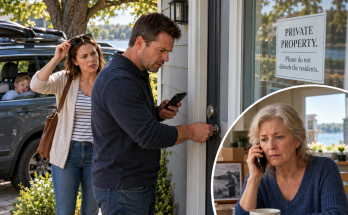
The older woman stayed until we had gone through the papers a second time.
She explained which details she had checked and which ones still needed confirmation.
I wrote down the questions that remained unanswered.
There were more than I wanted.
By the time the woman stood to leave, the light outside had begun to fade.
She slipped the documents back into the leather folder.
"I'll make myself available if you need me to clarify anything," she said.
I walked her to the door.
"Will you tell me if you discover something else?"
"Yes."
"Even if it changes your understanding again?"
She looked at me.
"Especially then."
I nodded.
It was the best answer she could give.
After she left, Benjamin remained in the living room.
Genevieve stood near the hallway, looking as though she wanted to say something but wasn't sure whether she should.
I returned to the table and sat down.
"Let's talk about what you knew," I told Benjamin.
He lowered his eyes.
"I know this looks bad."
"That's not what I asked."
He took a breath.
"I didn't have all the information."
"Neither did I."
He looked up.
For a moment, neither of us spoke.
I had imagined this conversation many times, but I had always pictured myself feeling stronger.
Instead, I felt tired.
I was tired of searching for the right words.
Tired of trying to make someone understand why being kept in the dark hurt.
And tired of wondering whether asking for honesty was somehow asking too much.
"I don't expect you to know everything," I said. "I expect you to tell me what you know."
"I understand."
"Do you?"
He nodded.
I wanted to believe him.
I also knew that a nod was not evidence.
We went through the questions one by one.
Whenever he gave an answer, I wrote it down beside the relevant entry.
If he said he didn't remember, I marked it as uncertain.
If he said he had never seen a document, I asked whether he was sure.
The process was slow.
It was also the first time I had felt that I could challenge his answers without being forced to defend my right to ask.
Genevieve eventually sat down beside him.
She listened for several minutes before speaking.
"I thought he was trying to keep things from becoming worse," she said.
I looked at her.
"Did he tell you that?"
"Yes."
"And did you ask him what that meant?"
She hesitated.
"Not enough."
I wrote that down, though not on the page.
It was an answer that applied to more than one person in the room.
I had also accepted explanations without asking enough questions.
The difference was that I had been the one left without the information.
Still, I couldn't pretend my own mistakes had never happened.
I had ignored doubts because I feared what would happen if I followed them.
I had chosen peace when what I really wanted was certainty.
And I had sometimes called my silence patience.
Looking back, I could see how much easier I had made it for everyone to avoid difficult conversations.
That didn't excuse anyone else.
It simply meant I had to change what I was willing to accept.
We stopped when Benjamin could no longer give useful answers.
He said he needed time to think about certain details.
I told him to take it.
But I also told him that anything he remembered later needed to be shared, even if it made his earlier answers look incomplete.
He agreed.
After he left, I sat alone at the table.
The folder was gone.
The questions remained.
I looked at the empty space where the documents had been.
For the first time, I understood that the woman had not brought me a complete answer.
She had brought me a reason to ask better questions.
That was enough for one day.
Over the next stretch of time, I returned to the information we had discussed.
I compared the dates.
I separated what I could verify from what I had merely been told.
I made a list of the people who had offered explanations and the specific claims each one had made.
It was uncomfortable to see everything written down.
Spoken explanations had a way of blending together.
On paper, contradictions were harder to overlook.
Some details remained uncertain.
Others became easier to understand once I stopped treating every statement as equally reliable.
I began to recognize the difference between a fact and an interpretation.
A date could be checked.
A record could be examined.
A statement about someone's intentions was harder to prove.
I had spent too much time arguing about intentions when I should have been checking the facts.
That realization changed how I approached every conversation that followed.
When Benjamin contacted me, I asked him to be specific.
When Genevieve offered an explanation, I asked what information supported it.
When either of them said they couldn't remember something, I accepted that as an answer only to the question of memory.
It wasn't proof of anything else.
I also kept the older woman's promise in mind.
She had admitted that she could be wrong.
I began to understand how important that was.
People often spoke as if changing their minds were a weakness.
In reality, refusing to change your mind after discovering new information could cause far more damage.
I didn't know whether the woman had always been willing to admit a mistake or whether this experience had forced her to learn.
I only knew that she had returned to the information rather than continuing to defend what she had believed.
That mattered.
A few days later, Benjamin came back.
This time, he arrived alone.
I opened the door and let him in.
He looked different from the man who had stood on the porch beside Genevieve and the woman with the folder.
Not dramatically.
He was still Benjamin.
But he seemed less prepared to argue.
We sat at the same table where the documents had been arranged.
He placed a few sheets of paper in front of him.
"I went back through what I had," he said.
I waited.
"I found things I hadn't paid enough attention to."
"What things?"
He showed me the papers.
We went through them slowly.
Some information supported details we had already discussed.
Other parts required more checking.
He didn't try to tell me what I should conclude.
That was new.
When I asked him why he hadn't examined everything earlier, he admitted that he had focused on the details that supported his understanding.
He had not been as careful with the ones that challenged it.
I looked at him for a long time.
It was not the full confession I might once have wanted.
It was, however, an admission that the problem had not been limited to missing information.
He had also made choices about what information deserved his attention.
"Why?" I asked.
He looked down.
"Because I thought I knew what it meant."
I understood that answer better than I wanted to.
Certainty could become a kind of shelter.
Once you decided you were right, you no longer had to face the possibility that your actions had caused harm.
You could keep explaining.
You could keep defending.
You could even believe you were helping.
Until the facts refused to cooperate.
I didn't tell Benjamin that I understood.
Understanding wasn't the same as forgiveness.
Instead, I asked him to identify every point he still couldn't explain.
He did.
We added the questions to the list.
Then we agreed not to treat any of them as settled until we had enough information to do so.
It was a modest agreement.
No dramatic promises.
No claim that everything would be fine.
Just a decision to stop filling gaps with assumptions.
After Benjamin left, I read through the list once more.
The paper was covered in notes.
Some questions had answers.
Others did not.
I placed a mark beside each item that still required confirmation.
The marks bothered me.
I wanted everything resolved.
I wanted the missing explanations to appear, one after another, until I could finally put the entire matter behind me.
But I had no right to demand certainty where the evidence had not yet provided it.
I could only keep working with what I knew.
And I could refuse to pretend that what I didn't know had somehow been settled.
That evening, I thought about the older woman's expression when she first looked at my house.
She had arrived prepared to defend someone.
Then she had seen enough to question the position she had taken.
I wondered whether she had felt ashamed.
I wondered whether Benjamin had expected her to keep defending him.
Most of all, I wondered how many people had been willing to accept a convenient explanation because challenging it would have required them to admit that they had been wrong.
I had been one of those people.
Not because I had known the truth and deliberately ignored it.
Because I had allowed my desire for peace to become stronger than my need to understand.
I could not change the time I had lost.
But I could change what happened next.
I returned to the table and placed the question list inside a drawer.
I didn't lock it away.
I left it somewhere I could reach.
That was the point.
The questions were no longer something I needed to hide from.
They were something I needed to answer.
Click here to continue reading: PART 4: I Finally Learned That Trust Could Not Be Repaired by Promises Alone, and That the Truth Had to Matter Even When Nobody Liked It
The Stranger Outside My House Carried a Folder That Seemed to Hold Answers Nobody Had Been Willing to Give Me
Part 3 of 4