
I could hear Patrick breathing on the other end of the phone.
He was waiting for me to explain myself.
I knew that waiting.
I had heard it in his voice countless times before, usually when I had done something he hadn't expected.
He would become quiet.
Then he would ask a question that made it sound as though I had created a problem for everyone.
Eventually, I would start explaining.
I would tell him why I had made a decision, what I had considered, and how I had tried to avoid hurting anyone.
By the end, I would somehow be apologizing.
That was how our conversations usually ended.
But I wasn't standing in the old kitchen anymore.
I wasn't looking at the familiar cabinets or listening to the refrigerator hum in the corner.
I was in a rented apartment, with my belongings still packed and a view of the lake that belonged to no one in particular.
For the first time in years, I had room to think before answering.
"Patrick," I said, "you need to understand that things are different now."
"Different how?"
I looked toward the window.
A small patch of sunlight had reached the water.
"I don't live there anymore."
He didn't respond right away.
I could imagine the expression on his face.
He had known I was leaving, of course.
He had known I was making changes.
But knowing something was happening and accepting that it had actually happened were two different things.
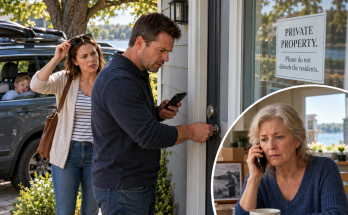
"That doesn't explain the lock," he finally said.
"No," I replied. "It doesn't."
He waited for more.
I didn't give him any.
The truth was that I had spent too long trying to make every decision understandable to people who had already decided they didn't like it.
There was no perfect explanation that would make Patrick welcome the change.
If I offered one, he would find another question.
If I answered that question, he would find another objection.
And if I kept going, we would end up exactly where we had always been.
He would be angry.
I would feel guilty.
Nothing would change.
I was tired of that arrangement.
Behind him, I heard a car door close.
Megan said something I couldn't understand.
Then Patrick spoke again.
"We drove all the way here."
I knew that.
I could see the packed SUV in my mind, the luggage in the back and the sleeping child resting against the window.
I knew the inconvenience of arriving somewhere and discovering that your plans had been disrupted.
But I also knew that Patrick had never questioned whether he had the right to use my home whenever he wanted.
He had treated that right as something permanent.
He had never asked whether I was comfortable with it.
He had never wondered whether I might want a quiet weekend without visitors.
I had made it easy for him not to wonder.
"Then you should take the time to read what's posted there," I said.
"Mom, I'm serious."
"So am I."
The words came out more firmly than I expected.
I sat up straighter at the counter.
For a second, I almost softened my voice and tried to make the moment easier for him.
The habit was still there.
It had been built over years of small compromises.
But I let the words stand.
Patrick exhaled.
"This makes no sense."
I didn't tell him he was wrong.
I didn't remind him of every conversation that had brought us here.
I didn't list the moments when I had felt like a guest in my own home.
I had learned that a person could spend hours explaining an injury to someone who had no intention of admitting they had caused it.
Sometimes, the explanation only gave them more chances to argue.
"Read the notice, Patrick," I repeated.
He said nothing.
I could hear Megan again, this time closer to the phone.
"Who is she talking to?"
"Mom," Patrick answered.
Megan's response was too quiet for me to hear.
Then Patrick returned to the call.
"Are you telling me we can't go inside?"
I looked around my apartment.
The cardboard boxes.
The little kitchen table.
The fishing photographs waiting to be hung.
I thought about how strange it was that a place could remain familiar even after you had stopped feeling at home there.
For a long time, I had believed that leaving meant losing something.
I hadn't considered that staying could cost me something, too.
"I'm telling you that you can't assume everything will remain the way it was," I said.
He made a frustrated sound.
"That's not an answer."
"It is the answer I have for you right now."
I heard him shift the phone.
Then the call ended.
I sat still for several seconds, holding the phone against my ear even though the line had gone silent.
My hands were shaking.
I hadn't expected that.
I had imagined that once I finally stood up for myself, I would feel strong.
Instead, I felt frightened and strangely sad.
I had spent so many years trying to avoid disappointing my son that I had forgotten what it felt like to disappoint him for a reason I believed in.
I put the phone on the counter.
Then I went to the window.
The lake was still there.
The water moved gently between the buildings, broken into narrow pieces by the reflections of the surrounding windows.
It wasn't the view I had once loved.
But it was enough.
I made myself a cup of tea and returned to the counter.
The tea was too hot, so I let it sit.
I opened the box containing George's photographs and lifted the top picture out of its wrapping.
He was standing beside the lake in that photograph, holding a fishing rod with one hand and shielding his eyes from the sun with the other.
He had been smiling at someone outside the frame.
Probably me.
I ran my thumb along the edge of the picture.
George had understood something I had taken too long to learn.
A home wasn't supposed to be a place where one person made all the sacrifices so everyone else could remain comfortable.
It was supposed to be somewhere people could live without constantly measuring their worth by how useful they were to others.
I hadn't understood that while he was alive.
After he died, I tried even harder to keep everything together.
I thought that if I preserved the house, the routines, and the family traditions, I could somehow protect what remained of us.
Instead, I had allowed the house to become another place where I was expected to give more than I received.
I placed the photograph carefully on the counter.
Then I took out my phone and looked at Patrick's name.
I could have called him back.
I could have tried to make him feel better.
I could have explained the situation until neither of us remembered what the original argument had been about.
I didn't.
Not because I wanted to punish him.
Because I needed to stop confusing his discomfort with my responsibility.
I turned the phone facedown.
For the rest of the afternoon, I unpacked the things I needed.
I put the plates in the cupboard.
I folded my clothes into the dresser.
I found a place for the fishing photographs, though I left the one of George beside the window for the time being.
By evening, the apartment looked less like a temporary stop and more like somewhere I might actually live.
I was beginning to settle when my phone lit up again.
Patrick's name appeared on the screen.
This time, I didn't feel the same immediate panic.
I watched it ring.
Then I picked it up.
Click here to continue reading: PART 3: The Call I Had Been Dreading Finally Came, but the Question Patrick Asked Revealed How Little He Had Understood
The Key That Had Opened My Home for Years Suddenly Meant Nothing, and I Finally Understood What My Silence Had Cost Me
Part 2 of 4

One Comment on “PART 2 – While Patrick Demanded an Explanation, I Sat Beside the Lake and Remembered How Many Times I Had Called Giving In Love”