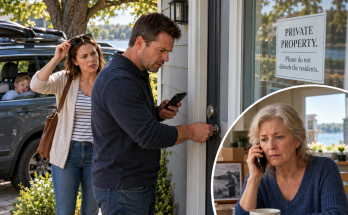
I used to believe that when people came to your door, you could tell what they wanted by looking at their faces.
I was wrong.
That afternoon, I stood behind my living room curtain, watching a car parked outside my house.
Three people had arrived.
The first two were people I knew.
Benjamin stood beside the driver's door, his shoulders stiff and his hands hanging at his sides.
Genevieve was near the front of the car.
Neither of them moved toward the house.
They just stood there, looking at my front door.
Then the third person got out.
She was an older woman wearing a dark green raincoat.
A thin leather folder rested against her chest, held tightly in both hands.
She closed the car door carefully.
For a moment, she remained beside the vehicle, looking at the house as though she were checking that she had arrived at the right address.
Something about her seemed familiar.
I couldn't place her face.
Not exactly.
It was something else.
The way she looked at the house reminded me of someone who had spent a long time believing she understood a situation, only to discover that the truth might be entirely different.
She looked uncertain.
Almost uncomfortable.
And I knew that expression because I had worn it myself.
Benjamin glanced toward her.
Genevieve did not.
She kept her eyes on the older woman, waiting for something I couldn't see from inside.
That was when I began to suspect this visit had nothing to do with offering support.
Something had happened.
Something had changed their minds.
I let the curtain fall back into place and stepped away from the window.
For several seconds, I stood in the middle of the room, listening to the quiet house.
The refrigerator hummed in the kitchen.
A clock ticked somewhere behind me.
Everything was ordinary.
That made the situation worse.
I had spent enough time dealing with people who smiled while hiding the truth to know that the most important moments rarely announced themselves.
I looked at the front door.
Then I looked down at my hands.
They were shaking.
I was angry with myself for that.
I had told myself I would remain calm if Benjamin ever came back.
I had imagined conversations in which I would ask direct questions and refuse to accept vague answers.
I had even practiced what I would say.
But now that he was standing outside, I couldn't remember a single sentence.
I only remembered all the things he had left unexplained.
And the things I had allowed him to leave unexplained.
That part mattered.
I had spent years making excuses for people because the truth was often harder to live with than a lie.
If someone avoided a question, I assumed they were tired.
If a story changed, I told myself I must have remembered it incorrectly.
If money disappeared and nobody could explain where it had gone, I blamed confusion.
It was easier than admitting that someone I trusted might be taking advantage of me.
Looking back, that habit cost me more than money.
It cost me time.
It cost me sleep.
And it taught the wrong people that I would eventually stop asking questions.
I walked toward the hallway.
Then I stopped.
I could hear a faint sound outside, the movement of shoes on the walkway.
Someone had started toward the porch.
I waited for the knock.
It didn't come immediately.
Instead, there was a short exchange between Benjamin and the older woman.
I couldn't make out the words.
Their voices were low, and the closed window swallowed most of the sound.
Genevieve said something.
The older woman answered.
Then everything went quiet.
I stood there longer than I needed to.
Part of me wanted to open the door before anyone knocked.
Another part wanted to pretend I wasn't home.
That second impulse embarrassed me.
This was my house.
I had no reason to hide inside it while other people decided what they were going to tell me.
I walked to the kitchen and placed my hand on the counter.
The surface was cool beneath my palm.
I stared at the empty space where I usually left my keys.
I had always liked knowing where things belonged.
Keys in the bowl.
Bills in the drawer.
Important papers in the cabinet.
There was comfort in putting something away and knowing I could find it again.
People were different.
You could know someone for years and still discover that the person you trusted had been keeping an entirely separate account of your life.
I had learned that the hard way.
The knock finally came.
Three firm taps.
Not aggressive.
Not friendly, either.
I drew a breath and walked to the front door.
Before opening it, I looked through the small glass panel beside the frame.
Benjamin was standing closest to the entrance.
Genevieve remained a step behind him.
The older woman stood farther to the side, holding her leather folder.
Her eyes were lowered.
She looked like someone who had prepared herself to say something difficult and was now reconsidering every word.
I opened the door.
Nobody spoke immediately.
Benjamin looked at me, then down at the porch.
Genevieve shifted her weight.
The older woman raised her head.
Up close, she looked more tired than I had first thought.
There were fine lines around her eyes, and her raincoat was damp at the shoulders.
She held the folder against herself as though she were afraid someone might take it away.
I waited.
Benjamin cleared his throat.
"Can we come inside?"
I looked at him.
Then I looked at Genevieve.
Finally, I turned toward the woman with the folder.
"That depends on why you're here."
Benjamin opened his mouth, but nothing came out.
Genevieve glanced at him.
It was a small movement.
Still, I noticed it.
The older woman noticed it too.
Her fingers tightened around the folder.
"I think you should hear what I have to say," she told me.
Her voice was quiet.
There was no confidence in it.
That made me pay attention.
I stepped aside and let them enter.
Benjamin came in first.
Genevieve followed him, keeping her distance from the others.
The older woman crossed the threshold last.
She stopped just inside the living room and looked around.
Not casually.
She examined the room with the careful attention of someone comparing what she saw with something she had been told.
Her eyes moved from the window to the hallway, then to the small table beside the sofa.
I wondered what she had expected to find.
I also wondered who had described my house to her.
"Please sit down," I said.
Benjamin lowered himself onto the sofa.
Genevieve remained standing until the older woman chose a chair.
Then she sat opposite him.
I stayed on my feet.
The leather folder rested across the woman's knees.
She ran her thumb along its edge without opening it.
I watched her do that for several seconds.
"Before we begin," I said, "I want to know who you are."
She looked directly at me.
"My name is—"
She stopped.
Her eyes moved toward Benjamin.
He stared at the floor.
Genevieve turned toward the window.
I felt the familiar pressure building in my chest.
There it was again.
A simple question.
Three people in the room.
And nobody willing to answer it without first checking what everyone else might think.
I almost laughed.
Not because anything was funny.
Because I recognized the pattern.
I had seen it before, and I had spent too long pretending not to understand it.
"Look at me," I said to the woman.
She did.
"You came to my house carrying something you believe I need to see. You came with Benjamin and Genevieve, and neither of them seems willing to explain why. I think I've waited long enough for people to decide what I can handle."
The woman lowered her eyes to the folder.
For the first time since entering the house, she seemed to understand that I wasn't going to make this easy for her.
I wasn't trying to frighten her.
I simply wanted the truth.
She placed the folder on the table between us.
The sound was small.
But everyone looked at it.
"I was told things about you," she said.
I waited.
"Things that made me believe I understood what had happened."
Benjamin moved on the sofa.
Genevieve folded her hands in her lap.
The woman continued.
"I believed I was helping someone who needed protection."
She paused.
Then she looked at me again.
"But I may have misunderstood who actually needed it."
Nobody spoke.
I stared at the folder.
I had spent so much time wondering what Benjamin knew, what Genevieve had been told, and why certain questions always seemed to make people uncomfortable.
Now a stranger had arrived with a different explanation.
Or perhaps a different problem.
I couldn't tell yet.
"What changed?" I asked.
The woman took a slow breath.
"I found something I wasn't expecting."
"What did you find?"
She looked toward Benjamin.
This time, he didn't meet her eyes.
That told me more than anything he had said since arriving.
The woman opened the folder.
Inside were several sheets of paper, arranged carefully in a stack.
She didn't hand them to me.
Not yet.
Instead, she rested one hand on the first page and looked at me as if she were still deciding whether she had the right to continue.
I felt anger rise, followed by something colder.
I was tired of being the last person to learn what concerned my own life.
"Whatever it is," I said, "you can tell me now."
She nodded.
But before she could speak, Benjamin leaned forward.
"Maybe we should explain everything together."
I turned toward him.
For the first time that afternoon, I didn't feel nervous.
I felt clear.
"No," I said. "You can explain your part after she tells me hers."
Benjamin sat back.
Genevieve looked down.
The older woman remained still, one hand resting on the open folder.
I had expected the truth to arrive with an argument.
I had expected raised voices, accusations, perhaps another attempt to convince me that I was remembering things incorrectly.
Instead, it had arrived in a quiet room, carried by a woman who no longer seemed certain which side she had been standing on.
And that was more frightening than anger.
Because anger could be answered.
Uncertainty meant the story I had been given might never have been the whole story.
Click here to continue reading: PART 2: The Papers on the Coffee Table Forced Me to Question Not Only Benjamin’s Story but Also the Reasons I Had Believed It
The Stranger Outside My House Carried a Folder That Seemed to Hold Answers Nobody Had Been Willing to Give Me
Part 1 of 4