The next morning, I woke before the alarm.
For a few seconds, I didn't remember where I was.
The room was unfamiliar, and the light came through the window at a different angle than it had in my old bedroom.
Then I saw the boxes against the wall.
I remembered.
I was in the apartment.
The house was no longer where I slept.
I lay still and listened to the building waking up around me.
Someone moved across the floor above.
A door closed down the hall.
Water ran through the pipes.
Nothing unusual happened.
That was what surprised me most.
I had spent so much time worrying about the consequences of changing my life that I had imagined the change itself would be dramatic.
Instead, the morning arrived like any other.
I got out of bed.
I made coffee.
I stood beside the window and looked at the lake.
The water was calm, and the narrow view between the buildings seemed a little less disappointing than it had the day before.
I took George's photograph from the counter and found a place for it on the shelf beside the window.
It wasn't the wall I had originally imagined.
But it was a place where I could see him every morning.
Then I sat down and checked my phone.
There was a message from Patrick.
It was brief.
He wanted to know whether we could speak later.
I read it twice.
I didn't answer immediately.
I was still hurt by the way he had reacted the day before, but I didn't want to turn that hurt into another reason to avoid a conversation.
I wanted us to have a chance to understand each other.
That didn't mean I was willing to return to the way things had been.
I typed a simple reply.
We could talk later.
Then I put the phone down and finished my coffee.
For the rest of the morning, I unpacked the remaining boxes.
I arranged the kitchen the way I liked it.
I put the dishes where I could reach them without stretching.
I folded the towels and placed them in the bathroom cupboard.
I found a small container of old photographs and set it beside George's fishing picture.
Each ordinary task made the apartment feel more like mine.
I didn't have to ask anyone whether the arrangement was convenient.
I didn't have to explain why I wanted something in one place rather than another.
The freedom was small.
It was also real.
Later, I thought about the house.
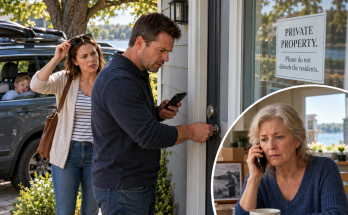
I remembered the old maple tree, the driveway, and the front door Patrick had tried to open with his key.
I remembered the notice on the window.
I knew that the scene had changed something between us.
But I also knew that the change had not begun when Patrick discovered the locked door.
It had begun long before that.
It had begun each time I swallowed a complaint because I didn't want to upset anyone.
It had begun each time I agreed to something I didn't want simply because refusing seemed too difficult.
It had begun when I started believing that being a good mother meant making my own wishes smaller.
I had told myself that I was keeping the family together.
Sometimes I had been.
Other times, I had simply been keeping everyone comfortable at my expense.
That was a painful distinction to accept.
I didn't want to see myself as a victim of my own family.
Patrick had not made every choice for me.
I had made choices, too.
I had chosen silence when I should have spoken.
I had chosen compromise when I needed a boundary.
I had chosen to hope that people would notice my unhappiness rather than telling them plainly that something had to change.
I couldn't undo those decisions.
I could only stop repeating them.
That afternoon, I waited for Patrick's call.
When it came, I answered.
Neither of us spoke immediately.
Then he asked how I was doing.
It was a small question.
Perhaps he had asked it before and I hadn't noticed.
Perhaps he had never understood how much it mattered.
"I'm doing all right," I told him.
I looked around the apartment.
The boxes were nearly gone.
George's photograph stood beside the window.
My coffee cup was on the table, and the afternoon light had begun to move across the floor.
For the first time in a long while, I wasn't waiting for someone else to decide whether my day had gone well.
"I'm getting settled."
Patrick made a quiet sound of acknowledgment.
Then he said that the situation at the house had been difficult.
I listened.
I didn't interrupt him or tell him that he had brought the difficulty on himself.
I knew he had been caught off guard.
I knew that arriving with the children and discovering that he couldn't enter the house had been upsetting.
I could understand those feelings without agreeing that I had done something wrong.
When he finished, I told him that I understood why he had been surprised.
Then I explained that I needed my decisions to be respected, even when he disagreed with them.
I didn't turn the conversation into a list of old grievances.
I didn't ask him to admit that every memory I carried was correct.
I simply told him what I needed going forward.
I wanted our relationship to be based on respect rather than assumption.
I wanted family visits to be discussed rather than treated as automatic.
I wanted to be able to make decisions about my own life without feeling that I had betrayed someone.
Patrick was quiet for a while.
I couldn't tell how much he accepted.
I couldn't tell whether he was beginning to understand or merely waiting for the conversation to end.
For years, I would have tried to read every pause and every change in his voice.
I would have searched for reassurance.
This time, I let him have his silence.
We didn't resolve everything in that one conversation.
I hadn't expected us to.
Years of habit couldn't disappear because I had finally found the courage to say what I meant.
There would be other difficult conversations.
There might be days when Patrick became frustrated again.
There might be moments when I questioned whether I had been too firm.
I knew myself well enough to expect those doubts.
But I also knew that returning to the old arrangement would not make those doubts disappear.
It would only make me smaller again.
When the call ended, I sat quietly for a few minutes.
I felt sad.
I missed the ease of the life I had once imagined we shared.
I missed the familiar rooms and the feeling that everyone knew where they belonged.
But I didn't miss the constant fear of disappointing someone.
That fear had taken more from me than I had wanted to admit.
I stood and walked to the window.
The lake was visible between the buildings, its surface catching the last of the afternoon light.
I thought about the old house beneath the maple tree.
I thought about Patrick standing outside with his key.
I thought about the person I had been before I made the decision to change my life.
I wished I had learned these lessons earlier.
I wished I had understood that love did not require me to surrender every preference, every boundary, and every quiet hope of my own.
But wishing couldn't change the years behind me.
What mattered was what I did with the years ahead.
I turned away from the window and began preparing dinner.
There was no grand celebration.
No sudden feeling that every problem had been solved.
Just a small apartment, a quiet kitchen, and a life I was finally learning how to arrange for myself.
Patrick still had his memories of the house.
I still had mine.
The key he carried could no longer give him the access he expected, and the notice on the window had made that clear.
But the deeper change had nothing to do with the lock.
It was about the limits I had finally allowed myself to set.
I couldn't decide how Patrick would respond to those limits.
I couldn't make him understand everything I had felt.
And I couldn't guarantee that our relationship would become easier.
I could only stop pretending that love meant giving him whatever he wanted.
For years, I had thought the cost of saying no would be losing my family.
Now I understood that saying yes to everything had been costing me something, too.
My peace.
My confidence.
My sense that my own life belonged to me.
I wasn't sure what the future would bring.
But I knew I didn't want to keep paying that price.
And for the first time, that was enough.
The End
Read more original stories on Feel Every Story.
The Key That Had Opened My Home for Years Suddenly Meant Nothing, and I Finally Understood What My Silence Had Cost Me
Part 4 of 4