
I did not answer Trevor that afternoon.
I told myself I would call him the next morning, after I had reviewed the property records and spoken to Brenda.
It was a sensible plan.
It was also a way of postponing a conversation I had been avoiding for years.
The following morning, I arrived at the office with the notebook in my handbag.
Brenda was waiting beside my desk.
"The box is still secure," she said.
I put my handbag down.
"Did you verify the registration?"
"Yes."
"And the inventory?"
"Yes."
"Nothing has been removed?"
"Nothing."
I nodded.
For a moment, I thought I might finally feel better.
I didn't.
The documents had remained where we had placed them.
The county had received its money.
The property was still standing in the records under the same parcel number.
Those facts should have been enough to settle my mind.
They weren't.
Because the real problem had never been the box itself.
It was the promise attached to it.
I had made that promise believing that silence would prevent harm.
I had believed that if I kept the papers safe, I could keep the family safe, too.
But the years had passed, and the silence had become a habit.
I had learned to protect the secret without examining the reasons for it.
I had learned to pay the bills without asking why the bills kept coming.
And I had learned to treat Trevor's demands as emergencies because it was easier than asking him to explain himself.
I sat down and opened the property file.
The old photograph was still there.
My husband stood in the muddy field, holding the survey level, looking toward a future he had not yet built.
I touched the edge of the picture.
He had trusted me to keep certain things safe.
I had done that.
What I could no longer claim was that I had always understood what keeping them safe meant.
Brenda stood across from my desk.
"Would you like me to arrange a time for you to speak with Trevor?"
"No."
She waited.
"I'll call him myself."
I picked up the telephone.
His number was still stored in the same place it had been for years.
I pressed the button and listened to the ringing.
He answered quickly.
"Mom."
"Trevor."
"I've been trying to reach you."
"I saw your message."
There was a pause.
"Did you get the address?"
I looked at the deed lying open before me.
"Which address?"
"The one I asked Brenda about."
"You could have asked me directly."
"I did ask you."
"No, you asked Brenda."
He exhaled.
"All right. I'm asking you now."
I let the silence sit between us.
For once, I did not rush to make the conversation easier for him.
"What do you need the address for?" I asked.
"I need to check something."
"What?"
"Something about the property."
"That doesn't tell me much."
He was quiet.
I could picture him standing wherever he was, one hand on his hip, his jaw tightening as he tried to decide whether I was being difficult.
It was a familiar picture.
I had seen it since he was young.
"Why are you making this complicated?" he asked.
I closed my eyes briefly.
There it was again.
The suggestion that my questions were the problem.
"I am asking you what you need."
"I told you. I need to check something."
"And I am asking what."
He did not answer immediately.
For years, I would have filled that silence.
I would have offered possible solutions, reassured him that I was trying to help, and eventually given him whatever he wanted.
This time, I waited.
When he spoke again, his voice was flatter.
"I thought you'd want to help."
"I do want to help you."
"Then give me the address."
"I will consider what you need once you explain why you need it."
He let out a short, frustrated breath.
"You've changed."
Perhaps I had.
Or perhaps I had simply stopped pretending that saying yes was the only way to prove I loved him.
"I hope so," I said.
He went quiet.
I could hear a faint sound in the background, but I could not tell where he was.
After a moment, he said he would call again.
I told him that was fine.
Then we ended the conversation.
I sat with the telephone in my hand for several seconds.
It had not been a dramatic exchange.
No shouting.
No threats.
No great revelation.
Just a mother asking her son a question and refusing to accept an answer that contained no information.
Yet I felt as though I had crossed a line I could not easily step back over.
Brenda appeared at the doorway.
"Everything all right?"
"I don't know yet."
She nodded.
I put the telephone down and turned to the file.
The deed address remained where it had always been.
I had not hidden it from Trevor.
I had simply refused to hand it over without understanding what he intended to do with it.
That distinction mattered to me.
It should have mattered sooner.
For the rest of the morning, I worked through the ordinary demands of the office.
I signed invoices.
I returned calls.
I reviewed a contract that needed correcting.
The routine helped, but it did not erase the uneasiness I carried.
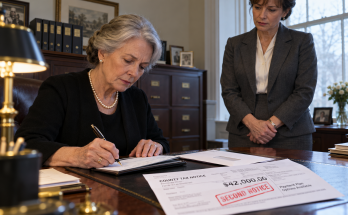
At lunchtime, I took the county receipt from the drawer and placed it beside the old photograph.
Forty-two thousand dollars.
A payment made from my own account.
A piece of land my husband had refused to abandon.
A son who had begun asking questions about its deed.
And a bank box holding papers I had promised to preserve.
The facts sat together on the desk.
They did not explain themselves.
I understood then that I had been treating each problem as if it could be solved separately.
The payment could be made.
The records could be checked.
The box could remain secure.
Trevor could be told no.
But none of those actions could tell me whether the promise I had made in 1998 was still the right promise to keep.
I had no new evidence to settle that question.
I had no confession from my husband.
I had no explanation from Trevor.
And I would not invent one simply because uncertainty had become uncomfortable.
That afternoon, I put the receipt back in its folder.
I returned the photograph to its envelope.
Then I closed the property file and placed it in the cabinet.
I did not destroy anything.
I did not move the papers from the bank box.
I did not make another payment.
For the first time in a long while, I allowed a problem to remain unresolved without trying to purchase a little peace.
It was not courage in any grand sense.
It was a small decision.
But it was mine.
Before leaving the office, I spoke to Brenda once more.
"Keep the records exactly as they are."
She nodded.
"And if Trevor asks again?"
"Tell him he needs to speak with me."
She studied my face.
"Do you think he'll understand?"
"I don't know."
That answer frightened me more than I wanted to admit.
I had spent years believing that a mother's job was to anticipate the trouble her children might encounter and quietly remove whatever obstacles she could.
I had thought love meant making sure they never had to face the full weight of their mistakes.
Now I could see what that belief had cost me.
It had cost me honesty.
It had cost me peace.
And it had made it harder for my son to understand that help was not the same as surrender.
I turned off the office light.
The next time Trevor called, I would listen.
I would ask what he wanted.
I would tell him what I knew and what I did not know.
I would not promise answers I could not give.
I would not pay another bill merely to keep him from being angry with me.
And I would not pretend that the papers in the bank box were harmless simply because they had remained untouched for so long.
The property still existed.
The payment had been made.
The records had not changed.
The box remained secure.
Beyond those facts, there were questions I could no longer answer with a check or a closed door.
I went home that evening and left my handbag on the hall table.
Then I stood in the kitchen for a moment, listening to the refrigerator hum.
My husband was gone.
My son was grown.
And I was still trying to decide what it meant to protect a family without protecting every mistake it made.
I had no neat conclusion.
No comforting explanation.
Only the knowledge that silence had not settled anything.
It had merely allowed the years to pass.
This time, I would let the questions remain where I could see them.
And when Trevor was ready to speak honestly, I would be ready to listen.
The End
Read more original stories on Feel Every Story.
The Forty-Two-Thousand-Dollar Notice That Forced Me to Choose Between Protecting My Son and Protecting the Truth
Part 4 of 4

One Comment on “PART 4 – The Promise I Had Mistaken for Protection and the Quiet Price of Keeping My Family’s Most Difficult Questions Unanswered”