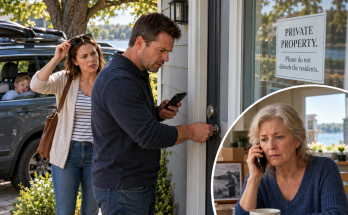
"Mom, we need to talk."
Patrick sounded different now.
The anger was still there, but something else had entered his voice.
I couldn't tell whether it was embarrassment, worry, or the realization that the situation wasn't going to resolve itself simply because he demanded an explanation.
I sat down at the counter.
"All right."
He waited, perhaps expecting me to fill the silence.
When I didn't, he continued.
"I read the sign."
I looked at the empty cup beside me.
"And?"
He let out a breath.
"It says the property is private."
"That's right."
"But this is still the house."
I understood what he meant.
He was referring to the place where he had grown up, the house where he had spent years coming and going without having to think about whether he was welcome.
In his mind, the familiar surroundings carried a kind of permanent permission.
The driveway was his usual parking place.
The entrance was the door he had opened countless times.
The key was the one he had carried without ever wondering whether it might stop working.
I could understand the comfort of those familiar things.
What I couldn't accept anymore was the assumption behind them.
"Yes," I said. "It's the same house."
"Then why can't we get inside?"
I looked at George's photograph.
There was no easy way to explain years of resentment in a single conversation.
There was no sentence that could turn every old habit into something new.
And I wasn't sure Patrick was ready to hear any explanation that didn't end with me agreeing to restore things exactly as they had been.
"I think you already know that I wanted things to change," I said.
He was quiet.
I could hear a faint noise in the background, perhaps the sound of one of the children moving inside the SUV.
Megan spoke briefly.
Patrick answered her, then returned to the call.
"This is a lot to spring on us."
I closed my eyes.
I had expected that response.
When people grow accustomed to receiving something, they sometimes experience the loss of it as an act of aggression.
They forget how many times they were given the benefit of the doubt.
They forget how often someone else adjusted their plans.
They remember only the moment the arrangement ends.
I had done that myself in other parts of my life.
I knew how easy it was to focus on the inconvenience instead of the reason behind it.
Still, knowing that didn't make the conversation less painful.
"I didn't want to keep living the way I was living," I said.
Patrick sighed.
"We could have talked about it."
"We did talk."
"Not like this."
I understood then that he wasn't talking about the words we had exchanged in the past.
He was talking about the outcome.
He had expected that any discussion would eventually lead to a decision he could accept.
He had expected me to make changes only as long as those changes didn't interfere with his expectations.
I had expected something different.
I had hoped that if I explained how I felt, he would eventually recognize that I was a person with needs of my own.
Neither of us had understood the other.
But only one of us had spent years pretending that misunderstanding didn't matter.
"I know this is difficult," I told him.
He didn't respond.
"I'm not saying that to dismiss what you're feeling. I know you didn't expect this."
"You're making it sound like we did something wrong."
I pressed my lips together.
That was the part I had feared most.
I didn't want to turn our relationship into a list of accusations.
I didn't want to make Patrick feel that every good memory we shared had been false.
But I also couldn't keep protecting him from the truth simply because the truth might hurt.
I had felt overlooked.
I had felt that my wishes mattered only when they matched someone else's plans.
I had felt that the house I worked so hard to maintain had slowly become a place where I was expected to accommodate everyone but myself.
Those feelings had not appeared overnight.
They had accumulated quietly, one small disappointment at a time.
And by the time I finally admitted how unhappy I was, I had already spent too long pretending everything was fine.
"I am not asking you to agree with every choice I've made," I said.
"Then what are you asking?"
I looked toward the window again.
The lake was darker now.
The narrow strip of water had turned gray as evening settled over the buildings.
"I'm asking you to accept that I can make choices about my own life."
He didn't speak.
For the first time since the call began, I didn't feel the need to keep talking.
I had said what I needed to say.
I could hear him breathing, and I imagined him looking at the house while he tried to decide what to say next.
I wondered whether he was thinking about the years he had spent there.
I wondered whether he remembered the ordinary evenings, the family meals, and the times he had walked through the front door without knocking.
I remembered them, too.
Those memories were part of my life.
I wasn't trying to erase them.
I simply couldn't let them become a reason to remain unhappy forever.
Finally, Patrick spoke.
"So what are we supposed to do now?"
It was the first question he had asked that sounded as though he was thinking about the situation rather than trying to undo it.
I took a slow breath.
"You'll have to make other arrangements for today."
He was silent.
I knew that wasn't what he wanted to hear.
I knew he had expected the conversation to end with a solution that restored the old arrangement.
But I had no intention of offering him a promise I couldn't keep.
"We've got the children with us," he said.
"I know."
"And all our things are in the car."
"I understand."
He sounded frustrated again.
I felt the old instinct rise inside me.
I wanted to tell him that he could come to the apartment, that I would find a way to make room, that I would do whatever was necessary to prevent the day from becoming any more uncomfortable.
But I stopped myself.
I had no reason to believe that offering another immediate solution would change what had brought us here.
It might make the afternoon easier.
It would not solve the problem between us.
"I hope you find somewhere comfortable to stay," I said.
Patrick didn't answer.
Then he asked a question that made me sit very still.
"Is this really how things are going to be from now on?"
I looked at the photograph beside the window.
George's smile seemed almost painfully familiar.
I thought about how many times I had told myself that things would improve once everyone understood how much I was doing for them.
I had waited for recognition.
I had waited for gratitude.
I had waited for someone to notice that I was tired.
I had waited so long that I had begun to treat waiting as a permanent part of loving my family.
"No," I said quietly. "I hope things will be better than they were."
He said nothing.
"But they can't get better if we keep pretending nothing needs to change."
The words settled between us.
I didn't know whether he understood them.
I didn't know whether he would remember them tomorrow.
All I knew was that I could no longer take responsibility for making every difficult moment disappear.
Patrick eventually ended the call.
I remained at the counter for a while.
The apartment was quiet.
The boxes were still there, though fewer of them remained unopened.
George's photograph stood beside the window, facing the water.
I picked it up and considered hanging it on the wall.
Then I decided to leave it where it was.
Some things didn't need to be settled immediately.
I was learning that I didn't either.
Click here to continue reading: PART 4: I Had Spent Years Protecting Everyone From Disappointment, and Now I Had to Discover Whether My Family Could Love Me Without That Sacrifice
The Key That Had Opened My Home for Years Suddenly Meant Nothing, and I Finally Understood What My Silence Had Cost Me
Part 3 of 4