The corrected record arrived on an ordinary Tuesday.
No courtroom.
No family meeting.
No dramatic knock at the door.
Just an email from Daniel with an attachment and one sentence.
This is the cleanest version we’ve been waiting for.
I opened it at my desk.
The fraudulent Calder materials connected to my identity had been formally addressed through the applicable processes.
Disputed obligations were documented.
Relevant records no longer treated me as an undisputed participant in Shane’s LLC or mortgage arrangement.
Not every system updated at once.
Not every legal question everywhere vanished.
But the foundation was there.
My name was no longer being casually carried forward as if Shane’s false documents spoke for me.
I stared at the screen.
Then I cried.
Quietly.
Jenna glanced over the divider.
“Bad?”
“No.”
“Good?”
“Yes.”
She rolled her chair back.
“Then why are you crying?”
“I’ve had a complicated year.”
“That is the most understated thing you’ve ever said.”
I laughed through the tears.
Daniel called later.
“We still keep records.”
“Of course.”
“We still monitor credit.”
“Yes.”
“Nothing about this means every downstream database has magically corrected itself.”
“I know.”
“But?”
“But this matters.”
“It does.”
I printed the document.
Not because paper was magically safer.
Because I wanted something physical.
Nine years earlier, I had signed documents I did not understand because I was tired and afraid and trusted my parents.
Months earlier, Shane had created documents I never signed because he believed paper could manufacture consent.
Now I held a document that did the opposite.
It reflected reality.
My name meant me again.
That evening Emily was at the kitchen table working on an essay.
“What’s that?”
I placed the document beside her laptop.
“Something good.”
She read the first page.
“I don’t understand any of this.”
“Basically, the Calder mess connected to my identity is being corrected.”
Her eyes widened.
“So Uncle Shane’s fake company isn’t yours anymore?”
“It never was mine.”
“You know what I mean.”
“Yes.”
She smiled.
“That’s good.”
“Very.”
Then she returned to her essay.
I stood there.
“That’s all?”
“What do you want, balloons?”
“Maybe.”
“We can get balloons.”
“No.”
“Cake?”
“Possibly.”
She grinned.
Normal.
The biggest legal relief of my life and my daughter wanted to finish homework.
Perfect.
Patricia came over later with takeout.
I had not told her why.
When I showed her the document, she read more carefully than Emily.
“I’m glad.”
“Me too.”
“Howard would—”
She stopped herself.
Then smiled.
“I’m glad.”
That was better.
We ate dinner together.
No one mentioned Shane until Emily went upstairs.
Then Patricia asked, “Did you ever answer his letter?”
“No.”
“Will you?”
“I don’t know.”
“He asked me if you had.”
“How?”
“Last visit.”
“What did you say?”
“That it wasn’t my business.”
I looked at her.
She smiled faintly.
“Progress.”
“Yes.”
I still had the letter.
Sometimes I reread it.
Not because I needed an apology.
Because it reminded me that Shane now understood at least one thing he had refused to understand before.
You can’t borrow what nobody agreed to lend.
Whether that understanding lasted was his responsibility.
Not mine.
Misty and the children came for dinner two Sundays later.
Garrett brought a soccer ball and nearly knocked over one of my porch planters.
Noah spilled juice.
Lily asked Emily for help with makeup.
The house was noisy.
Good noisy.
Misty stood beside me at the sink while we cleaned plates.
“Remember when we were all supposed to move in here?”
“I try not to.”
“I was awful to you.”
“You were operating on lies.”
“I also didn’t ask enough questions.”
“That too.”
She dried a plate.
“Thank you for not pretending I did nothing wrong.”
“I don’t think pretending helps us anymore.”
She smiled.
“Definitely not.”
Patricia sat outside watching the children.
Her own apartment had become truly hers.
Pictures on the wall.
Books she chose.
A plant she kept overwatering.
She still visited Shane.
Less often now.
She no longer returned wrecked every time.
She had learned how to leave his problems in the visiting room.
At least most of them.
Linda sometimes joined dinner.
Sometimes nobody invited her.
She survived.
Natalie’s case and Harbor Crest’s internal consequences moved on tracks I did not control.
Rick pursued his legitimate claims.
Denise dealt with hers.
Aaron stayed out of most of it.
Serena eventually closed her main forensic engagement with us and sent a final binder.
It was enormous.
I laughed when Daniel handed it over.
“Dad would have loved this.”
“Your father seems to have been a document person.”
“He was.”
I carried the binder home and placed it in the hall closet.
Not hidden.
Not sacred.
Available.
Then I created a smaller folder for Emily.
She stood beside me while I labeled it.
HOUSE.
“You’re giving me homework?”
“I’m giving you copies.”
“Of what?”
“The deed. Ownership documents. The occupancy agreement. The updated planning information.”
She stared.
“I’m sixteen.”
“That’s why I’m explaining it instead of asking you to manage it.”
“Can I just trust you?”
The question stopped me.
“Yes.”
She smiled.
“Great.”
Then I added, “But I still want you to know.”
Her smile faded.
“Why?”
“Because trust should survive information.”
She looked at the folder.
That was the lesson Dad had almost learned too late.
Secrets did not strengthen protection.
They made protection dependent on the right person always remaining alive, competent, honest, and in control.
I wanted Emily to understand enough that nobody could build a false story around her own property again.
So we went through it.
Slowly.
She complained.
Asked questions.
Got bored.
Checked her phone twice.
Then, unexpectedly, she asked, “What happens if I want to sell my part when I’m older?”
I felt the old instinct rise.
No.
Protect the house.
Keep it forever.
Dad wanted—
I stopped.
“That would be a serious decision.”
“Could I?”
“You would have whatever rights the law and ownership structure give you then.”
“Would you be mad?”
“Probably.”
She laughed.
“But?”
“But it would be your decision to discuss honestly.”
That was the point.
Dad had not saved the house so I could become the next person who confused protection with control.
Months later, on Emily’s seventeenth birthday, Patricia gave her a small envelope.
Not cash.
A statement from the restored education account showing her own latest restitution payment.
Emily looked at it.
“Grandma.”
“I know it’s not a fun gift.”
“It’s weird.”
Patricia smiled.
“I’m trying to be accurate.”
Emily hugged her.
Not because the balance erased anything.
Because Patricia was still showing up.
Repair was repetitive.
That made it believable.
The recovered assets eventually returned more money than I expected and less than the total losses.
Some funds went to legitimate creditors.
Some to victims.
Some remained tied up.
Some losses were never fully recovered.
That mattered.
Stories often make justice look clean by making every stolen dollar return.
Ours did not.
Emily did not get every dollar back immediately.
Patricia did not recover everything Shane took from her.
Misty absorbed financial damage that legal corrections could not fully erase.
I spent money on attorneys and monitoring I never should have needed.
Dad’s estate had lost funds years earlier that could only be partially traced.
The damage was real.
So was the repair.
We stopped measuring justice by whether the past could be restored perfectly.
It could not.
We measured it by whether the pattern continued.
It did not.
No one took money from Emily’s account without authority.
No one used my name without challenge.
No one promised the house to another person privately.
No one handed Shane blank checks.
No one hid a loan because family peace seemed more important than facts.
No one told a child she needed less because another child had more problems.
That was the recovery I trusted.
The following spring, I received one more letter from Shane.
I opened it the same day.
Shorter this time.
He wrote that he was working through treatment for gambling behavior and financial compulsions.
He did not ask me to believe him.
He did not ask for money.
He did not ask for access to Emily.
He ended with:
I understand if the best thing I can give you is distance.
I folded the letter.
For now, he was right.
Distance was not punishment.
It was structure.
Maybe one day the structure would change.
Maybe not.
I no longer treated uncertainty as a problem requiring immediate resolution.
Emily would decide her own relationship with him when she was older, with full information and whatever boundaries she needed.
Misty would decide hers.
Patricia hers.
Me mine.
One family.
Different choices.
No vote.
No majority rule.
No one person’s fear controlling everyone else.
On the anniversary of Dad’s death, Patricia asked whether we could visit the cemetery together.
Emily came too.
We brought no dramatic speech.
Patricia cleaned dirt from the edge of the marker.
Emily placed a small bunch of flowers.
I stood looking at Dad’s name.
For months I had treated him as the smartest person in the story.
He had seen Shane’s pattern.
Protected the deed.
Saved documents.
Created Emily’s education money.
Left warnings.
But Dad had made mistakes too.
He had kept too much secret.
He had tried to manage risk privately.
He had believed documents could substitute for hard conversations.
I understood why.
I also understood the cost.
“Grandpa tried,” Emily said.
I looked at her.
“What?”
“To protect everybody.”
“Yeah.”
“Did he?”
I thought.
“Partly.”
She nodded as if that made sense.
Patricia placed her hand against the stone.
“I wish he had told me more.”
I looked at her.
“Would you have listened?”
She gave a sad smile.
“Maybe not.”
That was honest.
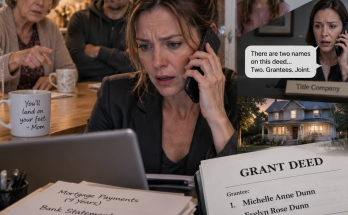
On the drive home, we passed the title company where Rebecca worked.
Emily noticed.
“That’s the place?”
“Yes.”
“Where they found our names?”
“They didn’t create them. They showed me what had been there all along.”
She looked out the window.
“That’s kind of weird.”
“How?”
“You thought Grandma owned everything because everybody acted like she did.”
“Yes.”
“But the paper said something different for nine years.”
“Yes.”
“So the truth was there before anybody believed it.”
I smiled.
“Sometimes.”
She became quiet.
Then she said, “That sounds like another Grandpa note.”
“Please stop.”
She laughed.
When we reached home, Emily went inside.
Patricia remained beside the car.
“I never thanked you.”
“For what?”
“Not making me leave.”
I looked at her.
“You did leave.”
“You know what I mean.”
I did.
“You were an owner too. It wasn’t as simple as me deciding.”
“You could have made it ugly.”
“So could you.”
She nodded.
“I did first.”
“Yes.”
Her eyes filled.
“I’m sorry.”
She had said those words before.
This time they did not need anything from me.
“I know.”
That was enough.
She hugged me.
Then drove home to her apartment.
I went inside.
The kitchen looked almost exactly as it had the night this began.
Same cabinets.
Same sink.
Same oven.
Different light fixture only because the old one finally burned out.
I replaced it myself.
Emily sat at the table filling out a summer-program application.
“What are you applying for?”
“College writing workshop.”
“Cost?”
She told me.
I did not think of Shane.
I did not calculate how many family emergencies that amount might solve.
I did not shrink her request before understanding it.
“Send me the information.”
She looked suspicious.
“That easy?”
“We’ll see if it makes sense.”
“Normal parent answer.”
“I’m trying.”
She smiled and returned to the form.
I stood at the sink and looked through the window at the yard.
The house had never been what I thought.
First I believed it was my mother’s generosity.
Then I believed it was evidence of Dad protecting me.
Then I believed it was something Shane had nearly stolen.
All of those were partly true.
None was complete.
A house is walls.
Debt.
Paper.
Maintenance.
Memory.
Legal rights.
It can be security.
It can be leverage.
It can become a weapon if people confuse access with entitlement.
Dad had not truly left me a house.
He had tried to leave me something harder.
A protected choice.
He wanted me and Emily to be able to say yes without pressure.
No without punishment.
Help without surrender.
Love without financial obedience.
Stay without owing gratitude forever.
Leave without being cast out.
That was what the deed had protected when everything else failed.
Choice.
Months earlier, my mother had stood in this same kitchen and said four words.
This is my house.
Those words had started the unraveling.
Now I understood the answer I should have had then.
Not mine.
Not yours.
Ours, according to the truth written down long before any of us were ready to respect it.
And because it was ours, nobody got to decide alone.
Emily called from the table.
“Mom?”
“Yeah?”
“Do you think I should write about Grandpa for the application essay?”
I dried my hands.
“What do you want to write?”
“That he taught me something.”
“What?”
She thought for a moment.
Then she said, “That protecting someone isn’t the same as choosing for them.”
I looked at her.
“That sounds worth writing.”
She smiled.
Outside, evening settled over the yard Dad had once stood in, arguing with Shane about money none of us understood.
Inside, my daughter began typing.
And this time, the future she was writing belonged to her.
The End
Read more original stories on Feel Every Story.
My Mother Gave Me Twenty-Three Days to Leave the Home I Had Spent Nine Years Quietly Paying For
Part 24 of 24