
The house meeting happened six weeks after Patricia told me to leave.
This one looked nothing like the first.
No pastor.
No church friends.
No Shane.
No audience assembled to pressure anyone into behaving.
Just the people whose rights actually mattered.
Me.
Patricia.
Emily.
Daniel.
And a property attorney Daniel had brought in named Grace Liu.
Emily sat beside me at the dining-room table.
She had asked to be present.
“She owns an interest,” Grace said when Patricia wondered whether sixteen was too young.
“So she deserves to understand what adults are doing around it.”
I liked Grace immediately.
She began by separating three issues everyone in my family had spent years mixing together.
Ownership.
Occupancy.
Expenses.
“The fact that someone lives here does not automatically create or erase ownership,” she said.
“The fact that someone contributes to expenses does not automatically create whatever ownership share that person imagines. And family expectations are not substitutes for recorded documents.”
Patricia looked down.
Emily remained very still.
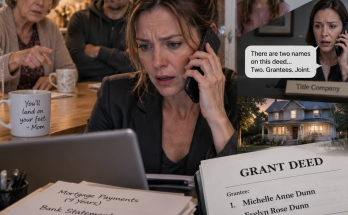
Grace reviewed the deed and related records.
She did not simplify percentages until she was satisfied the original conveyance language and later filings had been properly interpreted.
When she finished, she explained each person’s recorded interest and the limitations surrounding Emily’s because she had been a minor when the arrangement was created.
I listened carefully.
Not because I doubted we owned part of the house anymore.
Because I had spent nine years living under an assumption.
I would not replace that assumption with another.
Then Grace discussed the mortgage.
Patricia remained the borrower associated with the existing loan.
I had made nearly all payments.
Those facts both mattered.
Neither alone answered every future question.
“So who gets to stay?” Emily asked.
Grace smiled slightly.
“That is not something the deed decides by itself.”
Emily frowned.
“Then what does?”
“You do. Through agreement.”
That was the part Patricia and I had avoided.
Agreement required saying things directly.
No hidden assumptions.
No family hierarchy.
No emotional accounting.
Grace placed a blank occupancy agreement on the table.
“This is optional. But given what has happened, clarity would be useful.”
Patricia looked at me.
“You want me to sign something to live here?”
I waited for defensiveness.
It did not come.
“I think we all need clarity.”
She nodded.
“Okay.”
The agreement was simple.
Patricia could remain in the home.
She would have exclusive use of her current bedroom.
She would contribute a defined amount toward utilities and ordinary household costs.
She would not mortgage, pledge, transfer, promise, or represent any property interest beyond whatever rights she legally possessed.
No guest could establish residence without written agreement from the other owners or guardians as legally required.
No Shane.
That clause did not use his name.
It did not need to.
Patricia read it slowly.
Then signed.
I signed.
Emily’s interest was handled through the appropriate legal mechanism rather than pretending a sixteen-year-old could simply sign every adult contract.
Grace explained each step to her.
Emily asked more questions than Patricia did.
“What if Grandma gets mad and wants to sell?”
“She can seek whatever rights the law gives her,” Grace said. “But she cannot pretend Michelle and you do not exist.”
Emily nodded.
“What if Mom gets mad and wants Grandma out?”
Grace looked at me before answering.
“Then there would be procedures and agreements to consider. Ownership does not make anyone all-powerful.”
Good.
I wanted Emily to hear that too.
This was not about replacing Patricia’s unchecked authority with mine.
The point was not winning control.
It was ending unilateral decisions.
We also documented household contributions going forward.
Not because every grocery purchase needed litigation.
Because vague arrangements had allowed stories to change.
Patricia would pay a set monthly amount.
I would continue handling the mortgage pending longer-term financial planning.
Repairs above a certain threshold would be discussed.
Insurance records would be shared.
Statements would go to more than one person.
No single account holder would become the family’s only source of truth.
Patricia sighed when Grace finished.
“This feels very formal.”
“It is,” I said.
She looked at me.
“You don’t trust me.”
“Not with informal arrangements involving the house.”
That was painful to say.
Also true.
She nodded.
“I understand.”
Emily asked, “Do you trust Grandma at all?”
I looked at my daughter.
“Yes.”
Patricia’s eyes filled.
“But not in the same way.”
That mattered too.
Trust was not a light switch.
It could be specific.
I trusted Patricia to love Emily.
I did not trust her to manage Emily’s money without oversight.
I trusted her to tell me if Shane contacted her now.
I did not trust old family assumptions to stay dead without written boundaries.
I trusted her enough to let trust rebuild.
Not enough to pretend it already had.
After the property meeting came the restitution meeting.
Serena presented a cleaner accounting of Emily’s lost education funds.
Some had been withdrawn through forged acknowledgments.
Some had been moved by Patricia knowingly but for purposes that did not benefit Emily.
Some were linked directly to Shane’s businesses.
The question was not whether Emily had lost money.
The question was how responsibility would be allocated.
Patricia had liquid assets available.
Not enough to replace everything comfortably.
Enough to make a meaningful payment.
Emily insisted on attending part of that meeting too.
“I don’t want Grandma to sell everything.”
Serena said, “Your preference matters, but this is also an adult legal and financial issue.”
“I know.”
Emily looked at Patricia.
“I want the money put back over time.”
My mother’s mouth trembled.
“How much time?”
Emily glanced at me.
“I don’t know.”
I said, “That is what advisers are for.”
For once, nobody invented a number emotionally.
Serena developed a repayment plan using Patricia’s separate investment funds and monthly transfers that would not leave her destitute.
The first substantial payment went into a new education account.
Not controlled by Patricia.
Not controlled by Shane.
Structured with proper safeguards.
Emily could see statements.
So could I.
No one person could quietly redirect large withdrawals.
When the first deposit posted, Patricia showed me her phone.
“I know it doesn’t fix it.”
“No.”
“I still wanted you to see.”
I looked at the number.
It was not symbolic.
It was real money returned.
“That matters.”
She nodded.
That was enough.
Shane’s portion was handled differently.
Recovered assets and legal claims moved slowly.
The digital funds were subject to disputes.
The cash remained evidence.
Business assets had creditors.
Calder had a lender.
There would be no simple moment where someone handed Emily a check labeled justice.
Real financial repair was uglier.
Claims.
Priorities.
Documentation.
Negotiation.
Waiting.
But it had started.
Misty’s life was also changing.
She rented a townhouse near her sister.
Not glamorous.
Three bedrooms.
A small fenced yard.
Garrett hated it for two days and then discovered a boy his age next door.
Noah liked sleeping on the lower bunk.
Lily asked for a purple wall and was told the landlord would not approve it.
Ordinary problems.
Misty invited me over one Saturday.
Boxes were still stacked beside the dining table.
She poured coffee into mismatched mugs.
“I found another account.”
My stomach tightened automatically.
She smiled tiredly.
“Not fraud.”
I exhaled.
“Thank you for leading with that.”
“It’s a savings account I opened years ago.”
“You forgot?”
“Apparently.”
“How much?”
“Eleven hundred dollars.”
I laughed.
She did too.
It felt strange.
Good strange.
Then her face became serious.
“I kept thinking I had nothing.”
“You have more than you thought.”
“I mean before all this.”
She looked around the townhouse.
“I thought if Shane failed, we all failed.”
“That sounds familiar.”
“He made the family feel like one organism.”
“One crisis, everyone responds.”
“Yes.”
She rubbed both hands around the mug.
“I don’t know who I am financially without him.”
“You will.”
“How?”
“One boring decision at a time.”
She smiled.
“That sounds like you.”
“It’s becoming a compliment.”
Misty’s attorney handled the separation.
She did not ask me whether she should reconcile.
I did not tell her.
That choice belonged to her.
She did ask whether I thought Shane loved the children.
“Yes.”
She looked surprised.
“You do?”
“Yes.”
“After everything?”
“Loving someone and being safe with their money are not the same thing.”
Misty stared at her coffee.
“That’s the whole family, isn’t it?”
Pretty much.
Shane’s access to the children would be determined through proper channels and whatever agreements or orders applied.
I did not interfere.
Not because I did not care.
Because boundaries went both directions.
I would not complain that Shane ignored other people’s authority and then pretend I possessed everyone else’s.
At work, I finally told Jenna a simplified version.
“My brother used my identity in some financial transactions.”
Her mouth opened.
“That sounds like more than a family problem.”
“It became one.”
“Are you okay?”
I thought before answering.
“Yes.”
Not because everything was fixed.
Because I finally understood what okay meant.
I was functioning.
Emily was safe.
The house was secure.
Fraud was documented.
Professionals were handling what belonged to professionals.
I was not carrying everyone alone.
“Yes,” I repeated.
Jenna nodded.
“Good.”
No dramatic speech.
No pity.
I appreciated that.
The months moved.
Summer began.
The county sent notices connected to the Calder dispute.
The fraudulent LLC membership attached to my name was formally challenged.
The lender’s insurer became involved.
Harbor Crest faced its own internal and legal consequences, which were not mine to manage.
Natalie continued cooperating through counsel.
Rick’s company separated Shane’s legitimate obligations from disputed family guarantees as best it could while investigations proceeded.
Denise returned some digital assets through a negotiated process while maintaining that she had not known their original source.
Linda attended therapy.
She told us that at dinner one Sunday.
Patricia almost laughed.
“Therapy?”
Linda glared.
“You should go too.”
Patricia thought.
Then said, “Probably.”
Two weeks later she did.
That surprised me more than most of the financial discoveries.
She did not come home announcing revelations.
She simply kept going.
That seemed healthier.
Emily finished her school year with a B in chemistry.
She was furious.
“I studied.”
“I know.”
“I deserved an A.”
“Maybe.”
She glared.
“You’re supposed to tell me grades don’t define me.”
“Grades don’t define you.”
“Too late. It sounds fake now.”
I laughed.
She did too.
Then she handed me another college brochure.
This one was closer.
“What do you think?”
“I think you have time.”
She nodded.
No panic.
No shrinking.
That was the outcome Dad had tried to buy with every document he filed.
Time.
Choice.
A future not consumed by someone else’s emergency.
One evening Patricia approached me while I was pruning a dead branch from the hedge.
“I found an apartment.”
I lowered the clippers.
“You’re moving?”
“I think so.”
I stared at her.
“Because of me?”
“No.”
“Because you feel guilty?”
“Some.”
“That’s not a good reason.”
“I know.”
She sat on the porch step.
“I think I need to learn whether I can live without being necessary to somebody.”
That sentence sounded like therapy.
I sat beside her.
“When?”
“End of next month.”
“Emily will be upset.”
“I know.”
“So will I.”
Patricia looked at me.
“You said I could stay.”
“You can.”
“I know.”
She smiled sadly.
“That’s why I can leave.”
I understood.
Leaving under threat was exile.
Leaving by choice was something else.
“Where?”
“Five minutes from Linda.”
“Still willing to live near her?”
“We’re sisters.”
I laughed softly.
“Apparently that remains true.”
“The apartment has two bedrooms.”
“For guests?”
“For Emily.”
I looked at her.
“If she wants.”
Good.
Choice again.
“I think she will.”
Patricia nodded.
Then she reached into her pocket and handed me a key.
Her old spare house key.
“I’ll get another when we decide what makes sense.”
“You don’t have to surrender access dramatically.”
“I’m not.”
She looked at the key.
“I’m trying to stop assuming it.”
That was different.
I took it.
The day she moved, Shane’s old bedroom stayed empty.
We did not give it to anyone.
We did not turn it into an office immediately.
We did not erase him.
Patricia’s room remained partly furnished until she decided what she wanted.
Emily stood in the doorway after the movers left.
“The house feels weird.”
“Yeah.”
“Bigger.”
“Yeah.”
“Do you want Grandma gone?”
“No.”
“Then why did you let her move?”
“Because wanting someone near you isn’t the same as needing them to stay.”
Emily considered that.
“That sounds like one of Grandpa’s notes.”
“It might be contagious.”
She smiled.
Then she walked into Patricia’s old room and opened the curtains.
Sunlight filled the space.
For nine years I had thought of that room as my mother’s.
Then as evidence of her control.
Now it was simply a room.
No one was claiming it yet.
I liked that.
Click here to continue reading: PART 23: Months Later the Courts and Account Reviews Returned Some of What Shane Took, but the Harder Question Was What We Would Refuse to Rebuild
My Mother Gave Me Twenty-Three Days to Leave the Home I Had Spent Nine Years Quietly Paying For
Part 22 of 24

One Comment on “PART 22 – We Finally Put Every Ownership Share and Family Debt in Writing, and the House Became Something None of Us Could Use as Leverage Again”