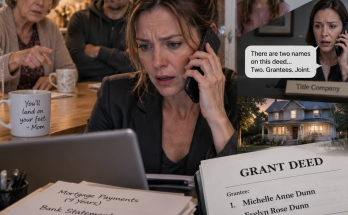
My mother told me to move out while I was rinsing her dinner plate.
There was no argument leading up to it, no slammed cabinet or raised voice. Patricia sat at the kitchen table with both hands around a mug of tea while I stood at the sink, warm water running over my fingers.
“I need you and Emily gone by the first,” she said.
The plate knocked against the stainless-steel basin. I caught it before it slipped from my hand, shut off the faucet, and turned around.
“The first of next month?”
She nodded.
That gave me twenty-three days.
I waited for her to explain. When she did not, I dried my hands on the towel hanging from the oven door.
“Why?”
My mother glanced toward the hallway. Emily was upstairs, supposedly doing algebra, although the faint pulse of music through the ceiling suggested algebra had competition.
“Shane needs the house.”
For several seconds I thought there had to be another sentence coming.
There wasn’t.
“My brother needs this house,” I repeated.
“His lease is almost up. Misty wants somewhere stable for the children. Rent keeps going up, Michelle. You know that.”
I looked around the kitchen. I had painted those cabinets myself. I had bought the refrigerator after the old one died. The light fixture above Patricia’s head had come from a hardware store clearance shelf and taken me three attempts to install because the wiring in the ceiling was older than I was.
Nine years earlier, after my divorce, my parents had offered Emily and me a place here. Emily had been seven. I had arrived exhausted, embarrassed, and grateful for anything that resembled safety.
Since then, I had paid the mortgage.
Every month, $1,412 came from my checking account.
I paid most of the utilities too. When the furnace failed during a freezing January, the repair went on my credit card. When rain began staining the ceiling of the back bedroom, I hired the roofer. When the water heater split and flooded the utility closet, I paid for the replacement before my mother even knew what had happened.
Nobody had ever called those payments rent.
My mother called them helping.
“So where will you live?” I asked.
She frowned. “Here.”
Something shifted inside me.
“You’re staying?”
“Of course.”
I set the towel on the counter. “Then you want Emily and me out so Shane, Misty, their three children, and you can all move into the same house.”
“There’s room.”
“But not for us.”
“Please don’t make this unpleasant.”
“I’m asking you to explain it.”
Patricia rubbed one thumb along the rim of her mug. “You have one child. Shane has three.”
There it was.
The arithmetic my family had been using my entire adult life.
Shane needed more because his problems were bigger. Shane deserved another loan because he had children. Shane missed birthdays because he was overwhelmed. Shane forgot to repay money because finances were hard. Shane could stumble repeatedly and somehow his mistakes became obligations the rest of us were expected to share.
I had been dependable for so long that dependability had stopped being considered an effort.
It had become evidence that I needed less.
“Emily having no siblings doesn’t mean she needs a home less than his children do.”
“That isn’t what I said.”
“It’s what you meant.”
My mother carried her mug to the sink. “Your brother is struggling.”
“And now I am.”
“You have a good job.”
“So does Shane.”
“You manage money better.”
I stared at her.
She apparently did not hear the absurdity.
“So because I pay my bills, I’m easier to displace.”
“Nobody is displacing you.”
“You just gave me twenty-three days to leave.”
“I’m asking you to find somewhere else.”
“That sounds remarkably similar.”
Her shoulders stiffened.
Then she said the sentence that had apparently been waiting beneath the entire conversation.
“This is my house, Michelle.”
I stopped arguing.
The mortgage was in her name. I knew that much.
After my divorce, my credit had been damaged, and my parents had handled most of the purchase paperwork. I had been too busy surviving custody schedules, legal bills, and the collapse of a marriage to examine every document placed in front of me.
But I remembered something else.
Forty-eight thousand dollars.
That was what remained from my divorce settlement after debts and attorney fees. Nearly all of it had gone into this property.
My mother had called the house a fresh start.
My father had called it security.
Neither had ever called my money a gift.
That evening, Emily found me on the edge of my bed with apartment listings glowing on my laptop.
She was sixteen now, tall and sharp-eyed, with the unsettling talent teenagers have for noticing precisely what adults want hidden.
“Why are you looking at apartments?”
I lowered the screen.
“Come here.”
She stayed in the doorway.
“Grandma wants us to move.”
It was not a question.
“Did she tell you?”
“No.”
“Then how do you know?”
“Uncle Shane.”
My stomach tightened.
“When?”
“Sunday.”
That was three days before my mother had spoken to me.
Emily folded her arms. “He asked whether I was excited about having a new bedroom somewhere else.”
“What?”
“I thought he was joking. Then Aunt Misty told him to stop talking about it.”
I closed the laptop.
My brother had not merely known.
He had known long enough to discuss bedrooms.
“What exactly did he say?”
Emily stared at the carpet.
“Emily.”
“He said his kids would finally have enough room once they moved in here.”
A cold pressure settled behind my ribs.
“Anything else?”
She hesitated.
That hesitation hurt more than the answer.
“He said Grandma had carried us long enough.”
For a moment, neither of us moved.
Then Emily looked away, embarrassed as though she had done something wrong by repeating it.
I held out my hand.
She crossed the room and sat beside me.
“Listen. Whatever happens with Grandma or Uncle Shane, you and I will be okay.”
“Are we leaving?”
I wanted to promise we weren’t.
Instead, I told her the truth.
“I don’t know.”
The next morning I checked my checking account before getting dressed for work.
The mortgage payment had cleared three days earlier.
$1,412.
I scrolled backward.
August.
July.
June.
The same withdrawal.
I kept going until my thumb hurt.
Nine years.
One hundred eight payments.
I opened the calculator.
The total was $152,496.
Then there was the $48,000 from the divorce.
More than two hundred thousand dollars before repairs, appliances, insurance contributions, groceries, and utilities.
I sat on the edge of my bed staring at the number.
Twenty-three days.
That was how long I had been given to leave a house into which I had poured more money than I had ever possessed at one time.
At lunch, Shane called.
I almost ignored him.
Then I answered.
“Mom says you’re upset.”
“She told me to move out.”
“She said she needs the house.”
“What difference does that make?”
“You knew living there wasn’t permanent.”
“No, Shane. Apparently you knew. Nobody told me.”
He sighed in the exaggerated way he had since adolescence whenever another person’s feelings inconvenienced him.
“Don’t turn this into some huge drama.”
“When are you moving in?”
“Misty wants to bring some boxes next week.”
I looked out the break-room window.
“I haven’t found an apartment.”
“You make decent money.”
“And I pay the mortgage.”
A pause.
Then he said, “You help Mom with the mortgage.”
“No. I pay it.”
“That was the arrangement.”
“Yes. My arrangement. Not yours.”
“You’ve lived there rent-free for nine years.”
I pulled the phone away from my ear and stared at it before putting it back.
“Who told you that?”
“Everybody knows.”
“Everybody is wrong.”
“You never paid Mom rent.”
“I paid the bank.”
He dismissed that distinction with a noise.
Then something slipped.
“This is exactly why Mom didn’t want to tell you.”
I went still.
“She didn’t want to tell me?”
“You know what I mean.”
“No. Explain it.”
Silence.
That silence answered more than he intended.
This had not been decided yesterday.
“Sunday,” he finally said. “Mom wants everyone together.”
“Everyone?”
“Me, Misty, Aunt Linda. Maybe some people from church. She doesn’t want a fight.”
I almost admired the preparation.
They were arranging an audience before I had even understood the accusation.
“What are we discussing?”
“The house. Money. Your move.”
“What money?”
Another pause.
“Mom thinks you should contribute something before you go.”
I stood up.
“I have contributed more than one hundred fifty thousand dollars in mortgage payments.”
“That doesn’t make the house yours.”
After we hung up, that sentence stayed with me.
That doesn’t make the house yours.
Maybe it didn’t.
But for the first time, I wanted to know exactly what did.
That evening, while Patricia watched television downstairs and Emily studied at a friend’s house, I searched the hall closet for the old mortgage folder.
Behind tax records and appliance manuals, I found it.
I carried everything into my bedroom and locked the door.
Statements. Insurance notices. Repair invoices. Escrow papers. Closing documents covered with signatures I barely remembered making.
Then I found an envelope.
The paper had yellowed slightly.
Across the front, in my father’s handwriting, were my name and one word.
MICHELLE — HOUSE.
Dad had died five years after the purchase.
I sat on the bed before opening it.
Inside were photocopied closing papers and a small handwritten note.
Six words.
Keep copies. Never surrender your interest.
I read it again.
My interest?
I examined the documents more carefully.
My mother’s name appeared.
So did mine.
One sheet carried the name of a title company. Another referenced the Larkin Street property. I could not tell what was a loan disclosure and what was part of the ownership record.
But Dad’s message was impossible to misunderstand.
He believed I possessed something worth protecting.
I photographed every page.
The title company still existed.
At 8:03 the following morning, I called from my desk before most of my coworkers arrived.
After two transfers, a woman named Rebecca Farrow answered.
I gave her the property address and my name.
She typed.
“And this closing was approximately nine years ago?”
“Yes.”
More typing.
Then nothing.
The silence lasted long enough for me to straighten in my chair.
“Ms. Farrow?”
“I’m here.”
“What did you find?”
“Before we continue, I need to verify your identity.”
“Why?”
“I’ll explain afterward.”
She asked several questions.
I answered them.
Then I heard the keyboard again.
“Are you being asked to sign anything concerning this property?”
“No.”
“Has anyone told you there is going to be an ownership transfer?”
My fingers tightened around the phone.
“My brother is moving in.”
“That isn’t exactly what I asked.”
I stood.
“What are you looking at?”
“A transfer application was opened this week.”
The office around me seemed to recede.
“Transfer to whom?”
“I need to review the recorded documents before answering that.”
“My mother told me to leave.”
Rebecca became quiet.
Then her voice changed.
“Do not sign anything.”
“What?”
“Until I contact you again, do not sign a deed, waiver, release, or any other document involving that property.”
My mouth went dry.
“Why?”
“I need to confirm the chain of title.”
The call ended minutes later.
I remained beside my desk holding the note my father had written years earlier.
Keep copies. Never surrender your interest.
For the first time, I wondered whether my mother’s deadline had anything to do with Shane’s lease, his children, or available bedrooms.
And one question, nine years overdue, finally became impossible to ignore.
What exactly had I signed when we bought that house?
Click here to continue reading: PART 2: While My Family Prepared to Call Me a Guest, One Question About My Divorce Money Made My Mother Suddenly Afraid
My Mother Gave Me Twenty-Three Days to Leave the Home I Had Spent Nine Years Quietly Paying For
Part 1 of 24