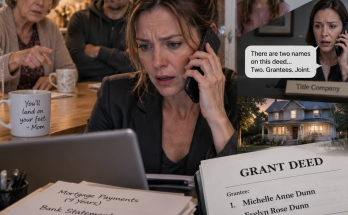
Rebecca Farrow placed the thick file on the kitchen table without opening it.
For several seconds nobody moved.
Shane remained seated across from my mother, one hand pressed flat against the bank statements I had spread in front of him. Misty stood behind his chair with both arms folded. Aunt Linda had gone unusually quiet. The pastor watched everyone with the expression of a man who had expected a family disagreement and discovered he had walked into something closer to a legal proceeding.
Daniel Reeves set his briefcase beside the refrigerator.
My mother wiped her face.
“Michelle,” she whispered, “you didn’t need to bring lawyers into this.”
“I didn’t bring this into the family.”
Her mouth tightened.
Shane pointed at Daniel. “Who exactly is he?”
“My attorney.”
That landed harder than I expected.
My brother leaned back as though physical distance might make the word less serious.
“You hired an attorney against Mom?”
Daniel answered before I could.
“Ms. Dunn retained me regarding questions about ownership of this property and a recently initiated transfer.”
Shane’s face reddened.
“There wasn’t any transfer. It was paperwork.”
Rebecca finally opened her file.
“The paperwork was submitted as a request to transfer title.”
Misty looked down at Shane.
“You told me it was just something your mom had to sign.”
“That’s basically what it was.”
“No,” Rebecca said evenly. “It was not.”
The room went still.
She slid a copy of the application across the table.
I had seen part of it before, but not the entire form.
At the top were Patricia’s name and the property address. Below that, under proposed new owners, were Shane Dunn and Misty Dunn.
The signature line for Patricia was blank.
Another page listed supporting representations.
One statement declared that Patricia Dunn held sole ownership and possessed full authority to convey the property.
Rebecca tapped that sentence with one finger.
“That representation is inconsistent with the recorded deed.”
Shane crossed his arms.
“I filled out what somebody told me to fill out.”
“Who?”
He looked at her.
Rebecca waited.
“So now I’m being interrogated?”
Daniel remained calm. “No. But if this dispute escalates, the origin of that representation will matter.”
My mother closed her eyes.
“Enough.”
Everyone looked at her.
Patricia’s voice was thinner than usual.
“Shane didn’t know everything.”
My brother turned sharply.
“What does that mean?”
“It means I told you the house would eventually be yours.”
“You said Dad wanted that.”
My mother flinched.
I reached into my folder.
The copy of Dad’s letter felt heavier than paper should.
“Dad wrote something about that.”
Patricia opened her eyes.
“Michelle.”
I ignored the warning.
Shane looked at me. “What?”
Rebecca glanced at Daniel, and he gave a small nod.
I set the first page on the table.
Shane stared at it without touching it.
“What is that?”
“A letter Dad left in the title company’s closing file.”
My brother’s expression hardened.
“You expect me to believe Dad wrote some secret letter giving you the house?”
“It doesn’t give me anything. The deed does that.”
He shoved the page toward me.
“Then why do we need some letter?”
“Because Mom told both of us what Dad supposedly wanted.”
Patricia stood so quickly her chair bumped the wall.
“This should not be happening in front of everyone.”
I looked at her.
“You invited everyone.”
Aunt Linda lowered her eyes.
That was the first sign any of Patricia’s chosen audience might understand what had happened.
Shane snatched up Dad’s letter.
At first he read with the impatient scowl of someone looking for a flaw.
Then his expression changed.
His eyes slowed.
He reread one section.
“What does he mean, I ‘treated inheritance as entitlement’?”
Nobody answered.
He looked at Patricia.
“Mom?”
She sat again.
Shane returned to the page.
His jaw tightened as he read the passage in which Dad explained why he had protected my interest and Emily’s. Then he reached the sentence explicitly rejecting any future claim that he had intended the house for Shane.
My brother stopped breathing for a moment.
“That’s not true.”
“It’s his handwriting,” Aunt Linda said quietly.
Shane looked at her.
“You don’t know that.”
“I watched your brother-in-law write Christmas cards for thirty years. I know his handwriting.”
That silenced him.
Misty took the letter.
Her eyes moved quickly.
Then she read more slowly.
“Patricia,” she said, “you told us Howard promised the property to Shane.”
My mother said nothing.
Misty’s face went pale.
“You said it was the one thing he wanted Shane to have.”
“I thought—”
“No.” Misty’s voice sharpened. “You didn’t say you thought. You said he promised.”
Patricia pressed both palms to the table.
“I was trying to keep the family together.”
I almost laughed.
Instead I asked, “By giving my house to Shane?”
“It isn’t only yours.”
“That is true,” Daniel said. “Which is one reason a unilateral transfer presents a problem.”
Shane looked at him. “How much of it is hers?”
Daniel glanced at me before answering.
“The recorded ownership interests require careful reading, especially because Emily was a minor at the time of conveyance. I’m not going to offer percentage conclusions in a kitchen meeting. What I can say is that neither Patricia nor Shane has authority to simply erase Michelle’s recorded interest.”
Shane pointed toward the ceiling.
“And Emily?”
“Her interest is also recorded.”
He stared upward, toward the floor where my daughter was waiting in her bedroom.
For the first time that morning, Shane seemed to understand that this was not merely a fight between him and me.
He had tried to take something from his niece.
“I didn’t know,” he muttered.
That was the most believable thing he had said.
Misty slowly sat beside him.
“You told me we were moving into a house your father left you.”
Shane turned on Patricia.
“That is what you told me.”
My mother began crying again.
But the tears did not soften the room anymore.
Daniel opened his briefcase.
“I’d like to address the immediate issue before this becomes more emotional.”
Shane gave him a bitter look. “Little late.”
Daniel ignored it.
“The title company has halted processing of the transfer request. No ownership change will occur through that application.”
My shoulders loosened.
I had known intellectually that the request was blocked.
Hearing it stated in front of Shane made the reality settle differently.
The house was not disappearing beneath me.
Not this week.
Not because my mother had decided it should.
Misty covered her face with one hand.
“So where are we supposed to live?”
The question was not directed at me, but everyone looked at me anyway.
For nine years I had solved family problems before anyone formally asked.
I had paid bills before Patricia worried about them.
I had loaned Shane money twice and stopped asking when he would repay it.
I had rearranged holidays around his children.
I knew what they expected.
They expected me to feel guilty quickly enough to surrender.
“I don’t know,” I said.
Misty stared at me.
“We already gave notice.”
“That was your decision.”
“Because Patricia told us the house was ours.”
“I didn’t tell you that.”
“You knew Shane was planning to move.”
“Three days before I was told to leave.”
Shane pushed his chair back.
“So you’re just going to let my kids be homeless?”
The pastor shifted uncomfortably.
I looked at my brother.
“Your lease ends in five weeks.”
“How do you know?”
“You told Mom. She told me.”
“We can’t afford the increase.”
“Then you have five weeks to find somewhere you can afford.”
His eyes widened.
“You have one kid and a good salary. You could move anywhere.”
There it was again.
The family arithmetic.
My stability converted automatically into availability.
“Then by your own logic,” I said, “you should have managed this before giving notice.”
His face hardened.
“Dad would be ashamed.”
The room changed.
Even Patricia looked at him.
I felt the old reflex—the one that wanted to defend myself, prove I was reasonable, explain every sacrifice.
Then I remembered Dad’s handwriting.
Do not beg.
Do not surrender under pressure.
I looked at Shane.
“Dad left written instructions because he expected you to say things like that.”
My brother’s face went blank.
The pastor exhaled slowly.
Aunt Linda murmured, “Shane.”
He stood.
“This is insane.”
Misty grabbed his sleeve.
“Sit down.”
“No. I’m not sitting here while everybody pretends Michelle is some victim.”
He pointed toward me.
“She’s been living with Mom for years.”
“I have been supporting this house.”
“So you say.”
“I have bank records.”
“You always keep records.”
“Yes.”
The words came out quietly.
For once, the trait my family mocked as excessive caution was exactly what protected me.
Daniel placed a spreadsheet on the table.
“I reviewed preliminary records Michelle provided. Mortgage transfers trace consistently from her account. We have also identified documented expenses for the roof, water heater, furnace work, insurance contributions, and property taxes.”
Shane looked at my mother.
“You told me she barely paid anything.”
Patricia stared down.
My stomach clenched.
Even after everything, hearing that hurt.
I asked, “You told him that?”
Her silence confirmed it.
Shane laughed once, but there was no humor in it.
“This whole family is unbelievable.”
Misty took the bank statement from under his hand.
“What about these charges?”
He glanced at her.
“What charges?”
“The ones Michelle showed us.”
He rubbed his forehead.
“Not now.”
“Did you have Patricia’s bank card?”
“It doesn’t matter.”
“It matters to me.”
Shane looked around the table as though searching for an ally.
Nobody offered him one.
Finally he said, “Mom gave it to me.”
Patricia made a small sound.
I turned toward her.
“Did you?”
She looked at Shane.
“Sometimes.”
“For what?”
“Things he needed.”
Shane interrupted. “I paid some of it back.”
I asked, “How much?”
“Why is that your business?”
“Because Mom was accusing me of draining her money.”
“I never said draining,” Patricia whispered.
“You blamed me when your card was declined.”
“I was upset.”
“So you knew Shane was using it?”
She hesitated.
“Yes.”
Misty’s chair moved slightly away from her husband.
“Did you tell me you were borrowing money from your mom?”
Shane snapped, “We are not doing our marriage in front of these people.”
“That clinic charge was yours, wasn’t it?”
His jaw tightened.
Misty looked at the statement.
“What was eighteen hundred dollars?”
No answer.
“Shane.”
Patricia spoke before he could.
“It was for Garrett.”
Misty froze.
Their youngest son was Garrett.
“What happened to Garrett?”
“Nothing,” Shane said quickly.
My mother looked horrified by what she had revealed.
Misty turned toward her husband.
“What clinic?”
“I handled it.”
“What clinic, Shane?”
He stood again.
This time he did not shout.
That frightened me more.
“I said I handled it.”
Misty stared at him for a long moment.
Then she gathered her purse.
“I’m taking the kids home.”
He stepped between her and the door.
“Misty.”
“Move.”
“Misty, don’t be dramatic.”
She laughed sharply.
“Apparently I don’t know where we’re living, how much money we have, why you’re using your mother’s debit card, or why there’s an eighteen-hundred-dollar medical bill involving our son. I think I’m allowed to be dramatic.”
The children had been in the den with cartoons playing.
She called them.
Shane watched his family put on their shoes.
Nobody stopped them.
At the door, Misty turned toward me.
“I’m sorry.”
The words were quiet.
I wasn’t sure what she meant.
For assuming the house was theirs.
For planning to put Emily out.
For believing Shane.
Maybe all of it.
I nodded once.
She left.
Shane remained standing by the door after the SUV backed away.
When he finally returned to the kitchen, his face had changed.
Some of the arrogance was gone.
In its place was panic.
He looked at Patricia.
“You had no right to tell her about Garrett.”
“You weren’t answering.”
“That was private.”
“So was my deed,” I said.
He looked at me with open hatred.
For years Shane and I had argued like siblings.
This was different.
He no longer saw me as his inconvenient sister.
He saw me as the obstacle between him and something he believed he needed.
Daniel seemed to notice it too.
He closed his folder.
“I recommend no further discussion today about ownership transfers.”
Shane laughed under his breath.
“You recommend.”
“Yes.”
“And if I don’t care?”
“Then you should obtain your own attorney before taking additional action.”
My brother stared at him.
Rebecca gathered the title-company papers.
“We will not process another request concerning this parcel without resolving the ownership questions.”
Shane pointed toward the file.
“You people have made a mistake.”
Rebecca met his gaze.
“The county record predates this argument by nine years.”
He had no answer.
One by one, Patricia’s invited witnesses began leaving.
Aunt Linda hugged my mother but whispered something I could not hear.
The pastor shook Daniel’s hand and then stopped beside me.
“I’m sorry this meeting became what it did.”
“So am I.”
He looked toward Patricia.
“Truth tends to make conflict worse before it makes anything better.”
Then he left.
Rebecca followed Daniel to the porch.
Before stepping outside, Daniel told me he would call Monday.
“Keep the original documents secured.”
“I will.”
“And Michelle?”
“Yes?”
“Do not leave the house because anyone pressures you to.”
I glanced at Shane.
“I won’t.”
After the front door closed, only three of us remained downstairs.
Patricia.
Shane.
Me.
My brother stood at the kitchen counter with his back toward us.
Then he turned.
His voice was quiet.
“You’ve ruined everything.”
I looked at him.
“No.”
He nodded toward the scattered papers.
“You had to dig all this up.”
“You filed a transfer.”
“Because Mom said I could.”
“And you were willing to put Emily and me out to do it.”
“You have options.”
“So do you.”
Something flickered in his eyes.
For one second I thought he might say something unforgivable.
Instead he grabbed his jacket.
At the door, he looked at Patricia.
“You better fix this.”
Then he left.
My mother flinched when the door slammed.
Neither of us spoke for almost a minute.
Finally she whispered, “He’s scared.”
“So was I.”
“He has debts.”
“I know.”
“No, you don’t.”
I looked at her.
Patricia covered her mouth.
The sentence had escaped before she could stop it.
“What debts?”
She shook her head.
“Mom.”
“Forget I said anything.”
“What debts?”
Her eyes filled again.
This time the fear looked different.
Not guilt.
Fear.
“He owes more than he told Misty.”
“How much?”
“I don’t know exactly.”
“Then why did he need this house?”
Patricia stared at the front door.
When she answered, her voice barely carried across the room.
“He didn’t only need somewhere to live.”
A chill moved through me.
“What did he need?”
My mother looked at me.
“He needed something he could borrow against.”
Click here to continue reading: PART 6: My Brother Did Not Want a Home for His Children—He Wanted Property He Could Use to Cover a Debt Nobody Knew Existed
My Mother Gave Me Twenty-Three Days to Leave the Home I Had Spent Nine Years Quietly Paying For
Part 5 of 24