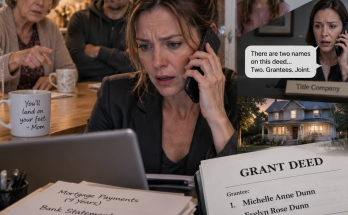
I carried Dad’s letter upstairs and placed it in the drawer beside my bed.
For years, I had treated his decisions as clues to what he wanted us to do after he was gone. That night I finally understood the difference between honoring someone’s intention and turning it into another commandment.
Dad had not told me what to do with Patricia.
He had tried to build a barrier against exactly what had happened.
One child’s crisis consuming another child’s future.
The barrier had failed because the people responsible for respecting it had chosen convenience over boundaries.
Now I had to decide what came next without asking a dead man to decide for me.
Emily was awake.
Light showed beneath her bedroom door.
I knocked.
“Come in.”
She was sitting cross-legged on her bed with a chemistry book open in front of her and headphones around her neck.
“You studying?”
“Pretending.”
“Effective?”
“Not especially.”
I sat beside her.
For a moment neither of us spoke.
Then she asked, “Is Grandma leaving?”
“I haven’t decided.”
Emily nodded.
“Are you asking what I think?”
“Yes.”
She considered that carefully.
“I don’t want her homeless.”
“Neither do I.”
“But I don’t want everything to go back to normal.”
“It won’t.”
“You always say that when something bad happens.”
I looked at her.
She immediately regretted the sentence.
“Sorry.”
“No. Finish.”
Emily pulled one knee closer.
“You fix things. Then everybody gets comfortable because you fixed them. And then people act like the thing they did wasn’t as bad because everything turned out okay.”
The accuracy hurt.
“When have I done that?”
“With Uncle Shane.”
I waited.
“When he borrowed your car and brought it back damaged.”
“He paid for part of that.”
“After you paid first.”
True.
“When Grandma forgot my birthday dinner because Garrett had that soccer thing.”
“She didn’t forget.”
“She called at nine.”
I remembered.
“And Christmas when Uncle Shane needed money and you told me we were doing smaller gifts because the family had expenses.”
I stared at her.
She had been eleven.
I had forgotten.
She had not.
“I thought I was teaching you that people mattered more than presents.”
“You were.”
Her voice softened.
“But somehow Uncle Shane’s problems always became everybody else’s lesson.”
I looked down at my hands.
There were moments when parenting offered no dignified defense.
Only the choice to listen.
“I’m sorry.”
Emily leaned against the headboard.
“I know.”
“No. I mean specifically. I’m sorry I made you absorb costs that belonged to adults and called it generosity.”
Her eyes moved to mine.
“That’s different.”
“What is?”
“You usually explain.”
I almost smiled.
“I’m trying something new.”
She smiled too.
Then her expression became serious.
“I love Grandma.”
“I know.”
“I’m really mad at her.”
“You can be both.”
“Are you?”
“Yes.”
That answer came easily.
It was perhaps the simplest truth of the week.
The next morning Serena called before eight.
“I found something.”
Those four words had become dangerous.
I sat on the edge of my bed.
“What?”
“An account connected to Dunn Family Property Group.”
“We know about the merchant account.”
“Not that one.”
My stomach tightened.
“What kind?”
“Custodial investment account.”
I stood.
“For whom?”
“That is what I want you to confirm in person.”
“Serena.”
“Michelle, I’m not trying to be dramatic. I need you to see the documentation before we characterize it.”
Facts first.
Daniel’s influence was spreading.
“I’ll be there in thirty minutes.”
Patricia was already awake when I came downstairs.
She had made coffee.
“Everything okay?”
“No idea yet.”
She looked frightened.
“I’m going to Daniel’s.”
“Should I come?”
“Not yet.”
She nodded.
A week earlier she would have demanded to know why.
Progress could be measured in surprisingly small silences.
Serena had three pages waiting when I arrived.
The first was an account-opening summary.
Custodian: Shane Dunn.
Beneficiary: Emily Dunn.
My skin went cold.
“What is this?”
“An investment account opened approximately fourteen months ago.”
“Emily already had the education account.”
“This is different.”
“Did Patricia open it?”
“No.”
“Did I?”
“No.”
I stared at Shane’s name.
“Why would he open an account for Emily?”
Serena slid over the second page.
Initial deposit: $2,500.
Then several small deposits.
Five hundred.
Seven hundred.
One thousand.
For the first four months, the account looked almost legitimate.
Then withdrawals began.
“What kind of custodial account lets the custodian withdraw money?”
“Depending on the structure, a custodian can transact for the beneficiary’s benefit.”
“For her benefit.”
“Yes.”
“What did Shane claim the withdrawals were for?”
Serena handed me the third page.
Educational enrichment.
Computer equipment.
Tutoring.
College preparation.
I laughed once.
Not because anything was funny.
Because those were exactly the kinds of expenses that would sound plausible for Emily.
“How much?”
“Approximately nineteen thousand dollars moved through the account.”
“Where did it come from?”
“Mostly credit-card deposits and transfers.”
“Whose?”
“We’re tracing them.”
“How much remains?”
“Four hundred twelve dollars.”
I stared at the number.
“What was the point?”
Serena folded her hands.
“I have a theory. I don’t want to present it as fact yet.”
“Give me the theory and label it.”
She nodded.
“The account may have served two purposes. First, it created a legitimate-looking financial relationship between Shane and Emily. Second, it gave him documentation showing that he acted as custodian for her assets.”
“For the student-loan application.”
“Possibly.”
My stomach turned.
“He was building a paper trail.”
“That is one possibility.”
Daniel entered carrying another folder.
“We received preliminary information from the student-loan company.”
I looked at him.
“And?”
“The failed application included supporting documents.”
“What documents?”
“A custodial investment statement.”
The room went quiet.
Serena had been right.
Shane had created an account in Emily’s name, moved money through it, drained it, then used the account statement as evidence that he legitimately managed her finances.
“How did he list himself?”
Daniel checked.
“Financial guardian.”
“He isn’t.”
“No.”
“What did he list me as?”
“Parent with limited financial involvement.”
I stared at him.
“Limited.”
“Yes.”
“He made himself look like the responsible adult.”
“On paper.”
I thought of every school form I had signed.
Every doctor’s appointment.
Every savings deposit.
Every late-night drive.
Shane had created a few documents and attempted to replace reality with them.
“What stopped the loan?”
“Emily’s age and identity verification. The lender requested additional documentation from the legal guardian.”
“Me.”
“Yes.”
“And Shane couldn’t provide it.”
“Apparently not.”
I sat down.
Another barrier.
Small.
Procedural.
Enough.
“What happens to that custodial account?”
“We notify the institution that Shane’s authority is disputed and determine how it was opened.”
“Did they verify guardianship?”
“That is one of our questions.”
Serena turned to another spreadsheet.
“There is something else.”
Of course there was.
“Two deposits into that account came from a card ending 9916.”
“Whose?”
“Unknown.”
“Another victim?”
“Possibly.”
“How much?”
“Six thousand total.”
Daniel said law enforcement would receive the information.
I looked at Serena.
“You said nineteen thousand moved through it. Where did withdrawals go?”
“Mostly to Dunn Ventures.”
The same business that received Emily’s education money.
The same business that funded Calder.
The structure repeated.
“What about the remaining withdrawals?”
“Three thousand went to an online gaming payment processor.”
My stomach tightened.
Betting.
Even an account carrying my daughter’s name had become another path toward gambling.
I called Misty.
She answered on the second ring.
When I described the account, she became silent.
Then she said, “I know what it was.”
“What?”
“Shane talked about opening accounts for the kids.”
“His kids?”
“Yes. He said it was smart for building financial histories.”
“Did he?”
“I don’t know.”
“Serena can check with your authorization.”
“Do it.”
Misty arrived an hour later and signed what was needed.
By afternoon Serena found two additional custodial accounts.
One for Garrett.
One for Shane’s youngest child, Noah.
Both had been used similarly.
Money in.
Money out.
Dunn Ventures.
Gaming processors.
Credit-card payments.
Misty stared at the statements.
“He used all of them.”
Nobody contradicted her.
“Did he use our daughter too?”
Their oldest child, Lily.
Serena searched.
Nothing appeared immediately.
“That doesn’t prove there isn’t one.”
“I know.”
Misty pressed her fingertips against her forehead.
“I keep thinking we’ve reached the bottom.”
“So do I.”
“But there isn’t one.”
Daniel looked at us.
“There will be.”
Misty gave him a tired smile.
“You sound confident.”
“Not about what else we’ll find. About the fact that documents are finite.”
That helped more than reassurance would have.
Shane’s lies had felt infinite because every conversation produced another version.
Records were different.
Eventually there would be a last account.
A last forged signature.
A last transaction.
Then we could stop discovering and start repairing.
That afternoon Patricia called.
“Can you come home when you’re done?”
“Why?”
“I want to show you something.”
“Can it wait?”
“Yes.”
Her answer made me curious.
I arrived shortly after six.
Patricia had emptied the dining-room cabinet.
Dad’s files covered the table.
Not financial records this time.
House records.
Receipts.
Repair invoices.
Tax bills.
Mortgage statements.
“What are you doing?”
“Figuring out what you paid.”
I stopped.
“For the house?”
“Yes.”
“Why?”
“Because I kept saying your father and I bought it.”
“You did.”
“We made the down payment.”
“Yes.”
“But that isn’t the same as paying for everything afterward.”
I pulled out a chair.
Patricia had created columns on a legal pad.
Mortgage.
Taxes.
Insurance.
Repairs.
Utilities.
She had gone back nine years.
“I don’t have all your records.”
“Serena does.”
“I know.”
That surprised me.
“I asked her whether she could calculate your contributions separately after the fraud accounting is finished.”
“Why?”
Patricia looked at me.
“Because if we decide what happens to the house, I want to start with the truth.”
I studied her.
“You don’t have to earn permission to stay by doing this.”
Her face tightened.
“I know.”
“Do you?”
“Yes.”
She took a breath.
“I also know you may ask me to leave.”
I said nothing.
“And if you do, I will.”
That was new.
No tears.
No accusation.
No reminder of motherhood.
Just acceptance.
“I haven’t decided.”
“I know.”
She pushed Dad’s letter toward me.
“I read the back again.”
“So did I.”
“He knew.”
“Yes.”
“He knew Shane could consume everything.”
“I think Dad knew all of us.”
Patricia looked down.
“He knew me too.”
“What do you mean?”
“He knew I would confuse helping with loving.”
I thought of the detective interview.
Patricia’s fear that Shane would stop calling.
“You were lonely.”
“Yes.”
“That doesn’t erase what you did.”
“I know.”
She said it without flinching.
Then she reached into the cabinet and removed a small metal cash box.
“I found this behind Howard’s tax folders.”
Inside were old photographs, two watches, a wedding ring that had belonged to my grandmother, and several sealed envelopes.
One had my name.
One had Shane’s.
One had Patricia’s.
Dad’s handwriting.
My heart tightened.
“When did he write these?”
“I don’t know.”
The envelope addressed to me had never been opened.
Patricia pushed it across the table.
“It’s yours.”
I opened it.
Inside was one page.
Dad’s handwriting became less steady near the bottom.
Michelle,
If you are reading this because there is trouble over the house, then I failed to make something clear while I had the chance.
I stopped.
Patricia watched silently.
I continued.
The house is not a prize for the child who needs the most. Need changes. Ownership should not change every time someone’s life goes badly.
My throat tightened.
Then came the sentence that changed the room.
I put Emily on the deed because I was already worried about Shane asking Patricia to borrow against the house.
I looked at my mother.
Her face had gone white.
“You knew?”
“No.”
“Dad was already worried.”
“I swear I didn’t know.”
I kept reading.
He had approached Dad before his death.
Not for the house itself.
For a home-equity loan.
Dad had refused.
Shane asked again.
Dad refused again.
Then Dad changed the deed.
Not years earlier as some abstract estate plan.
After Shane had already started circling the property.
The final paragraph was short.
Do not punish your brother for needing help. But never let his emergency become permission to take what belongs to you or Emily. If he asks honestly, decide honestly. If he goes around your answer, the answer must be no.
I lowered the page.
Patricia was crying.
“Your father never told me.”
“Maybe he knew you would tell Shane.”
She closed her eyes.
The possibility hurt because neither of us could dismiss it.
Then Patricia opened the envelope with her own name.
Her hands shook as she unfolded it.
She read silently.
“What does it say?”
She handed it to me.
Dad’s message to her was longer.
But one line had been underlined twice.
Patty, rescuing Shane from consequences will not save him. It will only teach him whose life to spend next.
My mother pressed both hands against her mouth.
For years, everyone had treated Shane’s collapse as something nobody could have anticipated.
Dad had anticipated it.
Not the forged documents.
Not Calder.
Not the gambling.
But the pattern.
And he had left us instructions that were less about property than permission.
Patricia whispered, “I thought I was proving your father wrong.”
I looked at her.
“About Shane?”
“Yes.”
“What did Dad say?”
“That one day there wouldn’t be enough money to fix what Shane broke.”
She wiped her face.
“I kept thinking if I could just get him through one more problem, Howard would have been wrong.”
Instead, every rescue had moved us closer to the exact outcome Dad feared.
My phone rang.
Serena.
I answered.
“We identified the card ending 9916.”
“Whose?”
There was a pause.
“Howard Dunn.”
I stared at Patricia.
“My father?”
“The card account remained open after his death.”
My mother’s face changed.
“What?”
Serena continued.
“Someone used it for the custodial deposits fourteen months ago.”
Dad had been dead nearly two years by then.
“How?”
“We’re tracing access.”
Patricia stood abruptly.
“That card was closed.”
“Apparently not.”
She hurried toward the kitchen desk.
“What are you looking for?”
“Howard’s wallet.”
My stomach tightened.
She opened a drawer.
Nothing.
Another.
Nothing.
Then she looked at me.
“It was here after the funeral.”
“Who had it?”
Her eyes filled with dread.
“Shane.”
Dad had protected the house from his son before he died.
Afterward, Shane had apparently taken something much smaller.
A dead man’s credit card.
And used even that to build the machinery that targeted Emily.
Click here to continue reading: PART 18: The Card Shane Used After Dad’s Death Led Back to His First Hidden Debt, and Patricia Finally Learned When the Rescue Cycle Truly Began
My Mother Gave Me Twenty-Three Days to Leave the Home I Had Spent Nine Years Quietly Paying For
Part 17 of 24