The next paragraph began with an apology.
Dad was asking me to forgive him.
I read it twice before continuing.
His handwriting had the same slight rightward slant I remembered from birthday cards, grocery lists, and the little notes he used to leave beside the coffeemaker when he woke before everyone else.
He wrote that there was something he had lacked the courage to explain while he was alive.
Then he told me the truth about the house.
My mother had not bought it for me.
He had.
I sat alone at the kitchen table while the refrigerator hummed behind me.
According to Dad, after my divorce I had been determined to use the settlement to eliminate debt and rent somewhere cheap.
Patricia had argued that Emily and I needed permanence.
Dad agreed.
But he had not trusted my mother to decide how ownership should be structured.
That sentence stopped me.
My parents had been married thirty-seven years.
As a child, I had believed they operated as a single unit.
Apparently, my father had understood cracks in their marriage that neither Shane nor I had seen.
Dad wrote that he knew Shane would eventually expect the property.
My brother had always treated inheritance as something already promised to him.
Dad also knew Patricia had a habit of soothing Shane with assurances about things she could not actually guarantee.
I thought of holidays when Shane casually referred to Dad’s tools as his future tools.
The old fishing boat as his future boat.
The house as something that would eventually “stay with the boys.”
Nobody corrected him.
I had assumed that meant everyone agreed.
Dad’s letter said otherwise.
He had structured the purchase deliberately.
The $48,000 from my divorce settlement had become the down payment.
Dad had supplied additional money through a trust.
Because my credit had been damaged after the divorce, the mortgage had been placed in Patricia’s name.
Ownership was another matter.
Dad had arranged for me and Emily to be protected on the deed.
I looked toward the hallway.
My daughter was asleep upstairs.
Nine years earlier she had been seven, small enough to climb into my bed during thunderstorms.
While I had been trying merely to survive the collapse of my marriage, my father had quietly tried to secure her future.
Then came the part that changed my understanding of Patricia.
She had known.
She had agreed to the arrangement.
Dad had required her to promise she would not tell Shane enough to provoke a fight over the property.
If everything went well, he wrote, perhaps the arrangement would never become a family conflict.
But he clearly doubted that.
He predicted Shane might eventually attempt to push me out.
If that happened, Dad instructed me not to beg, argue, or surrender anything under pressure.
He wanted me to take the documents to an attorney and protect both myself and Emily.
Then he addressed the lie my mother had already told.
If Patricia ever claimed he wanted Shane to have the house, I was not to believe her.
I stopped reading.
Only hours earlier my mother had invoked him.
Your father would have wanted Shane to have it.
She had not misunderstood.
She had used the name of a dead man to support a position he had explicitly rejected.
The final portion of Dad’s letter was gentler.
He believed a home should remain with the people who cared for it rather than whoever felt entitled to possess it.
He hoped Emily and I would be safe there.
He hoped someday I would understand why he had arranged things secretly.
Then came his signature.
Dad.
For a while I felt nothing.
I simply sat at the table with the letter beneath my hands.
Then I remembered something from the last year of his life.
He had once asked whether I trusted my mother.
I had laughed because the question seemed absurd.
Of course I trusted her.
Dad had not laughed.
He had only told me to keep copies of important documents.
At the time, I thought he was being his usual cautious self.
Now the memory hurt.
The following morning, I made an appointment with an attorney named Daniel Reeves.
I brought everything.
The deed.
The mortgage statements.
The title-company correspondence.
Dad’s note.
His longer letter.
The surviving closing documents.
Daniel spent nearly an hour reading before speaking.
“Based on what you’ve brought me, Patricia did not own this property outright.”
“I understand that now.”
“Your brother cannot transfer your ownership interest simply because your mother wants him to have the house.”
“What about Emily?”
“That makes the situation more sensitive, not less.”
I leaned forward.
“Can Patricia force us out?”
Daniel looked directly at me.
“No.”
The answer came without hesitation.
For the first time since the kitchen conversation, my lungs seemed to work normally.
“Then why has she acted like she owns everything?”
“That’s a family question. Legally, I’m more interested in something else.”
“What?”
“The money.”
I frowned.
“I paid the mortgage.”
“I can see that. What about property taxes, insurance, major repairs?”
“Mostly me.”
“Mostly?”
“My mother handled some bills.”
“With whose funds?”
I opened my mouth.
Then stopped.
I did not know.
Daniel tapped the mortgage statements.
“Find out as much as you can.”
That afternoon I went through years of financial records stored at home.
My payments were easy to identify.
Mortgage.
Insurance contributions.
Repairs.
Property taxes.
Over nine years, the pattern was remarkably consistent.
I had carried far more of the household than anyone outside it knew.
Then I noticed transactions from Patricia’s bank account.
At first they were small.
Three hundred dollars.
Five hundred.
Seven hundred fifty.
Then there were larger withdrawals.
Thousands at a time.
The descriptions were vague.
What caught my attention were the locations.
A gas station near Shane’s neighborhood.
A grocery store blocks from his house.
A hardware store.
A children’s clothing shop.
A private medical clinic.
I stared at the statements.
Two weeks earlier, Patricia had complained that her debit card had been declined.
She had blamed me, asking whether I had accidentally used it for groceries.
I had never possessed her card.
Someone else apparently had.
I called Daniel.
“I found transactions connected to places near my brother.”
“Are they your mother’s statements?”
“Yes.”
“Bring copies.”
I looked at the calendar.
Sunday was tomorrow.
The family meeting was still happening.
Oddly, I no longer wanted to avoid it.
That evening Shane texted me.
Don’t make tomorrow difficult. Mom is already upset.
A second message followed.
Misty thinks you should apologize before everybody arrives.
I typed three different replies.
Deleted all of them.
Finally I sent two words.
See you tomorrow.
He responded immediately.
Good.
I put the phone facedown.
Emily entered the kitchen wearing pajama pants and one of my old college sweatshirts.
“Mom?”
“Yeah?”
“Are we moving?”
I looked at her.
For days I had been careful not to promise what I could not guarantee.
Now I had a recorded deed, my father’s letter, and a lawyer’s answer.
“No.”
She studied me.
“Really?”
“Really.”
“Grandma said we would have to.”
“Grandma was wrong.”
Her face softened.
“So I can keep my room?”
“Yes.”
She came around the table and hugged me.
I held her tightly.
When she pulled away, she noticed my eyes.
“Why are you crying?”
“I think I’m relieved.”
She smiled.
“Me too.”
Sunday arrived under a gray sky.
At eleven, Shane’s SUV pulled into the driveway.
Another car followed.
Then another.
Patricia had invited Shane and Misty, their three children, Aunt Linda, two women from church, and, to my surprise, the pastor.
I stood at the kitchen counter making coffee.
Emily was upstairs. I had asked her to remain there until I knew how the conversation would unfold.
Shane entered without knocking.
He looked around the living room as though measuring it.
“This place will work once we rearrange everything.”
I said nothing.
Misty followed him and glanced toward the stairs.
“Emily up there?”
“Yes.”
“She’ll have to get used to sharing space.”
I turned.
“With whom?”
Misty gave me a thin smile.
“Don’t start.”
Patricia entered last.
She looked nervous.
Shane dropped into a kitchen chair.
“Okay. Let’s settle this.”
Aunt Linda sat beside him. The pastor remained near the doorway.
I poured coffee.
Shane tapped two fingers against the table.
“Mom wants to talk about the money.”
“Go ahead.”
“You’ve lived here nine years.”
“Yes.”
“Without paying rent.”
“I paid the mortgage.”
“That isn’t rent.”
I placed a folder on the table.
“No. It isn’t.”
He frowned.
“What’s that?”
“Documentation.”
“Of what?”
“Everything.”
Shane laughed.
“Nobody is attacking you.”
“You filed paperwork Monday to transfer this property.”
His smile vanished.
Misty turned toward him.
Patricia lowered her eyes.
Shane recovered quickly.
“It’s Mom’s house.”
“Is it?”
“Yes.”
“Then why did your application identify her as the sole owner?”
“Because she is.”
I opened the folder and slid the title record toward him.
“No.”
Aunt Linda leaned closer.
“What is this?”
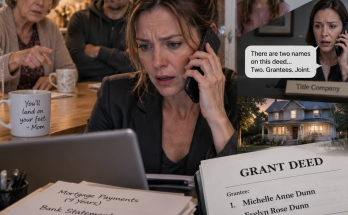
“The recorded deed.”
Shane looked at it.
Then at me.
“So?”
“Patricia is not the sole owner.”
He read farther.
I watched the exact moment he reached my name.
Then Emily’s.
His expression changed.
“My daughter and I are listed on the deed.”
Misty gave a short laugh.
“You’re kidding.”
I turned the document toward her.
“Read it.”
She did.
The laughter disappeared.
Shane picked up the page and read it again.
“This has to be wrong.”
“It’s recorded with the county.”
“Mom bought this house.”
“My money supplied the down payment.”
“You gave her that.”
“And I have paid the mortgage for nine years.”
He turned toward Patricia.
“Mom?”
She stared at the table.
“Tell her this is yours.”
Silence.
“Mom.”
Patricia finally looked at him.
“It’s complicated.”
His chair scraped the floor.
“What does that mean?”
For the first time, I watched my brother understand that the person who had promised him this house might never have possessed the power to give it away.
I opened a second folder.
“And while we’re all discussing money, we should discuss Grandma’s bank card.”
Patricia’s head rose.
Shane became very still.
Misty looked at her husband.
I laid copies of the statements on the table.
“There are transactions Patricia says she didn’t make.”
Shane stared at the papers.
I turned one page.
“Gas.”
Another.
“Hardware.”
Another.
“Children’s clothes.”
Another.
“A medical clinic.”
I looked directly at him.
“Almost all of them near your house.”
Nobody spoke.
The pastor slowly took an empty chair.
Shane pushed backward.
“You went through Mom’s private finances?”
“I found statements related to household expenses.”
“That’s none of your business.”
“It became my business when I was accused of taking advantage of her.”
I slid forward the most recent page.
There was a charge from the day Patricia’s card had supposedly been declined.
Then another.
Then an $1,800 transaction.
I looked at my mother.
“Who has your card?”
She did not answer.
Shane stood.
“We’re finished.”
“Sit down.”
He stared at me.
I had never spoken to my brother like that.
After several seconds, he sat.
I removed one last document.
“The title company has flagged your transfer application.”
Color drained from Shane’s face.
“What does that mean?”
“It means the ownership information you submitted conflicts with the recorded deed.”
He looked at Patricia.
She looked terrified.
Then he asked the question I had spent days waiting to hear.
“Mom, what did you do?”
Patricia began to cry.
Before she could answer, three firm knocks sounded at the front door.
Every face turned.
I walked through the living room and opened it.
Daniel Reeves stood on the porch with a briefcase in one hand.
Beside him was Rebecca Farrow, holding a thick file against her chest.
Shane’s face went white.
Daniel looked past me toward the crowded kitchen.
“We need to discuss the property,” he said.
His eyes settled on the papers spread across the table.
“And we should do it before anybody signs anything.”
I stepped aside.
They entered.
The door closed behind them.
For nine years, my family had treated me as though I owed them for being allowed to stay.
Now the question had changed.
It was no longer what I owed them.
It was what had been hidden from me—and how much it had already cost.
Click here to continue reading: PART 5: The Title Company Brought the Missing Closing File, and My Brother Learned Our Father Had Anticipated His Claim Years Ago
My Mother Gave Me Twenty-Three Days to Leave the Home I Had Spent Nine Years Quietly Paying For
Part 4 of 24