A few days later, Helen came to the shop without Tommy.
I was tightening a bolt when I noticed her standing near the entrance.
She held her purse in both hands.
"Is this a bad time?"
I set down the wrench.
"No. Come in."
She stepped inside and looked around.
Her eyes went to the shelf where Tommy's drawings were displayed.
She had seen them before, but this time she studied each one.
The picture of the motorcycles had started to curl at one corner.
I had placed a small piece of tape over it to keep it flat.
Helen noticed.
"You've taken good care of these."
"Tommy wanted them kept safe."
She nodded.
Then she glanced toward the chair.
"He's been having a difficult morning."
I waited for her to explain.
"He woke up upset. He couldn't tell me exactly what was wrong. He didn't want breakfast, and he didn't want to get dressed."
Her fingers tightened around her purse.
"I was getting frustrated. I had to leave for work, and we were running late."
I leaned against the bench.
"What happened?"
"I raised my voice."
She looked down.
"He started crying harder, and then I felt terrible."
I didn't know what she wanted me to say.
I could have told her that every adult lost patience sometimes.
I could have told her that she should never raise her voice at him.
Neither answer would have helped much.
So I waited.
"After he calmed down," she continued, "he asked whether he could still come here today."
I looked toward the empty chair.
"What did you tell him?"
"I told him I would ask you."
She took a breath.
"Would it be all right if he came on a day like that? When he's upset, or quiet, or doesn't want to help?"
I thought about the question.
It seemed simple, but I knew it mattered.
Helen was asking whether Tommy's place here depended on him being cheerful and cooperative.
She was also asking whether we understood that a grieving child might not arrive in the same mood every day.
"Yes," I said.
She looked up.
"You're sure?"
"I'm sure."
"What if he cries?"
"Then we'll give him a little time."
"What if he doesn't want to talk?"
"He doesn't have to."
"What if he just sits in that chair and looks at the floor?"
"Then the chair will still be there."
Helen's eyes grew damp.
She looked away before I could be certain.
"I don't know how you all manage to be so patient with him."
I shook my head.
"We aren't patient every minute of every day. We're human."
She gave a small, tired smile.
"But you keep trying."
"So does he."
That seemed to reach her.
She looked back toward the drawings.
"I think I've been expecting him to get better at being sad."
I didn't interrupt.
"I keep thinking that if I get the routine right, if I keep him busy, if I make sure he's eating and sleeping, then he'll stop asking for his mother."
Her voice dropped.
"But he still asks."
I nodded.
"He probably will for a while."
"How long?"
"I don't know."
She pressed her lips together.
I wished I had a better answer.
I wished there were a date on a calendar when a child could wake up and find that the ache of losing his mother had become easier to carry.
But grief didn't follow a timetable.
Sometimes it returned because of a song.
Sometimes it came with the smell of a meal.
Sometimes it appeared in the middle of an ordinary afternoon, when nothing seemed to have gone wrong.
"Maybe the goal isn't to make him stop missing her," I said. "Maybe it's to help him know he doesn't have to miss her alone."
Helen stood very still.
Then she nodded.
"I think I've been trying to make him feel better because I can't stand seeing him hurt."
"I understand."
"I thought if he cried less, it meant I was doing a better job."
She looked at me.
"Maybe I was measuring the wrong thing."
I thought about that for a moment.
"Maybe."
She let out a long breath.
"I'll bring him over after lunch."
"Whenever you're ready."
She thanked me and left.
I returned to my work, but I found myself thinking about her words.
It was easy to judge someone by the moment when they lost patience.
It was harder to notice what they did afterward.
Helen had come to the shop because she wanted to do better.
That mattered.
It didn't guarantee she would always get it right.
It meant she was willing to ask a question rather than pretend she already knew the answer.
Around one o'clock, Tommy arrived.
He didn't smile when he entered.
His backpack hung low on his shoulders, and his eyes were red around the edges.
Helen walked beside him.
"He had a rough morning," she told me.
"I heard."
She looked at Tommy.
"You can stay here for a little while. I'll come back later."
He nodded without speaking.
Helen bent down and straightened the strap of his backpack.
"Do you have your notebook?"
He nodded again.
"All right."
She touched his shoulder, then left.
Tommy stood near the doorway after she was gone.
He didn't move toward the chair.
I didn't ask him what had happened.
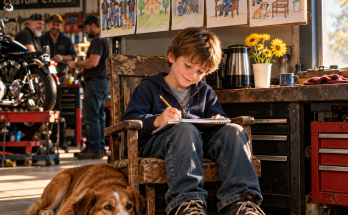
Instead, I pulled the crooked chair a few inches farther from the bench so he could reach it easily.
"Your seat's ready."
He walked over and sat down.
His hands rested in his lap.
The shop continued around him.
Tank worked on a carburetor.
Tiny moved a toolbox out of the way.
Wheels checked a list of parts he needed to order.
Nobody demanded that Tommy join in.
After several minutes, he looked at me.
"Are you mad?"
"No, buddy."
"Because I cried?"
I shook my head.
"Not at all."
He stared at his shoes.
"My aunt was mad."
I chose my words carefully.
"She was frustrated this morning. That doesn't mean she doesn't love you."
He looked up.
"She still loves me?"
"Yes."
He seemed to need more than a quick answer.
So I pulled the stool beside his chair.
"Sometimes grown-ups get tired or worried. Sometimes they say things in a louder voice than they mean to. They still have to try to do better, but it doesn't mean their love disappears."
Tommy rubbed his thumb over the seam of his trousers.
"Sometimes I get mad too."
"That's allowed."
"Sometimes I don't know why."
"That happens to grown-ups too."
He looked at me with a little surprise.
"Really?"
"Really."
His shoulders relaxed slightly.
He sat quietly for another minute.
Then he asked, "Can I draw?"
I handed him a clean sheet of paper and the pencil he liked.
He began drawing without saying anything else.
I went back to the bench.
From time to time, I glanced over.
He was drawing the shop again.
This time, he made the chair larger than everything around it.
The motorcycles were small.
The workbench was small.
The people were small.
But the chair stood near the center of the page.
I wondered whether he had drawn it that way on purpose.
When he finished, he carried the paper to me.
"Can you see it?"
"I can."
"That's my chair."
"I see that."
"It's where I sit when I'm sad."
I felt my throat tighten.
"Then I'm glad you have it."
He nodded.
He returned to the shelf and looked at the other pictures.
After a moment, he placed the new drawing beside them.
Four pictures now rested on the cardboard.
I made sure the corners were secure.
Tommy watched me.
"Will you keep all of them?"
"Every one you want us to keep."
He smiled faintly.
Then he sat down again.
The afternoon passed slowly.
He didn't laugh much.
He didn't ask questions about the motorcycles.
He didn't help Wheels sort anything.
He simply watched the work around him and drew another small picture in his notebook.
That was enough.
When Helen returned, she came inside rather than waiting at the door.
Tommy looked up.
"Aunt Helen."
"Hello, sweetheart."
She approached the chair and crouched beside him.
"How are you feeling?"
He shrugged.
"Still sad."
Helen's face tightened for a moment.
Then she nodded.
"That's okay."
He looked at her carefully.
"You're not mad?"
"No."
She brushed a strand of hair away from his forehead.
"I'm sorry I raised my voice this morning."
Tommy watched her.
"I was sad."
"I know."
"I didn't know why."
Helen took his hand.
"That's all right. You don't always have to know why."
He leaned toward her.
She put an arm around him, and he rested his head against her shoulder.
I turned back to the workbench.
Not because I wanted to avoid the moment.
Because it belonged to them.
I heard Helen whisper something to him, but I didn't try to make out the words.
After a while, Tommy stood up.
He collected his backpack and looked toward the shelf.
"Can I come again?"
Helen glanced at me.
Then she looked at him.
"Yes. We'll work out which afternoons."
Tommy smiled.
It wasn't the biggest smile I had seen from him.
It was enough.
Helen helped him put on his jacket.
Before they left, she turned toward me.
"Thank you for letting him have a hard day here."
I nodded.
"He's welcome on the easy days too."
She smiled at that.
Then they crossed the street together.
I watched them reach the house.
The door opened.
They went inside.
I returned to the shop and stood beside the chair.
It was still crooked.
One leg still wobbled.
The wood still creaked when someone shifted their weight.
But it had become something more than a piece of furniture.
It was a place where Tommy could laugh without being asked to explain himself.
A place where he could ask questions without being hurried.
A place where he could cry without being told he had failed to be brave.
And now, perhaps, it was a place where Helen could trust that her nephew would be cared for without being judged for having a difficult afternoon.
I looked at the four drawings on the shelf.
The little boy among the motorcycles.
The house beneath the yellow sun.
The shop with the open door.
The chair where he sat when he was sad.
I straightened the cardboard one last time.
Then I went back to work.
There was nothing dramatic about that afternoon.
No grand promise had been made.
No problem had been solved forever.
A little boy had come in sad and gone home still sad, but he had not been alone while he carried it.
For the moment, that was enough.
Click here to continue reading: PART 17: The Afternoon Tommy Came Through the Door Without His Notebook and Asked If Everyone Could Still Like Him on a Quiet Day
The Little Boy Behind the Window Had Lost His Mother, and None of Us Knew What He Was Waiting to Ask
Part 16 of 20