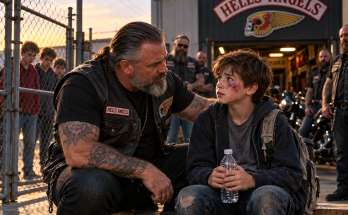
The first thing I learned about Tommy Morrison was that he paid attention.
The second was that he remembered things.
I discovered both without speaking to him.
Every morning, the men arrived at different times.
Tank usually came early because he liked having a few quiet minutes before the shop filled with noise.
Tiny arrived whenever his other responsibilities allowed.
Wheels came through the door talking, even when nobody was there to listen.
I opened the shop myself.
And Tommy watched all of us.
He seemed to know our routines.
When Tank rolled up his sleeves, Tommy would lean closer to the glass.
When Tiny appeared, the boy's expression softened.
When Wheels made one of his ridiculous gestures, Tommy sometimes smiled.
I started noticing the small reactions.
They were easy to miss if you weren't looking for them.
I was looking for them now.
One morning, I arrived carrying a box of parts and found Tommy standing at the window before I had even unlocked the front door.
The street was quiet.
His aunt's curtains were partly open.
He had both hands against the sill, and his face was turned toward our building.
I raised my hand.
He looked down.
For a second, I thought I'd frightened him.
Then he glanced toward the house behind him.
He stepped away from the window.
That movement stayed with me.
He wasn't simply shy.
He was checking whether somebody might see him looking at us.
I wondered what would happen if Helen caught him paying attention to the shop.
The thought made me angry, although I had no right to be angry with a woman whose situation I barely understood.
Taking care of a child was difficult.
Taking care of a grieving child who needed additional support could be harder still.
I knew that.
What I couldn't accept was the idea that a child should have to make himself smaller to keep the adults around him comfortable.
I didn't know whether Helen understood what she was doing.
Maybe she thought she was keeping things under control.
Maybe she was overwhelmed and had nobody to talk to.
I could admit all of that and still feel sorry for Tommy.
Both things could be true.
That was a lesson I had to learn before I could help anyone.
Inside the shop, Tank was already working.
He had dismantled part of a transmission and arranged the pieces in a neat line.
"You've been staring across the street again," he said.
I looked at him.
"Have I?"
"Unless there's another house over there you find interesting."
I set the box on the bench.
"There's a kid in that window."
"I know."
I turned toward him.
"You know?"
Tank gave me a look that suggested he had been waiting for me to catch up.
"Bear, half the neighborhood knows."
I didn't like hearing that.
It meant other people had noticed the boy, too.
I wondered whether anyone had done anything.
"What do you know about him?"
Tank wiped his hands on a rag.
"His mother died recently. He's staying with his aunt."
"That's all?"
"That's what I know."
He returned to the transmission.
I waited for him to say more.
He didn't.
Tank was a man who could talk for an hour about a baseball game but wouldn't gossip about a grieving child.
I respected that.
I also knew he was thinking about Tommy.
He had seen the boy.
He had noticed the same things I had.
And neither of us knew what to do.
Later that morning, Tiny stepped outside to sweep the pavement.
He took his time around the entrance, pushing dust away from the doorway and gathering a few leaves into a small pile.
Tommy appeared at the window again.
Tiny noticed him.
He stopped sweeping and gave the boy a friendly wave.
Tommy didn't wave back.
But he didn't move away, either.
Tiny returned to sweeping as if nothing unusual had happened.
That was another thing about Tiny.
He never made kindness feel like a demand.
He offered it.
Then he gave people room to decide what to do with it.
When he came inside, I asked whether he had seen Tommy.
Tiny nodded.
"Nice little fellow."
"You talked to him?"
"No."
"Then how do you know?"
Tiny shrugged.
"He watched me sweep the same spot for five minutes. I figure he's patient."
I laughed despite myself.
Tiny smiled.
Then his expression grew thoughtful.
"Something's bothering him."
"I know."
"Kids don't usually stand at windows like that unless they're waiting for something."
I leaned against the workbench.
"What do you think he's waiting for?"
Tiny looked through the open door.
"I couldn't tell you."
Neither could I.
We had spent our lives learning how to recognize trouble.
We knew the sound of an engine about to fail.
We knew when a man was pretending not to be hurt.
We knew the difference between anger that would pass and anger that might become dangerous.
But a quiet child behind a window was harder to understand.
He wasn't asking for help.
He wasn't telling us what was wrong.
He was simply watching us as though he had found something he wanted and was afraid to reach for it.
I thought about approaching the house.
I thought about knocking on the door and asking Helen whether Tommy could visit the shop.
Then I imagined how that conversation might sound.
I was a middle-aged biker with a beard and a leather vest.
She was a woman responsible for a child who had recently lost his mother.
She might think I was interfering.
She might refuse.
And if she did, Tommy would still be at that window, only now he would know that we had noticed him and chosen not to do anything.
I couldn't decide which possibility worried me more.
So I waited.
It wasn't my finest decision.
A few days later, I heard Helen speaking on the telephone again.
I was outside, checking a motorcycle that had been brought in for repairs.
Her window was open.
Her voice carried across the street.
She sounded tired.
She spoke about appointments, arrangements, and finding a suitable place for Tommy.
I couldn't make out every word.
Then she said something about children with special needs and the programs available for them.
I stopped working.
There was no way to know exactly what she meant.
Perhaps she was trying to find support.
Perhaps she was asking for advice.
Perhaps she was simply trying to understand what she was supposed to do next.
I wanted to believe that.
But I remembered the tone she'd used when she said she needed to find somewhere for him.
It hadn't sounded like someone looking for help for a child she loved.
It had sounded like someone looking for a way to get rid of a responsibility.
That might have been unfair.
I knew it might have been unfair.
Still, the thought settled heavily in my stomach.
I looked at the window.
Tommy wasn't visible.
I returned to the motorcycle and tightened a bolt that didn't need tightening.
I had no business judging Helen from across the street.
I also had no business pretending I hadn't heard what I'd heard.
Those two facts sat beside each other, and I couldn't make them fit.
When Wheels arrived that afternoon, he found me staring at the street.
"You planning to repair that road with your eyes?"
I shook my head.
"Just thinking."
"That's dangerous."
He set his helmet on the counter.
"What happened?"
I told him about Tommy.
Not everything.
Just what I'd seen and heard.
Wheels listened without interrupting, which was unusual enough to tell me he was taking it seriously.
When I finished, he looked across the street.
"Poor kid."
"Yeah."
"Does he ever come outside?"
"Not that I've seen."
Wheels was quiet for a moment.
Then he asked, "Have you tried talking to him?"
I didn't answer immediately.
That was answer enough.
He shook his head.
"Bear."
"I know."
"No, I don't think you do."
I looked at him.
Wheels leaned against the counter.
"We spend half our lives complaining that people judge us before they know us. Then a kid sits over there looking at us like we're the only people he wants to meet, and we stand here waiting for a formal invitation."
I felt the words land.
He hadn't raised his voice.
He didn't need to.
"I don't want to make things worse for him," I said.
"Then don't make things worse."
It was such a simple answer that I almost laughed.
Almost.
Wheels picked up his helmet and headed toward the back room.
Before he disappeared, he turned around.
"Maybe just let him know he's welcome."
I thought about that for the rest of the day.
Let him know he was welcome.
Not promise to fix his life.
Not offer to take him away from his aunt.
Not pretend we knew what he needed.
Just let him know that if he wanted to come closer, we wouldn't send him away.
The next morning, I made a decision.
I would go outside when Tommy appeared.
I wouldn't cross the street.
I wouldn't knock on his door.
I would simply greet him, the same way I greeted customers who came into the shop.
If he wanted to answer, he could.
If he didn't, I would leave him alone.
It seemed reasonable.
It also seemed painfully small.
I unlocked the shop and carried my coffee outside.
For several minutes, there was no sign of Tommy.
I checked the motorcycle parked near the entrance.
I adjusted a mirror.
I took a drink of coffee.
Then I saw him.
He was standing behind the window.
His hair was untidy, and his shirt hung loosely around his small shoulders.
He looked tired.
I set my coffee on the ledge beside the door.
Then I raised my hand.
"Morning, Tommy."
The boy froze.
I had never spoken his name to him before.
His eyes widened slightly.
For a moment, neither of us moved.
Then he glanced toward the room behind him.
He looked back at me.
I smiled.
He didn't smile back.
But he stayed.
I considered that a beginning.
I wanted to say something else.
Something friendly.
Something that would tell him he could approach us without having to explain himself.
But I couldn't think of the right words.
So I lifted my coffee and took a drink.
Tommy watched me.
I watched him.
Then a curtain moved behind him, and he disappeared from the window.
I stood outside a little longer.
When I finally returned to the shop, I felt foolish.
I had greeted a child.
That was all.
No miracle had occurred.
No problem had been solved.
But for the first time since I'd noticed him, Tommy knew that at least one person across the street had learned his name.
I hoped it mattered.
I hoped it was enough to make the next step easier.
I was wrong about one thing, though.
The next step wouldn't be mine.
Tommy would take it himself.
Click here to continue reading: PART 3: The More I Learned About the Boy’s Life Across the Street, the More I Questioned What It Meant to Be a Good Man
The Little Boy Behind the Window Had Lost His Mother, and None of Us Knew What He Was Waiting to Ask
Part 2 of 20