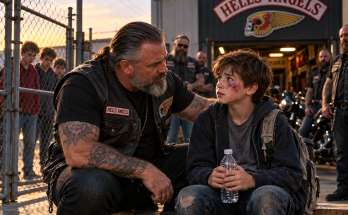
Tommy returned the following morning.
He came in wearing the same oversized shoes and carrying nothing but himself.
He looked toward the old chair first.
Then he looked at me.
"Good morning, Bear."
"Morning, Tommy."
He smiled and walked inside.
There was no dramatic moment.
No announcement.
He simply came in as if he had begun to believe there was a place for him here.
That mattered more than I knew how to explain.
I had started leaving the old chair near the workbench.
I told myself it was convenient.
The truth was that I wanted Tommy to see it whenever he arrived.
I wanted him to know he didn't have to ask whether he could sit down every single time.
Some things should be offered without making a child request them again and again.
So the chair stayed.
Its uneven leg still wobbled.
The paint was still worn away along the edges.
But Tommy seemed to like it.
He climbed onto the seat and settled himself beside the workbench.
Then he watched Tank repair a motorcycle.
Tank had learned that Tommy preferred explanations in small pieces.
He would show him a part, explain what it did, and then return to his work.
Tommy listened closely.
Sometimes he repeated the names.
Sometimes he asked a question.
And sometimes he simply watched.
Tank never seemed bothered by any of it.
One morning, Tommy asked why a motorcycle made a particular sound.
Tank paused.
"Because something isn't working the way it should."
Tommy thought about that.
"Can you fix it?"
"That's the plan."
Tommy nodded as if the answer made perfect sense.
Then he watched Tank work.
I wondered whether the boy saw something more than a repair.
A machine had a problem.
Someone noticed.
Someone stayed with it until the problem was understood.
Then someone tried to make it work again.
Perhaps Tommy liked that idea.
Perhaps he simply liked motorcycles.
I didn't ask.
I was learning not to turn every small moment into a question about his feelings.
He deserved some privacy, even in our shop.
Tiny began keeping a clean rag on the bench for him.
Wheels started telling his stories in a way that gave Tommy time to follow along.
Tank let him watch the repairs without making him feel that he was in the way.
And I made sure the door remained open whenever it was safe to do so.
These were small adjustments.
None of us considered them sacrifices.
We were changing a few habits to make room for a child.
That seemed reasonable.
What surprised me was how quickly Tommy noticed.
He remembered where the chair belonged.
He remembered which toolbox Tiny had asked him to wipe.
He remembered that Tank liked to explain things before demonstrating them.
He even remembered where Wheels kept his notebook.
One afternoon, Wheels couldn't find it.
He checked the counter.
He checked the workbench.
He checked the pocket of his vest.
Then he turned toward Tommy.
"Have you seen my notebook?"
Tommy pointed to a shelf near the wall.
Wheels looked.
There it was.
He picked it up and stared at the boy.
"How did you know?"
Tommy shrugged.
"You put it there."
Wheels looked at me.
I laughed.
"Looks like somebody's paying attention."
Wheels shook his head.
"Apparently more than I am."
Tommy smiled.
For a moment, the shop felt as ordinary as it had before I ever noticed him.
A boy.
A notebook.
A few men laughing.
Then I remembered that ordinary things had become important to him.
That knowledge stayed with me.
I began noticing what happened when Tommy arrived.
He didn't rush through the doorway.
He didn't demand attention.
He waited until someone greeted him.
Then he moved toward the chair or stood beside the workbench.
Sometimes he asked to help.
Sometimes he watched.
Sometimes he sat quietly while the men talked.
He was learning our routines.
We were learning his.
But there was one thing I still didn't understand.
I didn't know what happened when he went home.
At the shop, he smiled more often.
He spoke more freely.
He seemed to relax.
But whenever it was time to leave, something changed.
He would look toward the door.
Then he would glance at me.
Sometimes he asked whether I would be there the next day.
Sometimes he asked whether the others would be there, too.
I answered honestly.
When I knew I'd be working, I told him so.
When I wasn't sure, I said I wasn't sure.
I didn't want to teach him that a promise was something you made just to make a difficult moment easier.
His mother had taught him that promises mattered.
I could see it in the way he listened whenever an adult gave him an answer.
He didn't forget.
And he didn't seem to dismiss a promise simply because it had been made casually.
That made me careful with my words.
One afternoon, Tommy was preparing to leave when he turned back toward the shop.
"Bear?"
"Yes, buddy?"
"Can I stay longer?"
I looked at the clock.
We were still working, and there was no reason he couldn't sit with us for a while.
"Of course."
He returned to the chair.
I went back to the motorcycle.
A few minutes later, I heard him speaking quietly to Tiny.
I couldn't make out every word.
Tiny leaned closer so he could hear him.
Then Tiny nodded.
Whatever Tommy had said, Tiny didn't make a big deal out of it.
He simply answered him and returned to work.
I was grateful for that.
Children should be allowed to speak without every conversation becoming an event.
Still, I wondered what Tommy had wanted to tell him.
I didn't ask.
I was beginning to understand that trust wasn't something you could demand simply because you had been kind.
It took time.
It took patience.
And it took the willingness to let another person decide how much of himself he was ready to share.
Later that day, Helen appeared at the front door.
I recognized her immediately.
She stood just outside the entrance, looking into the shop.
Tommy was sitting in the old chair.
He saw her before I did.
His smile disappeared.
He stood up quickly.
The movement was so sudden that the chair scraped against the floor.
I turned toward him.
"Everything okay?"
Tommy looked at his aunt.
Helen stepped inside.
"I've come to get him."
Her voice was controlled.
I couldn't tell whether she was angry.
Tommy moved toward the door.
He didn't argue.
He didn't ask for another minute.
He simply followed her.
I felt a familiar tightness in my chest.
I wanted to say that he had been behaving well.
I wanted to tell her that he had helped Tiny clean the toolbox and remembered where Wheels had put his notebook.
I wanted her to know that he wasn't causing trouble.
But I stopped myself.
I didn't know what she needed to hear.
And I didn't want Tommy to feel that we were discussing him as if he weren't standing there.
So I kept my words simple.
"He's welcome whenever you're comfortable with it."
Helen looked at me.
Then she glanced at Tommy.
"I'll decide when he can come."
There was no warmth in the sentence.
But there was no argument, either.
I nodded.
"All right."
Tommy stood beside her.
He looked at the old chair.
Then he looked at me.
"Bye, Bear."
"See you, Tommy."
He hesitated.
I could see him trying to decide whether he was allowed to say anything else.
Then he asked, "Tomorrow?"
I looked at Helen before answering.
She didn't respond.
I returned my attention to Tommy.
"I hope so, buddy."
He nodded.
Then he left with his aunt.
I stood in the doorway and watched them cross the street.
Helen walked ahead.
Tommy followed a few steps behind.
He was wearing those same oversized shoes, and he kept his eyes on the pavement.
I wanted to cross the street after them.
I wanted to ask Helen what she needed from us.
I wanted to understand why Tommy's face changed so quickly when she appeared.
But I had to respect the fact that she was responsible for him.
I couldn't simply decide that my concern gave me the right to interfere.
That was the hardest part.
I could see that Tommy needed something.
I could offer him a chair, a place to sit, and a few hours of company.
But I couldn't decide what happened inside his aunt's house.
I couldn't see what he experienced when the door closed behind him.
And I couldn't know whether our kindness made his life easier or made him wish for something he couldn't have.
That uncertainty followed me for the rest of the day.
When the shop finally grew quiet, I looked at the old chair.
It stood beside the workbench, slightly crooked and empty.
Tommy would have to leave at the end of every visit.
He would have to return to the house where his mother was gone and his future was uncertain.
I couldn't change that simply by keeping a chair ready.
But I could make sure the chair was still there when he came back.
I could make sure the door opened.
I could make sure the men inside greeted him.
And I could keep telling him the truth.
He was welcome with us.
That was something I knew.
It was also something I intended to keep showing him, one ordinary morning at a time.
Click here to continue reading: PART 9: The Next Morning, I Found the Old Wooden Chair Empty and Realized How Much I Had Begun to Hope He Would Come Back
The Little Boy Behind the Window Had Lost His Mother, and None of Us Knew What He Was Waiting to Ask
Part 8 of 20