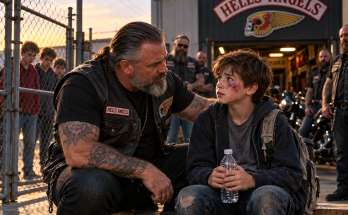
I opened the shop earlier than usual the next morning.
The street was still quiet, and the air carried that cool smell that comes before the sun warms the pavement.
I unlocked the front door and stepped inside.
The old wooden chair sat beside the workbench where I had left it.
I had straightened it the night before, although one leg still wobbled whenever someone shifted their weight.
I stood there longer than I needed to.
I told myself I was checking the chair.
Truth was, I was wondering whether Tommy would come back.
I put the kettle on and started sorting through the tools left from the previous day's work.
Tank arrived first, carrying two cups of coffee and a paper bag from the diner down the road.
He looked at the chair before he looked at me.
"Waiting for somebody?"
"I'm opening the shop."
"That's not what I asked."
I took the coffee he offered me.
Tank had a way of saying things without making them sound like accusations.
It was one reason I trusted him.
"He might come by," I said.
Tank nodded toward the chair.
"Then I guess we'll leave it where it is."
He didn't make a joke about me getting attached.
He didn't tell me I was acting like a grandfather who had just discovered his first grandchild.
He simply set the paper bag on the counter and went to wash his hands.
That small kindness meant more to me than he probably knew.
Tiny came in a few minutes later.
He had brought a clean cloth because he said the one we kept by the sink smelled like an old boot.
He looked at the chair and smiled.
"Little fellow got a seat waiting for him?"
"Looks that way."
Tiny rubbed his big hands together.
"Good."
Then he went outside to move a motorcycle away from the entrance.
Wheels arrived last, carrying a breakfast sandwich he had apparently bought for himself.
He noticed the chair, then the two cups of coffee, then the paper bag.
"Are we expecting company?"
"Not unless you count the mailman."
Wheels glanced toward the front window.
"Well, if we're having a guest, somebody should tell him the coffee is terrible."
"You're welcome to drink it somewhere else," Tank called.
Wheels grinned and sat on a toolbox.
For all his jokes, he was the first one to look toward the street whenever a car slowed down.
I noticed that because I was doing the same thing.
The morning moved along.
A customer came in to ask about a replacement part.
Tank worked on a motorcycle with a loose chain.
Tiny wiped down the counter.
Wheels made three trips to the parts shelf and somehow forgot what he had gone there to retrieve each time.
We were doing the same work we always did.
Still, the shop felt different.
The chair had changed the way I looked at the space around it.
I kept noticing things a child might reach for, things that could fall, and corners where a small hand might get caught.
I moved a metal container of bolts farther back on the bench.
I put a sharp tool in a drawer.
Then I caught myself rearranging the shop as if Tommy had already arrived.
I stopped and shook my head.
Nobody had promised me he would come.
And I had made a point of telling Helen that I wouldn't promise him anything either.
That was the trouble with wanting to help somebody.
Sometimes your hope started making promises before your mouth had a chance to stop it.
Around ten, I heard footsteps outside.
I looked up so quickly that I nearly knocked over my coffee.
It was an older man carrying a grocery bag.
He walked past the shop without glancing inside.
I felt foolish for being disappointed.
Tank caught my expression.
"He's got his own time," he said.
"I know."
"Knowing something and feeling it are different jobs."
I looked at him.
"Since when did you become a philosopher?"
"Since you started staring holes through the window."
I laughed despite myself.
It helped.
I went back to work.
At eleven, Tommy appeared.
He stood just beyond the open doorway, one hand holding the strap of his backpack.
He wore the same oversized shoes I had seen the day before.
His trousers were a little too long, and one cuff had folded over the top of a shoe.
He looked at the chair first.
Then he looked at me.
"Hi, Bear."
"Morning, Tommy."
He stayed at the threshold.
I didn't call him over.
I had learned that sometimes the best thing you could do for someone was give him room to decide.
After a few seconds, he took one step inside.
Then another.
"Can I sit?"
"That chair has been waiting for you."
His face brightened.
He crossed the floor and climbed onto the wooden seat.
It creaked under him.
He froze.
"Is it broken?"
"No, buddy. It's just old."
He pressed both hands against the seat and listened as the wood settled.
"Old things make noises."
"They sure do."
He looked toward Tank.
"Your motorcycle makes noises too."
Tank lifted his head from the engine he was working on.
"That one makes more noises than it should."
Tommy considered that.
"Can you fix it?"
"That's the plan."
Tommy smiled and swung his feet.
The soles of his shoes barely cleared the floor.
I noticed he was carrying a small folded piece of paper.
He kept it tucked between his fingers, smoothing the crease with his thumb.
I wondered what it was, but I didn't ask.
He had only just arrived.
There was no reason to turn his visit into a list of questions.
Tiny came in from outside and greeted him as if they had been apart for weeks.
"Good to see you, little man."
Tommy watched him wipe his hands.
"Did you feed the dog?"
"Not yet."
"He's probably hungry."
Tiny looked at me.
"Sounds like I've got an assignment."
He went to the cupboard where we kept a little bag of dog food for the stray that wandered behind the building.
Tommy watched him through the window as he carried the bowl outside.
When Tiny returned, Tommy asked whether the dog had eaten.
"He did."
"All of it?"
"Every bite."
Tommy seemed satisfied.
Then he unfolded his piece of paper.
It was a drawing.
The lines were uneven, and the page had been folded so many times that one corner was beginning to tear.
He held it toward me.
I wiped my hands before taking it.
There were four motorcycles drawn across the bottom of the page.
Above them stood four people.
One was very tall.
One was broad in the shoulders.
One was smaller than the others.
And one had a beard that covered most of his face.
I recognized us immediately.
"You drew this?"
Tommy nodded.
"That's Tiny."
He pointed to the tallest figure.
"That's Tank."
He pointed to the broadest.
"Wheels."
Then he touched the bearded figure.
"That's you."
I looked at the drawing again.
There was a fifth figure beside us.
It was smaller than all the others.
The figure had a round head, short arms, and shoes that looked enormous.
"Who's this one?" I asked, although I already suspected the answer.
"Me."
I swallowed before I spoke.
"Well, I think you got us right."
Tommy studied my face.
"Really?"
"Really."
He looked down at the picture, then back at the shop.
"Can I put it here?"
I glanced toward the old chair.
"You want to leave it with us?"
He nodded.
"Then we'll find a safe place for it."
I took a small piece of tape from the drawer.
Instead of sticking it directly to the wall, I found a clean sheet of cardboard and taped the drawing to that.
Then I set the cardboard on the shelf behind the chair.
Tommy watched every movement.
"There," I said. "Now we can see it without it getting dirty."
He leaned back and looked at his work.
For the first time that morning, he seemed completely at ease.
I went back to my bench.
He stayed in the chair.
Every so often, he asked a question about something he could see.
I answered when I could.
When I couldn't, Tank or Tiny took over.
Nobody talked down to him.
Nobody made him feel foolish for asking something twice.
And nobody expected him to entertain us.
He was simply a little boy spending a morning in a place where people were glad he had come.
That should not have seemed extraordinary.
But I had seen enough of the world to know that ordinary kindness could become rare when people decided somebody else's needs were inconvenient.
At lunchtime, I asked Tommy whether he was hungry.
He looked at the clock.
"Is it lunch already?"
"Close enough."
He opened his backpack and pulled out a small container.
Inside was a sandwich wrapped in paper.
He set it on his knees and tried to open the lid.
The plastic caught beneath his thumb.
He struggled with it for a few seconds.
Then he looked at me.
"Can you help?"
"Of course."
I opened it and handed it back.
He thanked me quietly.
I didn't ask whether Helen had packed it.
I didn't ask whether she remembered what he liked.
Those questions belonged to a conversation I hadn't earned yet.
Instead, I sat on the stool across from him and ate my own sandwich.
We ate together without much talking.
After a while, he pointed toward the cardboard drawing.
"Are you keeping it?"
"If you're sure you want us to."
"I want you to."
"Then we're keeping it."
He took another bite.
I looked at the crooked chair, the drawing on the shelf, and the small pair of shoes swinging above the floor.
I had spent years believing a man's character was measured by what he could repair, what he could protect, and how well he kept his word.
That morning, I began to understand another part of it.
Sometimes it was measured by whether you could make room for somebody without asking him to prove he deserved the space.
Click here to continue reading: PART 10: I Began to Understand That Tommy Was Not Asking Us to Fix His Life, Only to Let Him Have a Place in Ours
The Little Boy Behind the Window Had Lost His Mother, and None of Us Knew What He Was Waiting to Ask
Part 9 of 20