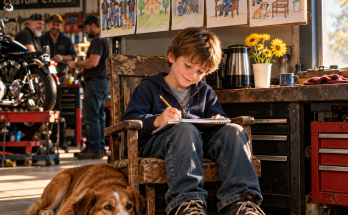
I used to think a child needed someone to take care of him.
I didn't understand that sometimes a child needed something harder to give.
A reason to believe he belonged somewhere.
I learned that from a seven-year-old boy who watched my motorcycle shop from across the street and never once asked me for anything.
At least, not at first.
My name is Bear Sullivan, and I owned Rex's Custom Cycles.
Most people knew the place by its noise.
Engines starting. Tools striking metal. Men laughing too loudly over coffee that had been sitting on a workbench for hours.
We weren't exactly the kind of people you'd expect to find helping a little boy feel safe.
Leather vests.
Heavy boots.
Long beards.
Faces that looked as if they had spent years arguing with the world and rarely losing.
We belonged to Rolling Thunder, a group of bikers that included veterans, mechanics, and men who had discovered that life didn't always give you a clean way to start over.
We had our problems.
We had our regrets.
But we had each other.
I thought that was enough.
Then I noticed Tommy Morrison.
He stood across Riverside Avenue, behind a window at his aunt's house.
The first morning I saw him, he had his forehead against the glass.
His hands hung at his sides.
He wasn't crying.
He wasn't waving at anyone.
He was simply watching.
I remember looking over while I carried a box of replacement parts through the shop door.
Something about that little boy made me stop.
He looked as if he wanted to come closer but had already decided that he wasn't allowed.
I raised a hand.
Tommy didn't respond.
I told myself he was shy.
Then I went back to work.
That should have been the end of it.
It wasn't.
The next morning, he was there again.
Same window.
Same position.
Same quiet attention directed toward the motorcycles parked outside our building.
I noticed him because children usually wanted something when they watched a motorcycle shop.
They wanted to hear an engine roar.
They wanted to touch a handlebar.
They wanted to ask how fast a bike could go.
Tommy never did any of those things.
He watched the people instead.
That was what I missed at first.
The motorcycles were only the reason he had found us.
The men were what kept him looking.
Inside the shop, Tank Washington was arguing with a stubborn transmission.
Tank could repair almost anything with an engine, and he had opinions about everything without one.
He was a former serviceman with broad shoulders and hands that looked too large for delicate work.
He also knew more baseball statistics than any man I'd ever met.
That morning, he was explaining why a particular team had ruined its chances before the season had properly begun.
Nobody had asked him.
Nobody expected him to stop.
Tiny Hayes stood near the workbench, sorting bolts into small containers.
Tiny was a ridiculous name for a man his size.
He had to duck beneath the doorway whenever he came inside, and strangers sometimes moved out of his way before they realized he was simply trying to pass.
But I had seen him spend twenty minutes coaxing a frightened stray dog out from beneath a parked truck.
He never rushed an animal.
He never raised his voice.
He just waited until it felt safe enough to come closer.
Then there was Wheels Rodriguez.
Wheels was the youngest of us and the quickest to make a joke when the room grew uncomfortable.
He could also spot trouble before the rest of us noticed anything was wrong.
He remembered who had skipped lunch.
He noticed when somebody was sitting down because his knees hurt.
He would put a glass of water beside a man who hadn't admitted he was thirsty.
We weren't perfect men.
We were simply men who had learned, in different ways, that people sometimes needed help before they could ask for it.
Tommy seemed to understand that without knowing any of our names.
He watched Tank work.
He watched Tiny smile at the dogs that wandered near the shop.
He watched Wheels carry a stool across the floor for an older customer.
And he watched me.
I didn't know why.
I wasn't especially friendly-looking.
Years of working around machinery had left my hands rough and my face permanently tired.
I spoke when I had something to say.
I wasn't good at making conversation just to fill the silence.
If a stranger had described me as intimidating, I probably wouldn't have argued.
But that boy kept coming back to his window.
After several mornings, I began looking for him before I unlocked the shop.
I didn't tell anyone.
I just glanced toward the house across the street.
Sometimes Tommy was there.
Sometimes the window was empty.
When he appeared, I found myself wondering whether he'd eaten breakfast or slept well.
I wondered why a boy his age spent so much time watching grown men repair motorcycles.
And I wondered why he looked so sad when he did it.
A few mornings later, I learned the answer to one of those questions.
I was carrying coffee inside when I heard a woman's voice from the open window of the house.
She was speaking on the telephone.
Her tone wasn't loud enough for me to catch every word, but I heard Tommy's name.
Then I heard her sigh.
It was the kind of sigh people make when they believe somebody has made their lives more difficult.
I stopped near the shop entrance.
I knew I shouldn't listen.
I listened anyway.
The woman said something about finding somewhere for him to go.
Then she mentioned programs for children like him.
I couldn't hear the other person on the line.
I didn't need to.
There was something cold in the way she said it.
Not hatred, exactly.
More like exhaustion mixed with resentment.
I looked toward the window.
Tommy wasn't there.
For some reason, that bothered me more than if he had been watching.
I went inside and set my coffee on the workbench.
Tank looked up from the transmission.
"You all right?"
"Fine."
He studied my face for another second.
Then he returned to his work.
Tank knew when not to push.
That was one of the reasons I trusted him.
I spent the next hour trying to forget the conversation.
I failed.
The woman across the street was Tommy's aunt, Helen Morrison.
I learned her name later, but I already knew she had taken the boy into her home after his mother died.
I also knew she didn't sound like someone who wanted him there.
At the time, I didn't know much about Tommy himself.
I knew he was seven.
I knew he had Down syndrome.
I knew he had lost his mother only a few weeks earlier.
The details reached me slowly, in pieces, and I wished I had understood sooner what those few facts meant to a child.
His mother had been sick with cancer.
The adults had talked about it around him, apparently believing that a child who couldn't fully understand their conversations wouldn't be affected by them.
They were wrong.
Tommy had heard enough to recognize that something terrible was happening.
Then his mother died.
Three weeks before I first noticed him, the person who had made his world feel familiar was gone.
I couldn't imagine what that did to a boy who still needed someone to remind him what came next in the day.
Breakfast.
School.
A favorite cup.
A voice calling from another room.
The ordinary things adults rarely notice until they're missing.
I had lost people myself.
I understood grief.
But understanding grief in a grown man was different from understanding it in a child who couldn't make sense of why the person he loved had disappeared.
Tommy had no way to fix it.
He couldn't bargain with it.
He couldn't promise to behave better if his mother would come back.
He could only wake up each morning and discover that the world was still the same world in which she was gone.
And then he had to live in somebody else's house.
Helen had taken him because there was nobody else available to care for him.
I knew that much.
What I didn't know was how often she reminded him of it.
Looking back, I wish I'd paid closer attention.
A child doesn't need to hear the words you're a burden to understand what an adult means.
Sometimes the adult only needs to look at the clock when the child enters the room.
Sometimes a sigh is enough.
Sometimes the difference between being tolerated and being wanted is visible in the smallest movements.
Tommy was learning those differences.
And he was watching our shop because something about us seemed different.
We didn't know it yet.
We were just fixing motorcycles.
That morning, I walked outside and leaned against the doorframe.
Tommy had returned to the window.
He was looking at Tiny, who had just come out of the shop carrying a paper bag.
A stray dog had been waiting beside the building.
Tiny lowered himself onto one knee, opened the bag, and offered the animal a piece of food.
The dog approached cautiously.
Tiny waited.
When the animal finally took the food, he smiled as if somebody had given him a gift.
Tommy watched the whole thing.
Then, for the first time, I saw the boy smile.
It was small.
Barely there.
But it changed his face.
I lifted my hand again.
This time, Tommy looked directly at me.
For a moment, I thought he might wave back.
He didn't.
His smile faded, and he stepped away from the window.
I stood there longer than I needed to.
Then I returned to work.
I didn't know what I was supposed to do.
I didn't know whether approaching him would make things easier or create trouble with his aunt.
I didn't even know whether he wanted to speak to us.
All I knew was that a little boy had been watching our shop for days, and something inside me had begun to hurt whenever I saw him standing alone.
I had spent years believing that helping people meant waiting until they asked.
It seemed respectful.
It kept me from interfering in lives I didn't understand.
But Tommy was seven.
His mother was gone.
And he had already learned to be quiet around adults who were supposed to care for him.
Maybe waiting for him to ask was just another way of leaving him alone.
I didn't act on that thought.
Not yet.
I finished the repairs I'd promised to finish.
I answered the telephone.
I drank my coffee cold.
And every time I stepped outside, I looked across Riverside Avenue.
Tommy kept watching us.
I kept pretending I didn't know why.
Neither of us was ready for what would happen when the distance between that window and our shop finally became too much for him to bear.
Click here to continue reading: PART 2: I Thought the Boy Was Interested in Our Motorcycles Until I Realized He Was Studying the Men Who Gathered Around Them
The Little Boy Behind the Window Had Lost His Mother, and None of Us Knew What He Was Waiting to Ask
Part 1 of 20