
The hardest part was not knowing what Lauren would do next.
If she had shouted at me, I would at least have understood the anger in her voice.
If she had explained herself clearly, I might have understood what she believed she was trying to accomplish.
Instead, she kept returning to the same words.
She wanted me to cooperate.
She wanted me to trust her.
She wanted me to think about the house.
None of those statements explained why I was still locked inside my room.
I sat quietly and tried to separate what I knew from what I feared.
I knew that Lauren had asked me repeatedly to put the house in her name.
I knew that she had asked about my original documents.
I knew that I had refused.
I knew that she had locked the door and would not open it when I asked.
Those were facts.
Everything else was a question.
I didn't know whether she had planned this in advance.
I didn't know what she expected to happen after I agreed to her proposal.
I didn't know whether she understood that her actions were making me afraid of her.
I couldn't answer those questions by sitting in the room and imagining possible explanations.
I needed to get out first.
I stood and walked to the window.
The light had grown weaker.
I looked at the yard and tried to judge how much time had passed.
I wished I could check my phone.
I wished I could call someone and hear a familiar voice.
I wished the day had gone differently.
But wishing did not open the door.
I turned away from the window and looked at the room again.
My jacket still hung where I had left it.
The chair remained near the wall.
The bedspread was rumpled from the times I had sat down and stood up.
Nothing had changed in the room itself.
Everything had changed in the way I understood it.
I had thought of my home as a place where I could make my own decisions.
I had thought of the door as something I could open whenever I wanted to leave.
I had never considered that my daughter might use that door to keep me from making a decision she disliked.
Now I couldn't ignore the possibility that our disagreement had become something more serious than a disagreement.
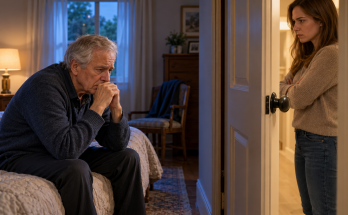
I approached the door again.
"Lauren?"
I waited.
No answer came.
I rested my hand against the wood.
"I don't want us to end up hating each other."
I heard no movement.
"I want you to open the door so we can talk like two people who respect each other."
The words sounded strange as soon as I said them.
I was asking for something that should never have needed to be requested.
I stepped away and sat down.
I thought about the old office.
It had always been a practical place.
I kept papers there because I liked knowing where everything belonged.
I could find a contract without searching through piles.
I could locate a financial statement without wondering whether someone had moved it.
The property papers were part of that system.
They were important because they recorded ownership, not because I wanted to use them to make Lauren feel small.
I had never hidden the fact that the house belonged to me.
I had never promised her that I would transfer it to her.
Yet she had continued asking as if my refusal were only a temporary obstacle.
I wondered whether she had come to believe that persistence would eventually make me change my mind.
Perhaps I had helped create that expectation by allowing the same conversation to continue for so long.
Whenever she became upset, I tried to soothe her.
Whenever she accused me of being difficult, I explained myself again.
Whenever she said she was trying to help, I tried to understand her intentions.
I had hoped that patience would preserve our relationship.
But I could now see that I had been doing most of the work to keep the peace.
Lauren had not accepted my answer.
And I had not insisted strongly enough that my answer mattered.
That realization hurt.
It was easier to blame myself than to accept what she had chosen to do.
Still, I had to be careful.
I could regret the way I had handled earlier conversations without taking responsibility for her decision to lock me inside.
Those were different things.
I had been willing to discuss the house.
I had been willing to answer questions about the records.
I had been willing to consider reasonable arrangements that did not require me to surrender ownership.
I had not agreed to give her everything she wanted.
That was my right.
I heard a sound in the hallway and stood.
"Lauren?"
The footsteps approached the door.
She stopped outside.
"What now, Dad?"
I took a breath.
"I need you to open the door."
"We've already talked about this."
"No. You've told me what you want. I have told you what I want. Keeping me in here isn't a conversation."
She sighed.
"You make it sound terrible."
I stared at the handle.
"It is terrible to be unable to leave your own room."
She didn't answer immediately.
I thought I heard her shift her weight.
For a moment, I hoped she might finally acknowledge what I had said.
Instead, she asked whether I had reconsidered the house.
I felt the last of my hope fade.
"No," I said. "I haven't changed my mind."
"Then we're getting nowhere."
"We could start by opening the door."
She said I was being impossible.
I remained quiet.
I had learned that answering every accusation only gave the conversation another direction to follow.
The silence lasted several seconds.
Then her footsteps moved away.
I sat down again.
I felt exhausted, but my thoughts had become clearer.
I did not have to decide what kind of person Lauren was.
I did not have to determine whether she had always intended to pressure me.
I only had to respond to what she was doing now.
She was keeping me inside.
I wanted to leave.
I would not agree to transfer the house in exchange for my freedom.
I repeated those points until I could think about them without the same wave of panic rising in my chest.
Then I looked toward the window again.
I needed to keep watching for a safe opportunity to reach help.
I would not try to force my way out recklessly.
I would not make promises I didn't mean.
And I would not let the argument about the documents distract me from the fact that I had been denied the ability to leave.
The papers mattered.
My home mattered.
But right then, the next step was simpler.
I needed the door to open.
Click here to continue reading: PART 19: I Refused to Sign Away the House in My Mind, Even as the Quiet Around Me Made Every Passing Minute Feel Longer
I Thought My Daughter Wanted the House Until I Realized She Needed Something I Had Never Agreed to Give Her
Part 18 of 20

One Comment on “PART 18 – I Began to See That the Documents Were Not the Real Disagreement, but the Control My Daughter Wanted Over My Home”