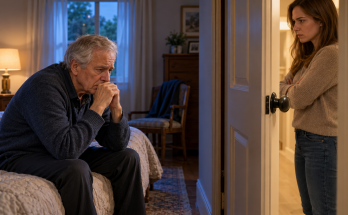
The next morning, Lauren didn't call.
I told myself that was probably a good thing.
We had reached a point where every conversation about the house left both of us upset.
A little distance might help.
I went about my day as usual.
I cleaned the kitchen, answered a few letters, and spent time in the office.
But I found myself thinking about her final remark.
You'll wish you'd listened to me.
It wasn't the sort of thing a person said after an ordinary disagreement.
Still, I tried not to attach a meaning to it that I couldn't prove.
People said unkind things when they were angry.
I had done it myself.
That didn't make every angry sentence a promise.
Two days passed.
On the third morning, Lauren called and asked whether I needed anything.
I said I didn't.
She asked if I had eaten breakfast.
I told her I had.
Then she asked whether I had considered what she had said.
I knew what she meant.
"No," I said. "My answer hasn't changed."
She was quiet.
Then she told me I was making a mistake.
I asked her to explain what mistake I was making.
She said I was refusing to plan sensibly for the future.
I told her I had planned for the future.
She asked whether I expected her to stand by and do nothing.
I said I expected her to respect my decision.
She ended the conversation soon afterward.
I sat with the phone in my hand, feeling a mixture of sadness and anger.
I didn't want to fight with my daughter.
But I was beginning to understand that avoiding a fight and giving someone what they wanted were not the same thing.
For years, I had tried to keep our relationship peaceful by finding the softest possible way to say no.
Now even a gentle refusal seemed to be treated as a personal insult.
I couldn't keep doing that.
Later that afternoon, I went into the office and looked at my records.
I checked the folders I used most often.
Then I checked the list I had made.
Everything appeared to be in order.
I was careful not to let my concerns become an excuse to spend every waking hour checking locks and papers.
I had other things to do.
I had bills to pay.
I had meals to prepare.
I had a life that existed beyond my daughter's demands.
I wanted to keep living it.
The following week, Lauren began visiting more frequently.
Sometimes she brought food.
Sometimes she arrived with no explanation beyond wanting to see me.
She could be pleasant for an entire visit.
Then, just before leaving, she would ask another question about the house.
Had I reconsidered?
Had I thought about the consequences?
Wouldn't it be better if she took responsibility now?
My answers remained the same.
No.
I wasn't transferring the property.
I wasn't signing documents I didn't understand.
And I wasn't giving her access to my original records simply because she wanted it.
One afternoon, she came into the kitchen while I was preparing lunch.
She watched me cut a piece of bread.
"You've made up your mind, haven't you?"
I put the knife down.
"Yes."
She nodded slowly.
"Then there's no point talking."
I didn't answer.
She stood there for a moment before walking into the living room.
I heard her moving a chair.
Then she returned to the kitchen.
"You know, people might think you're being unreasonable."
I looked at her.
"Which people?"
She didn't give me a name.
She said I was making things difficult for everyone.
I asked her who everyone was.
She looked irritated again.
"Forget it."
She walked out.
I stood at the counter with the knife beside the bread.
I had begun to recognize the pattern.
Whenever I asked for specifics, the conversation became about my attitude.
Whenever I asked what she wanted, she said I was refusing to understand.
Whenever I asked for a clear explanation, she walked away.
I couldn't tell whether she was deliberately avoiding the questions or whether she had convinced herself that I was the problem.
Either possibility troubled me.
That evening, I went through the house and checked the doors.
I stopped at the entrance to the forgotten room.
I didn't open it.
I simply looked at the lock.
The black key was still in my possession.
I had checked the documents enough times to know they were there.
I reminded myself that I couldn't control everything Lauren might think or say.
I could control whether I signed away my rights.
I could control whether I allowed someone to pressure me into a decision.
For now, that was enough.
A few days later, Lauren arrived earlier than I expected.
I was in the living room reading when she knocked.
I opened the door and let her in.
She seemed unusually serious.
She asked whether we could sit down.
I put my book on the table.
She sat opposite me.
For a few seconds, neither of us spoke.
Then she said she had been thinking about our conversations.
I waited.
She told me she didn't want us to keep arguing.
I said I didn't want that either.
She said she wanted to find a way forward.
I asked what she had in mind.
She said we should stop focusing on who owned what and start thinking about what was best for the family.
I felt a familiar heaviness settle in my chest.
Ownership wasn't an abstract subject.
The house had an owner.
The documents established that fact.
I had no intention of pretending otherwise to make the conversation easier.
"I want us to get along," I told her. "But that doesn't mean I have to give you the house."
She looked down at her hands.
"I never said you had to."
"You've asked me to put it in your name."
"Because I think it's the right thing to do."
"For whom?"
She didn't answer.
I waited.
Eventually, she said she was trying to prevent trouble later.
I asked what trouble.
She stood up.
"I can't explain everything to you if you refuse to listen."
"I've listened to every word you've said."
She picked up her handbag.
"Not really."
I remained seated.
I didn't follow her to the door.
I didn't apologize.
I didn't try to make the conversation end on a happier note.
When she left, I felt an emptiness I couldn't easily describe.
I had wanted an honest conversation.
I had wanted my daughter to tell me what she believed would happen if I kept control of my own property.
Instead, I had received another accusation.
I sat alone until the room began to darken.
Then I turned on the light.
That simple action made me realize how much time I had spent waiting for Lauren to make the next move.
I had been arranging my days around the possibility of another difficult visit.
I had been checking the office because I worried she might want something from it.
I had been holding back ordinary questions because I didn't want to upset her.
The house was still mine, but I no longer felt entirely comfortable in it.
That frightened me.
I had worked for years to create a home where I could live without having to explain myself to anyone.
Now I found myself listening for the sound of a car outside.
I didn't like the person I was becoming.
So I made another decision.
I would continue living normally.
I would answer the phone when I wanted to.
I would welcome Lauren when she came to visit respectfully.
But I would not spend every day preparing for an argument.
The following morning, I made breakfast and sat near the window.
I watched the sunlight move across the kitchen floor.
For a little while, I felt like myself again.
Then my phone rang.
It was Lauren.
I answered.
She asked whether she could come over that afternoon.
I said yes.
She thanked me and ended the call.
I looked at the phone after the screen went dark.
I hoped she wanted to talk about something other than the house.
I hoped we might find a way to repair the damage between us.
But I also knew that hope couldn't replace caution.
I went into the office and checked the cabinet one last time before lunch.
The important documents were still where I had left them.
I closed the cabinet.
Then I returned to the kitchen and waited for my daughter.
Click here to continue reading: PART 7: I Wanted One Ordinary Afternoon With My Daughter, but Her Visit Left Me Wondering Whether My Own Home Was Still a Safe Place
I Thought My Daughter Wanted the House Until I Realized She Needed Something I Had Never Agreed to Give Her
Part 6 of 20