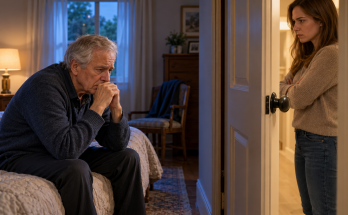
I didn't know how much time had passed when I heard footsteps in the hallway again.
I stood immediately.
For several seconds, I said nothing.
I listened to the steps approach and stop outside my door.
Then Lauren spoke.
"Are you ready to talk?"
I looked at the handle.
I had imagined this moment several times.
Each time, I had hoped she would come back ready to open the door and admit that the situation had gone too far.
Her first question told me that nothing had changed.
"I am ready to talk when you let me out," I said.
"We can't keep doing this."
I almost laughed at the words.
She was the one keeping me inside, yet she spoke as though we were both responsible for an argument that had simply gone on too long.
"Then open the door."
"You need to understand what I'm asking you to do."
"I understand."
"No, Dad. You don't."
I leaned closer to the door.
"You want me to agree to your proposal about the house and the documents. I don't agree. That doesn't mean I haven't listened."
She became quiet.
I waited for her to respond.
Instead, she said I was making a mistake.
I had heard that before.
Perhaps she believed repeating it would make the warning more convincing.
Perhaps she thought I would begin to doubt myself if she sounded certain enough.
I could not know.
"I am allowed to make my own decisions," I said.
"You're making this harder than it needs to be."
"Keeping me locked in my room is what is making this difficult."
She didn't answer.
I waited beside the door.
My throat felt dry, and my legs were tired from standing and sitting so often.
I wanted to ask her for water again.
I wanted to ask for my phone.
But I knew that the conversation would likely return to the same demand.
I decided to say what mattered most.
"I will not sign anything while you keep me in here."
She replied that she wasn't asking me to sign anything at that moment.
"Then there's no reason to keep the door locked."
I heard her shift her weight.
For a brief moment, I thought she might reach for the handle.
I waited.
The door did not open.
"Just think about it," she said.
"I have thought about it."
"Really think about it."
I closed my eyes.
"Lauren, I don't want to hurt you. I don't want us to keep arguing. But I am not giving you the house because you want it."
She said I was making her feel as though she were a stranger.
That hurt.
I had never wanted her to feel that way.
But I also knew that I couldn't fix her feelings by giving up my own choice.
"I love you," I said. "That has never been in question."
"Then trust me."
"I can love you and still say no."
She didn't respond.
I waited, hoping she would understand that I was not trying to punish her.
I was trying to hold on to a decision that belonged to me.
At last, she spoke again.
"You always have to have things your way."
I looked at the door.
"I am asking to leave my room."
She said nothing.
Then I heard her footsteps moving away.
I remained standing until the sound disappeared.
For a moment, I felt as if the floor had shifted beneath me.
I had hoped that speaking calmly would make her see what she was doing.
Instead, she had turned every request into another argument about whether I trusted her.
I stepped back from the door.
I was tired of explaining that my refusal was not an insult.
I was tired of hearing that love required agreement.
And I was tired of waiting for Lauren to decide that I deserved to leave.
I sat on the bed.
My mind returned to the house and the documents.
I had kept the records for practical reasons.
A person could forget what had been agreed.
A conversation could be remembered differently by two people.
A promise could become uncertain after years had passed.
Paper offered something more reliable.
The original contracts, property papers, business documents, and financial statements recorded what had actually happened.
They were not valuable because they gave me a way to defeat Lauren.
They mattered because they preserved the truth.
I had never intended to use them against my daughter.
I had wanted to keep them safe.
I had wanted to remain in my home without turning every decision into a family dispute.
That had been my intention from the beginning.
I wondered whether I had made a mistake by not insisting on clearer boundaries earlier.
I had allowed too many conversations to end without resolution.
I had let Lauren return to the same request again and again because I thought patience would eventually help.
But patience had not changed the situation.
It had only delayed the moment when I had to acknowledge how serious it had become.
I looked toward the door.
I couldn't undo the earlier conversations.
I couldn't make Lauren reconsider what she had done.
I could only decide what I would do when I had the opportunity to act.
First, I needed to get out of the room.
Then I needed to reach my phone and contact someone.
After that, I would make sure the documents remained secure.
I did not need to settle the future of the house while I was frightened and exhausted.
I did not need to make promises.
I did not need to surrender anything.
I repeated the plan quietly to myself.
The simple order of those steps helped me feel less helpless.
I rose and went to the window.
The view outside had changed again.
The yard looked peaceful, and the house appeared no different from how it had earlier.
That ordinary sight made the situation harder to accept.
I could see the world beyond the glass, but I could not simply step into it.
I turned away and returned to the door.
I tested the handle once more.
It stayed locked.
I released it and leaned against the wall.
I could hear my own breathing.
I had never imagined that I would have to remind myself to remain calm inside my own home.
But I also knew that fear could make a person agree to things they would never choose freely.
I would not let fear make this decision for me.
I would not sign away the house to end the confinement.
I would not hand over the original records just to make Lauren stop asking.
I would wait for the chance to leave, and I would use that chance to reach someone.
I sat down again.
The room was quiet.
I did not know when Lauren would return or what she would say when she did.
I did not know whether she understood that the longer she kept me there, the more difficult it would become to repair the trust between us.
I could not control those things.
I could control my answer.
The house was mine.
The documents were mine.
And I had not agreed to give either away.
I looked at the door, then lowered my eyes.
For the moment, I had no way to open it.
But I could stop treating my daughter's demand as something I was required to obey.
I could stop trying to win her approval by explaining myself one more time.
And I could hold on to the truth until I had the freedom to act on it.
Click here to continue reading: PART 17: I Stopped Asking My Daughter to Understand and Began Looking for a Way Out of the Room She Had Decided I Couldn’t Leave
I Thought My Daughter Wanted the House Until I Realized She Needed Something I Had Never Agreed to Give Her
Part 16 of 20