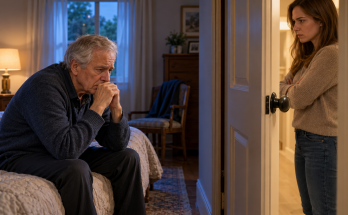
The morning after I found the documents, I woke up feeling more settled than I had in weeks.
I made coffee, opened the curtains, and went through the mail.
Nothing had changed in the house.
The same chair stood beside the kitchen table.
The same clock ticked above the doorway.
The black key remained where I had put it.
Yet I felt differently about everything.
I knew where my important records were, and I knew what they proved.
For once, I wasn't going to spend the day wondering whether Lauren would ask me to sign something.
I had made my decision.
That should have been enough.
Around midday, she called.
She asked whether I had slept well.
I told her I had.
She asked whether I had been feeling lonely.
I said I was used to living alone.
She didn't seem satisfied with that answer.
"You don't have to do everything yourself, Dad."
"I know."
"You could let me help."
"I could."
There was a pause.
"But you won't," she said.
I put my cup down.
"Not with the things we've been discussing."
She exhaled sharply.
Then she said she had to go.
I remained at the table for a while after the call ended.
I wasn't proud of how carefully I had begun choosing my words around my own daughter.
But every conversation seemed to return to the same place.
She wanted more control.
I wanted to keep it.
Neither of us was saying anything that changed the situation.
That afternoon, I went into the forgotten room again.
I wanted to check the folders once more and make sure I had remembered everything correctly.
The black key turned easily in the lock.
Inside, the air smelled faintly of old cardboard and dust.
I checked the original business documents first.
Then the older contracts.
Finally, I reviewed the property papers.
The ownership information remained clear.
I returned everything to its place and locked the door.
I was beginning to understand how much comfort there was in knowing that a thing was exactly where I expected it to be.
For the next two days, Lauren didn't visit.
I wondered whether she was angry with me.
I also wondered whether she had decided to leave the subject alone.
I hoped it was the second.
On the third day, she arrived in the afternoon.
I heard her car outside before she knocked.
When I opened the door, she smiled as if the last few weeks had never happened.
She held a small shopping bag.
"I brought you a few things."
I stepped aside to let her in.
She placed the bag on the kitchen counter and began taking things out.
There was bread, fruit, and a container of food she said I could heat up later.
I thanked her.
She asked about my day.
I told her it had been quiet.
For a while, we talked about ordinary things.
She mentioned someone she had spoken with.
I asked a few questions.
She complained about a minor inconvenience, and I offered an opinion she didn't entirely agree with.
It felt familiar.
I wanted to believe we could still have conversations like that without everything becoming a negotiation.
Then she glanced toward the hallway.
"Have you been working on your paperwork?"
I looked at her.
"A little."
"All the old stuff?"
"Some of it."
She leaned against the counter.
"You know, I could take some of that off your hands."
I put my cup in the sink.
"I've already told you I don't need that kind of help."
"I'm not asking you to give up anything."
"Then what are you asking?"
She looked annoyed.
"Why do you always make me explain myself?"
I turned to face her.
"Because you keep asking me for things you won't explain."
She looked down at the shopping bag.
For a moment, I thought she might apologize.
Instead, she picked up her handbag.
"I shouldn't have come."
I felt the old instinct to reassure her.
I nearly told her that I was sorry.
But I stopped myself.
She had brought groceries.
She had spent time with me.
Those were kind things to do, and I appreciated them.
They didn't mean I owed her control of my affairs.
"You can stay," I said. "We don't have to discuss the paperwork."
She hesitated.
Then she sat down again.
We finished our coffee without mentioning the documents.
When she left, I felt relieved.
I also felt ashamed that a peaceful afternoon with my daughter had become something I measured by the number of subjects we managed to avoid.
That evening, I checked the locks before going to bed.
It was a habit I had always had.
I checked the front door, then the side entrance.
I made sure the windows were closed.
Nothing was unusual.
I told myself I was being sensible, not fearful.
The following morning, I spent several hours in the office.
I reviewed business statements and put away a few letters that had accumulated on the desk.
I was halfway through the work when I heard the phone ring.
It was Lauren.
She asked if I would be home later.
I said I would.
She told me she wanted to stop by.
I asked whether something was wrong.
"No. I just want to see you."
I agreed.
She arrived near the end of the afternoon.
This time, she brought no groceries and made no effort to settle into a casual visit.
She came into the kitchen and stood beside the table.
"Dad, we need to talk about the house."
I felt my shoulders tighten.
"We've talked about it."
"Not properly."
"What haven't we discussed?"
She pulled out a chair but remained standing.
She said she was worried about what would happen if I became unable to manage things.
I told her that I had already thought about my future.
She said that wasn't the same as making practical arrangements.
I asked what practical arrangement she wanted.
She looked directly at me.
"I want you to let me handle the property."
There it was.
No more talk about helping with groceries.
No more vague references to family responsibilities.
I asked what she meant by handling the property.
She said she wanted the responsibility transferred to her.
I asked whether she meant ownership.
She didn't answer immediately.
Then she said it would be easier if the house were in her name.
I felt a strange calm settle over me.
For weeks, I had been trying to understand what she wanted.
Now she had finally said enough for me to understand.
"No," I told her.
She stared at me.
I repeated my answer.
"I'm not transferring the house to you."
Her expression changed.
I had seen that look before, but never so clearly.
She seemed less disappointed than offended.
As if I had refused something she already considered hers.
"You don't understand what I'm trying to do."
"Then explain it."
She shook her head.
"You always think you know best."
"I know who owns this house."
The words came out more sharply than I intended.
She went quiet.
I regretted the sharpness, but not the meaning.
Lauren picked up her handbag.
She said she couldn't keep having this conversation.
I told her we didn't have to have it again.
She walked to the front door.
Before leaving, she turned back.
"You'll wish you'd listened to me."
I watched her step outside.
She closed the door without slamming it.
I stood in the hallway, listening to her footsteps fade.
Then I returned to the kitchen.
Her words stayed with me.
I didn't know whether she meant I would regret refusing her help or whether she believed something would happen that I hadn't anticipated.
I had no way to know.
I only knew that I had given her a clear answer.
That night, I went to the forgotten room and checked the documents again.
I looked at the property papers for a long time.
I didn't need to read every line.
I knew what they said.
The house was mine.
I locked the room and returned the black key to its place.
For the first time, I understood that the papers might matter for reasons I had never expected.
Click here to continue reading: PART 6: After I Refused Her Again, Lauren Stopped Trying to Persuade Me and Began Treating My Decisions as Problems to Be Solved
I Thought My Daughter Wanted the House Until I Realized She Needed Something I Had Never Agreed to Give Her
Part 5 of 20