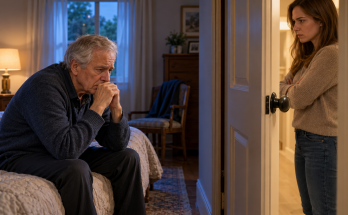
I began to understand that the conversation had become a circle.
Lauren wanted me to agree to her proposal.
I wanted her to open the door.
She told me to think about the house.
I told her I had already made my decision.
Then she repeated that I needed to cooperate.
Nothing changed.
I could keep going around that circle until I was exhausted, but I would still be standing in the same room.
I sat on the bed and tried to slow my thoughts.
My mouth felt dry.
I wanted water, and I wanted my phone.
More than anything, I wanted to walk out of the room without having to ask permission.
I had never thought of those things as privileges.
They were ordinary parts of living in my own home.
Now I had to remind myself that I was entitled to them.
I stood and went to the door.
"Lauren, I need you to open it."
Her answer came after a pause.
"Are you ready to talk?"
I closed my eyes.
"We have been talking."
"Are you ready to listen?"
"I have listened to everything you've said."
"Then why are you still refusing?"
I kept my hand away from the handle.
"Because I don't agree to what you're asking."
She sighed.
I could picture her standing in the hallway with her arms folded, waiting for me to change my mind.
I had seen that expression before.
It usually appeared when a conversation wasn't going the way she expected.
I had often tried to ease the tension by changing the subject or offering to discuss the matter another day.
This time, I couldn't do that.
I was already trapped in the conversation.
"I will discuss the house with you when I'm free to leave," I said.
"You always make everything about yourself."
I looked down at the floor.
I didn't want to argue about whether I was selfish.
That accusation would take us away from the only question that mattered.
"Open the door, Lauren."
She didn't answer.
I waited.
Then I heard her footsteps move away.
I felt the familiar disappointment rise in me, but I forced myself to sit down instead of following the sound with another plea.
I needed to stop treating every silence as an invitation to explain myself again.
I had explained my position.
The house belonged to me.
The records were mine.
I had not agreed to transfer either the property or control over the original documents.
That answer did not become less valid because Lauren disliked it.
I looked toward the window.
The light had grown softer, and the room felt different from the way it had earlier.
I tried to estimate the time.
I couldn't be sure.
Without my phone or a reliable sense of how long I had been inside, the hours had begun to blur together.
I thought about what might happen if I agreed simply to get out.
The idea frightened me more than I wanted to admit.
I could imagine saying the words Lauren wanted to hear.
I could imagine her unlocking the door once she believed I had surrendered.
For a moment, the thought offered relief.
Then I considered what I would have done.
I would have made a decision about my property while being denied the freedom to leave the room.
I would have handed over documents because I was afraid of what would happen if I refused.
I would have allowed pressure to replace consent.
I couldn't accept that.
Even if agreeing made the immediate problem disappear, it would not make the decision right.
And it would not repair what had happened between us.
I got up and paced slowly from the bed to the window.
There was not much room to walk, but movement helped me think.
I tried to remember everything I had noticed during the conversations about the house.
Lauren had asked about the original papers repeatedly.
She wanted to know where I kept the property documents.
She had asked about the old contracts and financial records.
She had seemed dissatisfied whenever I told her that everything was already organized.
I had assumed she wanted to help me manage them.
Now I wondered whether she wanted more than that.
I couldn't be certain of her reasons.
I did not need to invent them.
What mattered was that she wanted me to hand over something I was not willing to surrender.
The documents were important because they recorded the truth.
I had no reason to give them away merely to end an argument.
I returned to the bed.
I rested my elbows on my knees and looked at my hands.
My fingers were trembling slightly.
I pressed them together until they steadied.
I had spent much of my life solving problems by examining the facts.
I needed to do that now.
The first fact was that I was locked inside my room.
The second was that Lauren had the ability to open the door.
The third was that she had chosen not to do so.
The fourth was that I had not agreed to transfer the house.
I repeated those facts to myself.
They were simple.
They were also enough to keep me from becoming lost in all the questions I couldn't answer.
I couldn't know whether Lauren would return in five minutes or an hour.
I couldn't know whether she understood how frightened I was.
I couldn't know whether she believed that keeping me inside would eventually make me agree.
I could only decide what I would do if she returned.
I would not sign anything while I was locked up.
I would not promise to transfer the property simply to make her open the door.
I would keep asking to leave.
And once I had the chance, I would contact someone who could help me deal with the situation.
The thought gave me something practical to hold on to.
I stood and knocked again.
"Lauren, I need my phone."
No answer.
"I need to speak to someone."
The hallway remained quiet.
I stepped back and waited.
I had spent so much time trying to make Lauren understand that I had nearly forgotten I was allowed to seek help without her permission.
I did not have to settle our disagreement first.
I did not have to persuade her that my refusal was reasonable.
I did not have to earn the right to leave my room by agreeing with her.
I was her father.
I was also a person who had the right to make decisions about his own property and his own movements.
Those truths could exist together.
I sat down again.
The house remained quiet around me.
I thought about the old office and the records I had stored there.
I thought about the papers that established my ownership.
I had always kept them carefully because they mattered.
I could not reach them at that moment, but I did not need to hold them in my hands to know what they said.
Lauren's wishes did not rewrite them.
Her frustration did not change them.
And locking me in a room did not change who owned the house.
I repeated that last thought until my breathing became steadier.
I was still frightened.
I was still trapped.
But I was no longer trying to solve the problem by finding the perfect words for my daughter.
I needed to get out.
I needed to reach someone.
And I needed to keep my decision my own.
Click here to continue reading: PART 16: Even After Lauren Returned to the Door, I Refused to Trade My Freedom for a Promise I Did Not Mean
I Thought My Daughter Wanted the House Until I Realized She Needed Something I Had Never Agreed to Give Her
Part 15 of 20