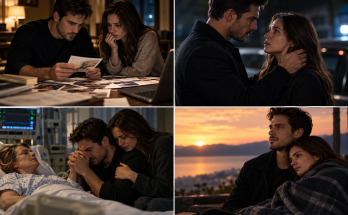
Sarah was sixty-three when the university proposed an exhibition.
The request arrived politely.
The medical ethics department wanted to collaborate with the archive on a public display about patient autonomy.
Sarah Reed's case would be one of several.
The archivist emphasized that nothing would happen without family permission.
Sarah's first answer was no.
David asked why.
“Because exhibitions simplify.”
“So do families.”
“Not the same.”
He smiled.
“No?”
Sarah ignored him.
The proposal sat on her desk for two weeks.
Then a medical student contacted her.
His name was Jonah Park.
He was researching the history of support-person rights.
He had read the public description of the Sarah Reed Family Care Initiative but could not access restricted family materials.
He asked for an interview.
Sarah almost declined.
Then remembered Leo's note.
Truth available.
Not compulsory.
She agreed to coffee.
Jonah arrived with a notebook but did not open it until Sarah gave permission.
Good start.
“What do you want to know?”
He looked nervous.
“Why your family eventually allowed the hospital to use Sarah's name.”
Sarah explained.
Not because they forgave the institution.
Not because reform balanced the harm.
Because a useful practice mattered more than protecting anger.
Jonah wrote that down.
Then he asked about Dr. Bell.
Sarah's expression hardened.
“What about him?”
“Was he responsible for Sarah's death?”
The question was exactly the kind she feared.
Clean.
Simple.
Tempting.
“The specialists said his delayed response significantly reduced her chance of survival.”
“So yes?”
“No.”
Jonah stopped writing.
Sarah continued.
“Don't improve the evidence because a stronger sentence feels satisfying.”
He looked embarrassed.
“I'm sorry.”
“Don't be. Just be accurate.”
He nodded.
“What about Daniel's father?”
“He deliberately interfered with Sarah and Daniel's relationship. He concealed Leo's survival. He arranged surveillance. He participated in the forged letter.”
“Why?”
“Control.”
“Did he think he was helping?”
“Probably.”
“Does that matter?”
Sarah thought.
“Yes.”
Jonah seemed surprised.
“It doesn't excuse him.”
“No.”
“But if you only study people who know they're villains, you'll learn very little about ordinary harm.”
Jonah stopped writing again.
Sarah smiled.
“That one you can write down.”
He did.
The interview lasted two hours.
Afterward Sarah reconsidered the exhibition.
Maybe simplification was not inevitable.
Maybe it depended on who controlled the frame.
She agreed to meet the curators.
Her conditions were extensive.
No dramatized reconstruction of Sarah's death.
No photograph of bloodstained hospital rooms.
No invented dialogue.
No completing Daniel's unfinished sentence.
No describing Leo as abandoned by his father without explaining the deception.
No implying I knowingly withheld Daniel's identity.
No treating Ruth or Evelyn as monsters.
No sentimental claim that everything “worked out.”
The curator, Amara Lewis, listened.
Then said, “You have thought about this.”
“For sixty-three years, apparently.”
Amara smiled.
“What do you want visitors to understand?”
Sarah looked at the table.
“Consequences accumulate.”
“Explain.”
“One person lies.”
She counted on her fingers.
“Another stays silent. Another assumes. Another delays. Another protects an institution. Another decides the truth would hurt too much.”
She looked up.
“Eventually a child grows up inside the combined result.”
Amara wrote that down.
The exhibition took a year.
Sarah remained involved.
She rejected three drafts.
One called Daniel and the first Sarah “star-crossed teenage lovers.”
“No.”
“Why?”
“They weren't characters in a romance novel.”
Another described me as “the grieving grandmother who fought for justice.”
Sarah crossed out the phrase.
“She raised Leo for ten years before she knew there was anything to fight.”
The final version was quieter.
Visitors first saw Sarah's name.
Her age.
Eighteen.
Then a few ordinary facts.
She wanted yellow curtains.
She argued with her mother about purple hair.
She loved Daniel.
She had chosen her baby's name.
Only then came the hospital.
The accident.
The interference.
The false information.
The missing nineteen minutes.
One display contained a reproduction of Sarah's crooked heart.
Another contained Daniel's returned letter.
The unfinished letter appeared only in transcription.
The sentence remained incomplete.
IF EVERYTHING GOES WRONG, REMEMBER THAT I CHOSE—
No speculation followed.
Beside it was a question:
WHAT HAPPENS WHEN OTHER PEOPLE COMPLETE SOMEONE'S SENTENCE FOR THEM?
Sarah approved that immediately.
The exhibition opened without ceremony.
She visited anonymously on the second day.
David walked beside her.
They watched strangers read.
A young couple stood before the section about support persons.
An older man spent several minutes reading Marianne's role.
Two nursing students discussed documentation.
Nobody knew Sarah was standing there.
She liked that.
Then she overheard a woman say, “The father abandoned the baby?”
Sarah turned.
The woman's friend pointed to the next panel.
“No. Look. He thought the baby died.”
“Oh.”
They kept reading.
Sarah smiled.
Context working in real time.
Later she saw a teenager standing before Sarah's photograph.
Not the lake picture.
A school photograph.
Sarah at seventeen.
The teenager's mother said, “She was your age.”
The girl stared.
“She looks normal.”
Her mother frowned.
“What did you expect?”
“I don't know.”
Sarah understood.
History often turned dead people into symbols.
Seeing Sarah's acne, uneven bangs, and annoyed school-picture expression returned her to humanity.
The exhibition ended with no conclusion.
That had been Sarah's demand.
Instead, visitors encountered several questions.
Who is missing from the conversation?
Who benefits from delay?
Whose consent is being assumed?
What information are you withholding because you believe you know what another person can handle?
And finally:
WHO IS WAITING OUTSIDE?
Sarah stood before that one.
David joined her.
“You okay?”
“Yes.”
“You sure?”
“No.”
He smiled.
“Family answer.”
She leaned against him.
A group of medical students entered behind them.
One read the final question aloud.
“Who is waiting outside?”
Another said, “That's brutal.”
Sarah looked toward the exit.
For nearly a century, that waiting room had lived inside her family.
Now strangers were carrying the question.
Not the grief.
The question.
That distinction mattered.
Several months after the exhibition opened, Sarah received a letter.
Handwritten.
A woman named Celeste explained that she had visited while struggling with whether to tell her adult daughter about a hereditary medical condition.
She had convinced herself withholding the information would protect her.
Then she read Leo's archived statement about people deciding what someone else could know.
Celeste told her daughter.
The conversation was difficult.
But necessary.
She thanked the family.
Sarah read the letter twice.
Then she placed it in a drawer.
Not the archive.
Not everything had to become history.
Another visitor wrote that the exhibition was unfair to Dr. Bell because medicine had been different then.
Sarah did not respond.
Another claimed Daniel's father had only wanted the best for his son.
Sarah did not respond to that either.
Public truth meant surrendering control over interpretation.
That was difficult.
Necessary too.
One evening Jonah Park called.
He had graduated.
He was beginning residency.
“I wanted to tell you something.”
“What?”
“Last week a patient asked for her sister.”
Sarah waited.
“The chart said no visitors.”
“Okay.”
“I almost accepted it.”
Sarah's chest tightened.
“Then?”
“I asked why.”
The restriction had been entered incorrectly after an earlier conflict with a different relative.
The sister was permitted.
Jonah verified.
The patient saw her.
Nothing dramatic happened.
No life saved.
No lawsuit prevented.
Just two sisters sitting together.
Jonah laughed softly.
“It felt almost disappointingly ordinary.”
Sarah smiled.
“That's the goal.”
After the call, she told David.
He understood.
The family's story had spent generations attached to extraordinary harm.
But the best consequence of remembering it was ordinary care.
A question asked.
A door opened.
A person found.
Sarah returned to the exhibition on its final day.
The museum planned to preserve a digital version.
Physical materials would return to storage.
She stood once more before the unfinished sentence.
If everything goes wrong, remember that I chose—
For the first time, she imagined Daniel writing it.
Eighteen.
Angry.
Frightened.
Certain he could still fix everything.
She did not finish his words.
Instead she whispered, “They know.”
Then she walked to the final panel.
WHO IS WAITING OUTSIDE?
She touched the edge of the display.
Not the words.
Then she left.
Outside, David was waiting.
Sarah smiled when she saw him.
“You ready?”
“Yes.”
They walked home together.
Click here to continue reading: PART 20: Long After Everyone Who Knew Sarah Was Gone, One Ordinary Choice Proved Her Story Had Finally Reached Its True Ending
Ten Years After My Daughter Died, a Stranger Came to Her Grave Carrying the Truth She Had Hidden
Part 19 of 35