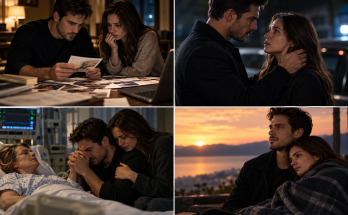
Daniel died in early spring.
Quietly.
No emergency.
No locked hospital doors.
No missing minutes.
Leo was beside him.
So was Nora.
I arrived twenty minutes later.
For once, being late did not contain tragedy.
Daniel had been comfortable.
He had not died alone.
When I entered the room, Leo stood and hugged me.
“He knew me yesterday.”
I held him tighter.
“I know.”
“He called me his boy.”
“I know.”
Nora was crying near the window.
On Daniel's bedside table sat Sarah's lake photograph.
The staff had placed his glasses beside it.
His cane leaned against the wall.
For decades, that cane had been evidence of the accident that divided his life.
Now it was only an object no one needed anymore.
The funeral was small.
Daniel had requested that.
No speeches longer than five minutes.
Leo ignored the limit.
He stood before us holding no notes.
“My father missed the first ten years of my life.”
The room went silent.
“He spent the rest of his trying not to miss anything.”
A few people smiled.
“He overcorrected.”
More laughter.
“He came to games too early. He texted too often. He once drove three hours because I told him my apartment made a weird noise.”
Maya whispered, “Runs in the family.”
Leo heard her and smiled.
“He wasn't perfect.”
Then his expression changed.
“For a long time, I thought family meant knowing where everyone was supposed to be from the beginning.”
He looked toward me.
“But ours never worked that way.”
He spoke about lies.
Not details.
Just enough.
He spoke about people returning.
Apologizing.
Learning.
Staying.
Then he looked toward Daniel's photograph.
“Dad once told me he couldn't prove the future. He could only keep showing up until I knew.”
Leo swallowed.
“I knew.”
That was enough.
We buried Daniel near Evelyn.
Not beside Sarah.
That had been his choice.
When Leo once asked why, Daniel told him Sarah's grave belonged to her story, not his claim on her.
“He finally learned boundaries,” Leo had joked.
Daniel laughed for ten minutes.
After his death, my own health declined quickly.
Not because grief killed me.
People like to say things like that.
The truth was less poetic.
My heart was tired.
My kidneys were failing.
I was old.
The body eventually collects its debts.
I spent more time in bed.
Nora visited constantly.
She was twenty now.
Studying nursing.
That choice surprised all of us.
Given our family history, I expected hospitals to repel her.
Instead she said the opposite.
“Someone has to be the person who checks the waiting room.”
Marianne cried when she heard that.
Leo worried nursing would burden Nora with the past.
She told him to stop trying to control her future.
Daniel would have loved the argument.
One afternoon, Nora sat beside me studying.
I watched her highlight a textbook.
“You're using too much yellow.”
She looked up.
“That's your criticism?”
“Yes.”
“You're dying and still judging stationery.”
“Standards.”
She laughed.
Then her expression softened.
“Are you scared?”
Nobody had asked me directly.
“Yes.”
“Of dying?”
“A little.”
“Of what?”
I thought.
“Leaving all of you.”
“You've been leaving us instructions for thirty years.”
“I'm serious.”
“So am I.”
She closed the textbook.
“Dad knows what to do.”
I smiled.
“That sounds familiar.”
Nora looked toward Sarah's photograph.
“Do you think you'll see her?”
“I don't know.”
“That's a disappointing answer.”
“Would you prefer I invent one?”
“No.”
I took her hand.
“I hope so.”
“That better.”
Later Leo came in carrying soup.
I had stopped eating much.
He pretended not to notice.
“You need some.”
“I've had enough.”
“Three bites.”
“You're bossy.”
“Genetics.”
We had used the joke for decades.
It still worked.
He sat beside me.
After a while he asked, “Do you remember the cemetery?”
“Which time?”
“The first.”
Of course I did.
Sarah's birthday.
Leo ten years old.
His handmade card.
Evelyn beneath the tree.
“Yes.”
“I asked if dead people know when we remember them.”
“You did.”
“What did you say?”
“I said I thought being remembered mattered.”
Leo nodded.
“You were avoiding the question.”
“Obviously.”
He smiled.
“What would you say now?”
Age did not always bring wisdom.
Sometimes it only brought longer evidence.
I considered Sarah.
She had been remembered every year.
But what sustained us was not the memory alone.
It was what we did with it.
Daniel had spent decades loving a son he once believed dead.
Leo raised Nora without making her responsible for old grief.
Nora carried Sarah into a profession built around staying when people were afraid.
Ruth had apologized.
Evelyn had finally told the truth.
Marianne had checked the waiting room.
“Remembering isn't enough,” I said.
Leo looked at me.
“What is?”
“What happens because you remember.”
He waited.
“If remembering Sarah only made us sad, that would be a very small legacy.”
“It changed us.”
“Yes.”
“Sometimes badly.”
“Yes.”
“And sometimes not.”
I smiled.
“Exactly.”
He looked toward the window.
“I still wish she got more.”
“So do I.”
“I wish Dad got more.”
“So do I.”
“I want more with you.”
That one hurt.
I reached for his hand.
“That's how it works.”
“I hate that.”
“I know.”
We sat quietly.
Then I asked him to bring me the fireproof box.
Inside were the papers that had once controlled our lives.
Sarah's original letter.
Marianne's final note.
Copies of Daniel's returned letter.
The forged document.
The hospital acknowledgment.
Photographs.
I separated them.
“What are you doing?”
“Deciding what matters.”
“They all matter.”
“Historically.”
He frowned.
“You want to throw things away?”
“Some copies.”
“You kept them forever.”
“Yes.”
“Why now?”
“Because evidence and memory aren't the same thing.”
I handed him the forged letter.
“This did its job.”
“What job?”
“It proved a lie.”
He looked at Sarah's letter.
“And that?”
“That stays.”
Marianne's note stayed too.
So did Daniel's returned letter.
Not because it proved wrongdoing.
Because it proved he tried.
We shredded duplicate legal papers.
Boxes of them.
Years of fear reduced to thin strips.
Nora fed pages into the machine.
“This feels illegal.”
“It isn't.”
“Are you sure?”
“Laura said we could.”
“You asked?”
“Of course.”
Some habits survived.
When we finished, the box was almost empty.
Only a few papers remained.
The human ones.
A month later, Ruth came to see me.
She was very old too.
We had become sisters again gradually.
Never the way we had been.
Something different.
She sat beside my bed.
“I think about Daniel's letter every day.”
“I know.”
“I wish you'd yell at me one more time.”
“No energy.”
She laughed.
Then cried.
“I loved Sarah.”
“I know.”
“I loved Leo.”
“I know.”
“I was still wrong.”
“Yes.”
That answer once would have hurt her.
Now it comforted her.
Because truth no longer meant abandonment.
She kissed my forehead before leaving.
“I'll see you soon.”
“Threat?”
“Promise.”
She died the following year.
I did not make it that long.
My final weeks were peaceful.
Nora arranged home care.
Maya handled medications.
Leo slept in the chair beside my bed more nights than he admitted.
One morning I woke before sunrise.
The house was quiet.
Leo was asleep.
His face, relaxed, suddenly resembled the ten-year-old boy at Sarah's grave.
I watched him for a while.
Then he opened his eyes.
“You okay?”
“Yes.”
“You need something?”
“No.”
He sat up anyway.
I had grown very tired.
Speaking took effort.
“Leo.”
“I'm here.”
I smiled.
Of all the words he could have chosen, those were the right ones.
“I know.”
He moved closer.
“Don't talk if you're tired.”
“I need to.”
He waited.
“Your mother loved you.”
His face crumpled.
“I know.”
“Your father loved you.”
“I know.”
“I love you.”
“I know.”
I frowned.
“That's a lot of knowing.”
He laughed through tears.
“Sorry.”
“Let me finish.”
“Okay.”
I took his hand.
“You don't owe us a perfect life because we lost things.”
He looked down.
“You've told me.”
“I'm old. I repeat.”
“I noticed.”
“Nora doesn't owe it either.”
“No.”
“Tell her.”
“I will.”
I closed my eyes for a moment.
Then remembered something.
“The card.”
“What card?”
“The cemetery.”
His expression changed.
“My birthday card for Mom?”
“Yes.”
“You remember that?”
“I remember everything inconvenient.”
He laughed again.
“You wrote that you thought you would've liked her.”
“I was ten.”
“You would've.”
He wiped his face.
“I think so too.”
I rested.
A while later Nora came downstairs.
She climbed into bed beside me as if she were six.
Maya brought coffee nobody drank.
The morning brightened.
There was no dramatic final sentence.
No revelation waiting decades to be discovered.
We had used those already.
There was only family.
I died that afternoon.
Leo told me later—if later is a thing I could somehow know—that my hand remained around his until near the end.
They buried me beside Sarah.
My name appeared beneath hers on a separate stone.
Leo chose simple words.
Mother.
Grandmother.
Stayed.
Years later, when Nora had children of her own, she brought them to the cemetery.
One of them asked why so many family members were buried in different places.
Nora explained what children needed.
Then they came to Sarah's stone.
Her daughter pointed.
“Who's that?”
Nora smiled.
“That's Sarah.”
“Your grandma?”
“Sort of.”
Children accept strange families easily when adults do not teach them otherwise.
Nora sat in the grass.
“She had my dad when she was very young.”
“Did she know him?”
“For a little while.”
“Did she love him?”
“Yes.”
“How do you know?”
Nora looked toward my name beneath Sarah's.
“Because she made sure somebody told him.”
That wasn't literally true.
Sarah had told me.
I had told Leo.
Leo told Nora.
Nora told her daughter.
But perhaps that was how love worked across generations.
Not by surviving untouched.
By being carried.
The child touched Sarah's stone.
Then mine.
“Did this grandma know Dad?”
Nora laughed.
“Oh, yes.”
“Was she nice?”
“Sometimes.”
I would have objected.
Her daughter smiled.
“What did she do?”
Nora looked across the cemetery.
Then she began.
“She stayed.”
And that was the part worth remembering.
Click here to continue reading: PART 13: Years After the Graves Went Quiet, Nora Found a Recording That Let Leo Hear His Grandmother’s Voice One More Time
Ten Years After My Daughter Died, a Stranger Came to Her Grave Carrying the Truth She Had Hidden
Part 12 of 35