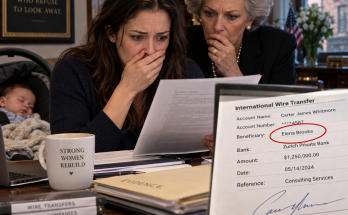
Evelyn did not speak for nearly a minute.
Seven-point-two million dollars.
Money moved from the trust.
Money diverted through foundation-linked companies.
Money Evelyn had hidden because she claimed she was protecting the Whitmore family from Richard.
Gone.
Mark was the first to break the silence.
“When?”
Marianne’s voice shook through the phone.
“Over three days.”
“Three days?”
“He said the accounts had to be moved before the court froze them.”
Evelyn whispered, “You gave him credentials.”
“I thought you sent him.”
“Why would you think that?”
“He knew everything.”
Of course he did.
Victor’s greatest asset had never been money.
It was knowledge.
He knew the companies.
The passwords.
The fears.
The private arrangements each person believed belonged only to them.
Emily felt a cold admiration for the mechanics of it.
Victor had spent years making himself indispensable to people who distrusted one another.
When the structure began collapsing, he used their secrecy as authentication.
Marianne continued.
“He knew the phrase.”
Evelyn stiffened.
“What phrase?”
“The one you told me to require if anyone ever needed emergency access.”
Evelyn closed her eyes.
Mark said, “Mom.”
She looked older suddenly.
“It was something Richard used to say.”
“What?”
Evelyn hesitated.
“Keep the doors open, lock the drawers.”
Emily remembered hearing Richard say variations of it at family dinners.
Business advice disguised as wisdom.
Victor would have heard it dozens of times.
“You used a family saying as a security phrase?” Harrison asked.
“I didn’t think anyone knew Marianne and I used it.”
“Victor knew.”
“Yes.”
Marianne had initiated transfers into three foreign accounts.
Then two more.
By the time she realized Evelyn had not authorized anything, the funds had moved again.
Tracing would take time.
Recovery was uncertain.
The admission created another problem.
Marianne had helped transfer money she knew originated from concealed reserves.
Her own exposure was substantial.
Harrison said, “You need independent counsel immediately.”
“I don’t want a lawyer.”
“That is not a sensible position.”
“I want to fix this.”
“Then get a lawyer.”
For once, Evelyn agreed with him.
“Marianne, do it.”
The call ended.
Emily looked at Evelyn.
“You were ready to let Victor keep managing the reserve even after you knew he threatened people.”
Evelyn’s face tightened.
“I did not know the extent.”
“You knew enough.”
“Yes.”
“You knew he followed Thomas.”
“Yes.”
“You knew he pressured Peter Lang.”
“I knew he frightened him. I didn’t know exactly how.”
“Does the distinction help you sleep?”
Evelyn looked directly at her.
“No.”
That answer took some of Emily’s anger with it.
Not forgiveness.
Only momentum.
The next forty-eight hours became an accounting operation.
Prosecutors, private counsel, bank compliance teams, and foreign investigators began tracing the missing funds.
Emily remained outside the criminal investigation itself.
Harrison insisted.
“You are a witness and civil party, not federal law enforcement.”
“I know.”
“You have a distressing habit of saying that immediately before doing something.”
“I’m reviewing discovery.”
“That, you may continue.”
Within produced records, Emily mapped every known Victor-linked entity.
She built a timeline.
Payments from Richard-controlled companies.
Transfers from Evelyn’s reserves.
Victor’s vendors.
Northline.
Meridian.
Private investigators.
Rental properties.
She added dates of known surveillance.
Then the threats.
Then Victor’s disappearance.
Something bothered her.
Martha saw it.
“You’re making that face.”
“What face?”
“The one you make when numbers offend you personally.”
Emily pointed to the screen.
“Victor stole the reserve after he knew M-42 had been found.”
“Yes.”
“He fled the country.”
“Yes.”
“Then why keep watching me?”
Martha frowned.
“Do we know he is?”
“The black sedan surveillance happened before he left.”
“Correct.”
Emily shook her head.
“Not that.”
She opened a bank alert Harrison had forwarded.
A transaction had hit one of the frozen Seventeen North accounts the previous evening.
Only nine dollars.
A verification charge.
It failed because the account was restricted.
Merchant:
MERCER CONSULTING SERVICES.
Martha leaned closer.
“That’s your surname.”
“Yes.”
“And?”
“I have never owned a company called Mercer Consulting Services.”
Could be coincidence.
Emily searched only within discovery materials and public information authorized by Harrison.
The company had been formed six days earlier.
Registered through an online agent.
No public owner.
No real office.
“What would a nine-dollar verification do?” Martha asked.
“Test whether the account still accepts transactions.”
“Why use your name?”
Emily felt cold.
“To make sure I notice.”
She called Harrison.
He agreed.
“This may be communication.”
“From Victor?”
“Possibly.”
“He’s supposed to be in Nassau.”
“Supposedly.”
Another transaction appeared three hours later.
Eleven dollars.
Merchant:
DANIEL MERCER ARCHIVES.
Emily stood.
Her father’s name.
This was no coincidence.
Harrison contacted investigators immediately.
The merchant accounts had been created through a payment processor using prepaid credentials.
IP data was subpoenaed.
The first traced to a hotel Wi-Fi connection in Nassau.
The second did not.
It originated domestically.
Within fifty miles of the city.
Emily stared at the result.
“He came back.”
“Or someone acting for him is here.”
“Why?”
“We don’t know.”
The next failed charge arrived at 2:14 in the morning.
Seventeen dollars.
Merchant:
LEO HOLDINGS.
Emily stopped breathing.
Harrison’s voice over the phone became steel.
“Pack nothing. Stay inside. Police are already on the way.”
Martha checked the locks.
Emily lifted Leo from the bassinet and held him against her chest.
Her son slept through the entire thing.
Sirens did not approach.
The police came quietly.
Two unmarked vehicles.
Officers positioned outside the house.
The payment processor traced the third charge faster.
A coffee shop twelve minutes away.
Security footage showed a man using a laptop.
Not Victor.
Young.
Baseball cap.
Beard.
Investigators located him within hours.
His name was Kevin Doyle.
Freelance technology contractor.
He had been paid through cryptocurrency to create the merchant accounts and initiate the charges.
“By whom?” Harrison asked during the update.
Kevin claimed he did not know.
Instructions arrived through encrypted messages.
He was told exactly what names and amounts to use.
Eight hundred dollars total.
No idea why.
“Can they trace the sender?” Emily asked.
“They’re trying.”
“What was the next instruction?”
Harrison hesitated.
“There was one.”
Emily tightened her grip on the phone.
“What?”
Kevin had been told that if all three charges failed, he should deliver an envelope.
“To me?”
“Yes.”
“Where?”
“Martha’s house.”
Martha said something under her breath.
Police recovered the envelope from Kevin’s car.
They opened it before Emily saw it.
Inside was no threat.
Only a photocopy.
An old invoice from Daniel Mercer’s repair business.
One line highlighted.
EMERGENCY COOLING REPAIR — WHITMORE ESTATE EAST SERVICE ANNEX.
Date:
Nine years earlier.
Emily stared.
“What is the east service annex?”
Mark, contacted immediately, did not know.
Neither did Evelyn.
Richard did.
His reaction on the call was instant.
“Where did you get that?”
Emily felt her pulse rise.
“Why?”
“Answer me.”
“No.”
Richard’s silence changed.
Harrison spoke.
“Mr. Whitmore, identify the east service annex.”
Richard ignored him.
“Emily, do not go there.”
She almost laughed.
“I wasn’t planning to.”
“Listen to me.”
“Then answer.”
Richard exhaled hard.
“It was an old utility building.”
“Was?”
“Demolished.”
“When?”
“Five years ago.”
“What was inside?”
“Mechanical systems.”
“My father repaired them.”
“Yes.”
“Why would Victor send me the invoice?”
Silence.
“Richard?”
“It wasn’t Victor’s building.”
That caught everyone.
“Whose was it?”
Richard answered reluctantly.
“Thomas used it.”
Mark leaned toward the phone.
“For what?”
“Records. Meetings. Whatever he wanted.”
Emily looked at Harrison.
Thomas had another archive.
Another location.
Richard continued.
“When I found out he was meeting people there, I shut it down.”
“Federal investigators?” Emily asked.
“I don’t know.”
“Laura Chen?”
A pause.
“Maybe.”
Harrison asked, “What was demolished?”
“The structure.”
“And its contents?”
“Removed.”
“By whom?”
“Thomas, supposedly.”
Emily looked again at her father’s invoice.
Nine years ago.
Long before Thomas’s final investigation.
“What did my father repair?”
“Cooling.”
“For records?”
“I don’t know.”
Emily heard the lie.
Not because of tone.
Because Richard Whitmore did not preserve buildings he did not understand.
“Was there something underground?”
Silence.
Mark looked sharply toward Emily.
Richard said, “Why would you ask that?”
Because the estate archive had been hidden behind mechanical access.
Because her father specialized in climate systems.
Because Thomas trusted concealed spaces.
“Was there?”
Richard did not answer.
Harrison ended the call after advising Richard’s counsel that preservation would be sought immediately.
Public property records showed the east service annex parcel still belonged to a Whitmore subsidiary.
The building was gone.
But old site plans revealed a basement.
A very small one.
No current structure sat above it.
The court approved inspection the next morning.
This time, investigators attended because Victor had apparently directed Emily toward the location.
The ground had been paved into an equipment lot.
Scanning identified the old foundation.
And beneath it, a sealed chamber.
Not accessible from above.
A side entrance had been filled with concrete.
Excavation began under supervision.
At 3:20, workers exposed a steel door.
It had rusted around the edges but remained intact.
Inside, they found shelves.
Most empty.
A desk.
Two broken chairs.
Old ventilation equipment with Daniel Mercer’s service tag.
And a single metal filing cabinet.
The cabinet contained no financial records.
Only photographs.
Dozens.
Thomas meeting people.
Laura Chen.
Peter Lang.
Lawyers.
Former Whitmore employees.
Richard.
Evelyn.
Victor.
Mark.
Even Emily’s father.
The surveillance archive was older than anyone realized.
One photograph showed Daniel Mercer and Thomas Whitmore standing together outside the annex.
They were shaking hands.
Emily stared at it.
“My father knew Thomas.”
Not merely through a repair job.
They knew each other personally.
The date on the photograph was nine years earlier.
Long before Emily met Mark.
Inside the same folder was a handwritten note from Thomas.
Danny thinks his daughter can read the structures if we ever need someone outside the family.
Emily’s throat tightened.
Her father had known about Thomas’s concerns.
Perhaps more than the letter said.
At the bottom of the filing cabinet lay a small digital recorder.
Its battery long dead.
Forensic technicians recovered the memory.
One audio file.
Thomas and Daniel Mercer speaking.
Her father’s voice.
Emily had not heard it in years.
The first sound nearly broke her.
Then Daniel said:
“If Emily ever gets close to these people, I’m telling her everything.”
Thomas answered:
“Then pray she doesn’t.”
Her father laughed once.
“No. If she gets close, pray she believes me.”
The recording continued.
They discussed Richard.
The trust.
Victor.
Evelyn.
Then Thomas said something that made Emily stop breathing.
“Mark is the way in.”
Daniel responded immediately.
“My daughter is not marrying somebody so you can investigate his father.”
Thomas laughed.
“That isn’t what I meant.”
“Then what did you mean?”
Thomas’s answer came clearly.
“Mark has already started asking questions.”
Emily looked toward Mark.
He stared back.
The recording was nine years old.
Mark had been questioning Richard long before Thomas came to him eighteen months earlier.
Long before he claimed he knew anything.
Click here to continue reading: PART 16: The Nine-Year-Old Recording Exposed Mark’s First Lie, and Emily Finally Learned How Long He Had Known the Whitmore Family Was Dangerous
Before Dawn, Mark Said One Word and Expected Emily to Break, but She Had Already Started Counting Everything He Hid
Part 15 of 24