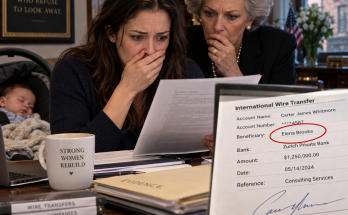
Chloe was sentenced eight months after I returned from Hawaii.
No prison.
Two years of supervised probation.
Community service.
Financial penalties.
Restitution tied to costs created by the fraudulent transfer.
The judge cited her early cooperation, truthful plea, lack of prior record, and the evidence of manipulation by Jason.
He also said something I appreciated.
“Manipulation can explain conduct without erasing responsibility for it.”
Chloe looked at me after court.
“You would like him.”
“Possibly.”
“You’ve become very difficult to impress.”
“That is age.”
Jason received a far longer sentence under his federal plea.
I did not attend.
Chloe did.
Once.
She said goodbye.
Not dramatically.
No promise to wait.
No vow of eternal hatred.
She simply told him their marriage was over.
He signed the divorce papers several months later.
Richard Sterling pleaded guilty to charges connected to financial concealment and obstruction from more recent years.
His cooperation exposed additional accounts and helped identify several victims.
Martin Creed also pleaded guilty to financial and conspiracy offenses tied to his private control network.
His cooperation reduced but did not eliminate his sentence.
Captain Reddick was convicted after refusing a plea.
The institutions moved slowly.
Imperfectly.
Publicly.
For once, nobody in my family controlled the outcome.
That was probably the healthiest thing about it.
The property cases continued.
Some homes were returned quickly.
Others became years-long litigation.
The Ruth Vance fund represented dozens of owners.
Chloe started there part-time after completing training in records intake and fraud prevention.
Ashley supervised none of her work.
That was intentional.
Chloe needed bosses who were not relatives.
She complained about them.
Another sign of normal life.
The blue hydrangeas returned the following spring.
I planted them myself.
Chloe offered to help.
I gave her a shovel.
We worked without discussing symbolism.
That pleased me.
Not every flower needed to represent trauma.
Sometimes a hydrangea was a hydrangea.
Eleanor came by in a wide straw hat and criticized our spacing.
“You planted them too close.”
“They’ll survive.”
“They need air.”
“You disappeared for fifty-seven years. You forfeited landscaping authority.”
She laughed so hard she had to sit down.
We still fought.
That surprised people who expected reunion to produce sweetness.
It produced familiarity instead.
Eleanor sometimes became evasive.
I called her on it.
I sometimes became cruel when angry.
She called me on that.
We learned each other late.
Late was not nothing.
Helen and I became sisters again in smaller ways.
Telephone calls.
Lunch.
Complaints about medication advertisements.
We did not rebuild childhood.
We built old age.
Martin wrote twice.
I answered once.
He asked permission to be buried near Ruth someday.
I told him that was not mine to grant.
He wrote back:
Fair.
I kept the letter.
Not because he was my father.
Because he had finally asked instead of arranging.
Robert remained harder.
The dead are inconvenient that way.
You cannot confront them properly.
I spent months furious with him.
Then less furious.
Then furious again.
He had protected me.
He had manipulated me.
He had loved Chloe.
He had used Chloe as part of a strategy.
He had built a system because he feared institutions.
He had eventually tried to return control to me.
None of those truths canceled the others.
One evening, I sat beside his actual burial place near Boston.
Eleanor had finally taken me.
His ashes rested beside his mother.
Not Oak Hill.
The marker was small.
I sat on the grass.
“You made a mess.”
Wind moved through the trees.
“You also saved evidence that helped people.”
I picked at the edge of the grass.
“You should have told me.”
That was the sentence that mattered.
“You should have trusted me enough to let me be afraid.”
I began crying.
Not for the first time.
Not the last.
“I still love you.”
That did not excuse him.
It did not need to.
Love was not acquittal.
When I returned home, I finally opened Robert’s sealed succession amendment with Ashley.
Legally, I had several options.
Restore Chloe’s automatic beneficiary status.
Name another successor.
Place Willow Lane into charitable ownership.
Sell it voluntarily.
Even terminate certain trust restrictions through court because the historical purpose had substantially changed.
Everyone assumed I would restore Chloe.
Perhaps the old Margaret would have.
The mother who rushed to solve discomfort.
The widow who let Robert’s instructions shape decisions after his death.
The woman who mistook inheritance for love.
Instead, I asked Ashley to draft something different.
Willow Lane would remain mine for life.
After my death, ownership would pass to the Ruth Vance Property Defense Fund.
Not for sale.
The house would become an office and temporary legal-support residence for older property owners displaced during title disputes.
The front rooms would hold attorneys and advocates.
The upstairs would offer short-term rooms for people who suddenly discovered their keys no longer opened their homes.
Ashley stared at me when I explained it.
“You’re giving away the house.”
“No.”
I looked around the dining room.
“I’m deciding what it becomes.”
“What about Chloe?”
“She gets something else.”
“What?”
“Nothing tied to obedience.”
Ashley smiled.
“You already told her?”
“No.”
“When will you?”
“Tonight.”
Chloe arrived after work carrying groceries.
She had moved into a rented apartment three months earlier.
Small.
Ugly kitchen.
Bad plumbing.
She loved it.
“It’s mine,” she kept saying, though technically it belonged to a landlord.
What she meant was that nobody had arranged it for her.
We ate dinner.
Afterward I gave her the amended trust.
She read it quietly.
When she reached the disposition of Willow Lane, she stopped.
“The fund gets it.”
“Yes.”
She looked at me.
“Not me.”
“No.”
I waited.
She continued reading.
Then reached the final section.
I had created a separate inheritance for her.
Not the house.
A modest investment account from my own savings and Robert’s legitimate assets.
No behavioral conditions.
No requirement to marry.
No requirement to remain near me.
No requirement to care for Eleanor.
No requirement to work for the fund.
No clause permitting anyone to control her choices.
She looked up.
“What is this?”
“Your inheritance.”
“I thought I lost it.”
“You lost automatic succession to the house.”
“So you restored me differently.”
“No.”
She frowned.
“I don’t understand.”
“The house was never supposed to be a prize.”
I pointed toward the trust.
“You do not get Willow Lane because you became better.”
Her eyes filled.
“You also do not lose every inheritance because you once became worse.”
She stared at the papers.
“I don’t deserve this.”
I sighed.
“We discussed that word.”
She laughed through tears.
“I know.”
“This is what I choose to leave my daughter.”
“Why?”
“Because I want to.”
No dead person’s instruction.
No ancient condition.
No secret obligation.
I wanted to.
That was enough.
Chloe stood.
For one nervous second I thought she might hug me before I was ready.
Instead, she asked:
“Can I?”
I smiled.
“Yes.”
Then I hugged my daughter.
Not the little girl she had been.
Not the woman I wanted her to become.
The complicated adult standing in front of me.
Months later, the final title order concerning Willow Lane was recorded.
My ownership was confirmed.
Every fraudulent instrument connected to Hawthorne’s attempted acquisition was voided.
The new trust designation was entered publicly.
No hidden ledger.
No secret grave.
No duplicate deed waiting behind a wall.
Public record.
I asked for three certified copies.
One went to Ashley.
One to the fund’s independent counsel.
One went into my desk.
Not Robert’s.
Mine.
The old desk remained in the den, but I moved it away from the wall.
The false electrical outlet was repaired.
The hidden cavity stayed empty.
I liked it that way.
Eleanor visited on the first anniversary of my return from Hawaii.
Chloe came too.
Helen.
Ashley.
Mrs. Alvarez wandered over because she had seen cars and considered privacy a character flaw.
We ate outside beside the new hydrangeas.
At one point Chloe went inside for plates.
She returned holding my old brass house key.
The original lock had been restored months earlier.
She placed the key beside me.
“You dropped this.”
I picked it up.
The metal was worn smooth where my thumb had rubbed it for decades.
A year earlier I had stood on the porch with that key refusing to fit.
Jason laughed.
Chloe told me I no longer had a home.
At the time, I thought the worst thing anyone could do was take a house.
I had been wrong.
The worst thing was convincing someone that love required surrendering the right to choose.
Eleanor had done it through silence.
Thomas through fear.
Robert through contingencies.
Martin through control.
Jason through manipulation.
Chloe through betrayal.
And I had done smaller versions whenever I treated my daughter’s life as something I could correct for her.
The house survived all of us.
That evening, after everyone left, I walked through each room.
Kitchen.
Dining room.
Den.
Staircase.
Chloe’s old bedroom.
My bedroom.
The pantry above the hidden chamber.
Nothing felt haunted.
History was still there.
But history and haunting were not the same.
I opened the back door.
The hydrangeas moved in the warm air.
Blue.
Exactly as Robert had liked them.
Exactly as Eleanor once had too.
I sat on the porch steps.
My phone rang.
Chloe.
“You left five minutes ago.”
“I know.”
“What happened?”
“Nothing.”
“Then why are you calling?”
She laughed.
“I wanted to ask whether you want breakfast Sunday.”
I thought about pretending to check my calendar.
“Ten.”
“Too early.”
“Then eleven.”
“Deal.”
She paused.
“Mom?”
“Yes?”
“I’m glad you kept the house.”
“I’m not keeping it forever.”
“I know.”
“Does that bother you?”
“No.”
I believed her.
That was the ending Robert could never have written.
Not because he lacked imagination.
Because it required Chloe and me to become people he could not predict.
After we hung up, I remained outside until the porch light clicked on automatically.
The blue door stood behind me.
My key rested in my pocket.
Tomorrow it would still open the lock.
Someday it would not be my door anymore.
That no longer frightened me.
A home was never proof that nobody could take something from you.
It was the place where you learned what you would no longer surrender.
And after seventy-four years of people hiding truth beneath floors, behind graves, inside marriages, and within love itself, I finally understood what Ruth had meant.
Someone had to stand somewhere and say no.
For now, that place was Willow Lane.
And I was still standing.
The End
Read more original stories on Feel Every Story.
I Came Home From Hawaii to Find My Daughter Wearing My Pearls Beside a Door My Key Could No Longer Open
Part 24 of 24