Harrison Sterling’s office occupied the second floor above a bakery that smelled of cinnamon, burnt sugar and hot bread.
Nothing about the building suggested power.
That reassured Emily.
The Whitmores advertised power everywhere—columns, gates, monograms, plaques bearing Richard’s name. Harrison’s office announced itself with a brass plate small enough to miss if someone climbed the stairs too quickly.
Martha pushed open the door.
Inside, old legal books climbed from floor to ceiling. Paper files sat in disciplined stacks. A large wooden desk filled most of the back room.
Behind it stood Harrison Sterling.
He was in his early seventies, broad-shouldered despite the slight stoop of age, with white hair and heavy black-framed glasses.
His first glance went to Leo.
His second went to Emily.
His third went to the leather portfolio she carried.
“Mrs. Whitmore?”
“Emily.”
“Good.”
He pointed toward a chair.
“I dislike titles in domestic cases. They confuse people about who they are without the marriage.”
Emily sat.
Martha took the chair beside her.
Harrison lowered himself behind the desk.
“What happened?”
Emily began at 4:30.
Harrison interrupted rarely.
When he did, his questions were precise.
Did Mark explicitly order her from the property?
No.
Had Mark physically threatened her?
No.
Had he ever restricted her access to funds?
Increasingly, yes.
Was Leo safe?
Yes.
Was there an existing custody order?
No.
Had she taken property that belonged exclusively to Mark?
Not knowingly.
When Emily described Evelyn’s phone call, Harrison stopped writing.
“Exact wording.”
Emily read from her notes.
You do not want to make an enemy of this family.
Harrison’s mouth tightened.
“Keep that notebook.”
“I intend to.”
“Back it up digitally.”
“I already photographed each page.”
He glanced toward Martha.
Martha looked pleased.
Then Harrison asked about money.
Emily opened the portfolio.
“I received a two-hundred-thousand-dollar inheritance from my father.”
“Separate property initially.”
“Yes.”
“What happened to it?”
“Mark convinced me to contribute it toward a residence we were supposedly renovating together.”
“Whose name is on the deed?”
“Not mine.”
Harrison’s pen stopped.
“Whose?”
“A Whitmore family LLC.”
“Did you know that when you transferred the funds?”
“No.”
“Do you have written evidence regarding the intended purpose?”
Emily slid several printed emails across his desk.
Harrison read.
His eyebrows rose slightly.
In one message Mark had written: Once your dad’s money clears, we can finally put the down payment behind us and the valley house becomes ours for real.
In another: I want this to be something we build together for Leo someday.
Harrison placed both pages aside.
“Useful.”
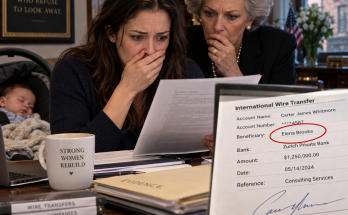
Emily removed additional records.
“After the transfer, the money moved.”
“Where?”
“Through a joint account, then through two affiliated entities, and eventually into something called Aria Development Group.”
Harrison looked over his glasses.
“Who owns Aria?”
“Mark controls it.”
“Purpose?”
“Nominally development consulting.”
“Actual operations?”
“I can’t identify any.”
Now Harrison stopped looking bored.
Emily connected her laptop and opened a spreadsheet she had created.
Different colors identified sources, intermediaries and destinations.
She explained each column.
Dates.
Amounts.
Entity registrations.
Overlapping addresses.
Authorized users.
Harrison moved from leaning back to leaning forward.
“How long did this take you?”
“Fourteen months.”
“Why?”
“Because the numbers bothered me.”
Something almost resembling amusement appeared in his expression.
“What did you do before you married into Camelot?”
“Forensic accounting.”
Harrison turned to Martha.
“You neglected to mention that.”
“I thought you’d enjoy discovering it.”
Harrison looked again at Emily.
“What level?”
“Senior forensic analyst. Corporate investigations.”
“Fraud?”
“Primarily.”
“Asset tracing?”
“Yes.”
“Hidden beneficial ownership?”
“Yes.”
For the first time, he smiled.
“Mark Whitmore is an idiot.”
Emily felt an odd protective reflex rise despite everything.
“He’s not stupid.”
“I didn’t say stupid.”
Harrison removed his glasses.
“Intelligent people become idiots when privilege convinces them other people are furniture.”
He returned to the spreadsheet.
Emily showed him Aria’s transfers.
Harrison’s humor disappeared.
“These are not small numbers.”
“No.”
“And some originate in marital accounts.”
“Yes.”
“Others from entities controlled by Richard Whitmore.”
“That’s what I can establish.”
“You said there was a transaction this morning.”
Emily pointed.
$275,000.
3:58 a.m.
Authorized under Richard’s executive credentials.
Harrison read the memo.
RWH-17.
He repeated it quietly.
“Recognize it?” Emily asked.
“No.”
He wrote the code on a legal pad.
“Do you?”
“Not yet.”
Harrison studied her.
“That phrase will keep opposing counsel awake.”
Emily almost smiled.
He continued through the records.
After several minutes he asked, “Does Mark know you have these?”
“I don’t think so.”
“Good. Do not tell him.”
“I wasn’t planning to.”
“Do not contact Aria. Do not investigate by accessing any system you aren’t legally authorized to access. From this moment, you stop playing detective.”
Emily stiffened.
Harrison saw it.
“This isn’t because I doubt your skill. It’s because you have a child and because the moment litigation begins, methodology matters. You give me what you already possess. We obtain the rest by discovery, subpoena and court order.”
Emily nodded.
“That’s what I want.”
“What do you want?”
The simplicity of the question caught her.
Harrison waited.
She could have said revenge.
At four-thirty, driving away from the manor, perhaps part of her had wanted it.
But sitting here with Leo’s carrier beside her foot, revenge felt wasteful.
“My father’s money restored.”
Harrison wrote.
“Fair division of marital assets.”
He wrote again.
“Financial independence.”
Another note.
“And?”
Emily looked down at her son.
“A custody arrangement that protects Leo from being used as leverage.”
Harrison studied her for a long moment.
“No scorched earth?”
“Only if they light the match.”
Martha’s mouth twitched.
Harrison sat back.
“Good. That’s a position a judge can understand.”
He explained what would happen next.
A divorce petition.
Temporary custody orders.
Financial restraining orders preventing either spouse from moving or dissipating significant marital assets.
Preservation demands for electronic records.
Formal discovery.
Subpoenas where justified.
The process sounded slow.
Slow was fine.
Emily knew what slow scrutiny did to dishonest accounting.
It made every hidden transaction wait under fluorescent light.
At noon Harrison’s assistant brought sandwiches.
Emily barely tasted hers.
Her phone had accumulated seventeen messages from Mark.
The progression fascinated her.
First irritation.
Then reasonableness.
Then accusation.
Then concern.
Then affection.
Emily, please come home so we can discuss this.
I shouldn’t have said it that way.
You’re exhausted.
We both are.
Mom is upset.
Dad thinks this is getting ridiculous.
Leo needs stability.
I miss my son.
We can fix this if you stop involving strangers.
Harrison read them with Emily’s permission.
“Classic compression.”
“What does that mean?”
“He wants time to move backward before you discover your forward options.”
At 12:27 another message arrived.
Do not hire anyone until we speak.
Harrison laughed.
“I’m offended already.”
Martha said, “You’ll survive.”
Harrison began drafting the petition that afternoon.
Emily signed just before three.
When the pen touched paper, she expected grief.
Instead she felt weight.
Not relief.
Not yet.
But weight becoming measurable.
As they prepared to leave, Harrison stopped her.
“One warning.”
Emily waited.
“The Whitmores will underestimate you first.”
“They already do.”
“Then they’ll try to charm you.”
She nodded.
“Then frighten you.”
Emily thought of Evelyn’s call.
“They started.”
“No. That was irritation. Fear comes after they understand what you can prove.”
Outside, the afternoon sky had cleared.
Emily stood beside Martha’s car while securing Leo.
For three minutes the world almost looked normal.
Then her phone rang.
Mark.
She ignored it.
It rang again.
Harrison had advised her not to discuss substantive issues but said she could answer if she wished, particularly where Leo was concerned.
On the third call, Emily answered.
“What?”
Mark exhaled hard.
“Finally.”
“If this is about Leo, he’s fine.”
“It’s about us.”
“There is no us to discuss without attorneys.”
“Jesus, Emily. Harrison Sterling?”
She looked across the street at Harrison’s office windows.
So Mark already knew.
“That was fast.”
“My father knows people.”
“I’m aware.”
“You’re turning a private marriage issue into a public spectacle.”
“No. I hired a lawyer.”
“You hired a man famous for destroying companies.”
“I hired a divorce attorney.”
“He’s barely a divorce attorney.”
“Then perhaps you shouldn’t have told a forensic accountant to divorce you while your family’s finances were tangled with hers.”
Silence.
A different silence than before.
Emily felt it.
Mark’s breathing changed.
“What finances?”
There.
Too quick.
Too controlled.
Emily looked at Martha.
“Talk to your lawyer.”
“Emily.”
She ended the call.
Martha unlocked the car.
“He knows something.”
“Yes.”
“But not everything.”
“No.”
They returned home shortly before four.
Leo fed, cried, slept, woke and fed again.
The ordinariness of caring for him kept Emily grounded.
At 6:12, someone knocked.
Martha approached the door without opening it.
“Who is it?”
“Courier.”
A thick envelope slid through the mail slot.
Inside was a letter from a prominent law firm downtown informing Emily that Mark Whitmore had retained counsel.
Harrison received a copy electronically minutes later.
At 7:03 he called.
“They’re requesting an informal settlement conference before filing responsive pleadings.”
“So quickly?”
“They want containment.”
Emily walked slowly through Martha’s living room, bouncing Leo against her shoulder.
“Why?”
“Possibly because they want an efficient divorce.”
“You don’t believe that.”
“No.”
“Neither do I.”
At 8:40, Leo finally fell asleep.
Emily sat at the kitchen table and opened her copied records again, not to investigate beyond what she was permitted to use, but to organize what she already had.
She compared the morning’s $275,000 transaction against earlier Aria transfers.
One pattern emerged.
Every major transfer above $150,000 occurred within forty-eight hours of a Whitmore family event.
A gala.
A property purchase.
A board restructuring.
A foundation donation.
Emily listed the dates.
Then she reached the most recent entry.
September 18.
What Whitmore event had happened near September 18?
She opened her calendar.
Nothing.
Then she remembered.
Richard had hosted three men in his study two nights earlier.
Emily had entered once with coffee.
The conversation stopped.
One of the men wore a distinctive square gold ring bearing a black stone.
He had watched Emily place the tray down.
Not glanced.
Watched.
She had never seen him before.
Emily wrote a description.
Then she checked her existing files for the initials RWH.
Nothing.
At 9:16, her phone buzzed.
Unknown number.
One text.
Mrs. Whitmore, you should stop looking at accounts that don’t concern you.
Emily stared at the screen.
A second message appeared.
Think about your child before you make this uglier.
Her hands went cold.
Martha read over her shoulder.
“Call Harrison.”
Emily did.
He answered immediately.
She read the messages.
His tone changed.
“Screenshot them. Do not respond.”
“Already done.”
“I’m contacting someone.”
“Police?”
“To start, yes.”
Emily looked toward the guest room where Leo slept.
“Harrison.”
“Yes?”
“How would anyone know what I’ve been looking at?”
A pause.
“That,” he said, “is now one of the questions that concerns me most.”
The call ended.
Emily remained at the table.
The house suddenly sounded different.
Pipes settling.
A branch brushing a window.
A car passing outside.
All harmless noises until someone had invoked her son.
She closed the laptop.
For the first time since leaving Whitmore Manor, Emily felt genuine fear.
Not fear of poverty.
Not fear of divorce.
Fear that the financial trail she had quietly followed led somewhere dangerous enough that someone wanted a mother with an eight-week-old baby to stop asking questions.
Then, through the front window, headlights slowed at the curb.
A dark sedan rolled past Martha’s house.
It did not stop.
But it passed slowly enough for Emily to see that the rear license plate had been covered.
Click here to continue reading: PART 4: When the Whitmores Offered Emily a Quiet Settlement, One Hidden Company and a Threat Against Her Baby Changed the Entire Fight
Before Dawn, Mark Said One Word and Expected Emily to Break, but She Had Already Started Counting Everything He Hid
Part 3 of 24