Martha Henderson opened her front door at 5:19 wearing a blue robe, wool socks and the expression of a woman who had already decided whatever emergency stood on her porch would be dealt with efficiently.
Her silver hair was tied loosely behind her head.
She looked first at Emily.
Then Leo.
Then the suitcase.
Her eyes returned to Emily’s face.
“Come inside.”
No questions.
Emily nearly broke then.
Not when Mark said divorce.
Not while packing.
Not during the drive through the fog.
But the simple absence of interrogation loosened something in her chest.
She carried Leo through the narrow hallway of Martha’s weathered house.
Nothing matched. That was one reason Emily had always loved the place. A floral runner crossed hardwood worn pale near the kitchen. Family photographs leaned against books rather than hanging in symmetrical rows. An old brass clock ticked above the pantry.
The Whitmores would have called it cluttered.
Emily thought it felt alive.
Martha had already switched on the kettle.
“You can put the baby in the guest room when you’re ready,” she said. “There’s a bassinet in the attic from when my niece stayed here. I kept it because throwing useful things away offends me.”
Emily sat at the kitchen table.
Leo remained against her chest.
Martha placed two mugs down.
“Tea first. Catastrophe second.”
Despite herself, Emily smiled.
Martha noticed.
“Good. You’re still in there.”
Emily wrapped both hands around the mug without drinking.
“He wants a divorce.”
Martha pulled out the opposite chair.
“Did he say why?”
“No.”
“Did you ask?”
“No.”
A faint approval sharpened Martha’s expression.
“What time?”
“Four-thirty.”
“In the morning?”
Emily nodded.
“I was cooking breakfast for his family.”
Martha stared at her for three silent seconds.
Then she muttered something profane.
Emily laughed once, too abruptly, and Leo startled.
She immediately pressed her lips to his forehead.
“I’m sorry, sweetheart.”
Martha leaned closer. “Don’t apologize to a baby for being human.”
That landed harder than Emily expected.
For years, she had apologized constantly.
Sorry dinner was late.
Sorry the traffic was bad.
Sorry she had questioned an expense.
Sorry pregnancy made her tired.
Sorry Leo was crying.
Sorry Richard’s coffee cooled while she fed her newborn.
Sorry she needed help.
She suddenly wondered how many times Mark had apologized during the same period.
Very few came to mind.
Martha waited until Emily had taken several sips of tea.
“So,” she said, “where are you going to stay?”
“If you’ll have us tonight—”
“You can stay as long as necessary. That wasn’t my question.”
Emily understood.
Martha wanted to know the plan.
Years earlier, before Mark, Martha had lived across the hall from Emily in a small apartment building downtown. She was already retired then, after a career as an investigative compliance officer for a federal contractor. She had taught Emily that panic was information poorly organized.
Emily placed her handbag on the table.
“I need an attorney.”
“Yes.”
“A very good one.”
“Yes.”
“One who won’t be impressed by the Whitmore name.”
Martha’s mouth curved.
“Now we’re getting somewhere.”
Emily opened the bag.
She removed the silver encrypted drive and set it between them.
Martha did not touch it.
“What’s on there?”
“I’m not entirely sure yet.”
“That is not the answer your face is giving me.”
Emily stared at the drive.
“Financial records.”
“Mark’s?”
“Mark’s. Richard’s. Some trust accounts. Companies tied to the estate.”
Martha leaned back.
“How did you get them?”
“Mostly legally accessible household records. Statements mailed to the residence. Documents left in shared areas. Files related to accounts containing marital funds. Copies of emails Mark forwarded to me when he wanted me to handle taxes.”
“Mostly?”
Emily hesitated.
“There were times his laptop was open.”
Martha nodded without judgment.
“We tell the lawyer everything. The lawyer decides what can be used.”
“That’s what I thought.”
Emily reached into the portfolio and pulled out several pages.
Numbers filled them.
Rows had been highlighted.
Martha adjusted her glasses.
“You’ve been tracking this.”
“For fourteen months.”
“While pregnant.”
“Yes.”
“Why?”
Emily looked toward the window.
Morning had begun to lighten the glass.
“Because something was wrong.”
She remembered the first discrepancy.
Her father had left her two hundred thousand dollars after his death.
Not generational wealth.
Not Whitmore wealth.
It was money accumulated slowly by a man who repaired industrial air-conditioning systems, lived in the same modest house for thirty-two years and wore boots until the soles separated.
Emily had almost refused to use it.
Mark persuaded her.
Their future house needed renovation.
The inheritance could cover the down payment and structural work.
“It’ll become part of what we build together,” he had promised.
Emily transferred the money.
Months later, she asked why her name still did not appear on the property documents.
Mark blamed attorneys.
Then permits.
Then restructuring.
During pregnancy, she stopped pushing.
But one afternoon a tax document arrived containing a figure that made no sense.
She searched.
The house was owned by a Whitmore family entity.
Her inheritance had not gone directly to renovations.
It had passed through three accounts.
One was associated with Aria Development Group.
Emily began keeping copies.
“What does Aria do?” Martha asked.
“On paper? Property consulting.”
“In reality?”
“I can’t identify a single property it has developed.”
Martha studied another page.
“These transfers are substantial.”
“Almost eight hundred thousand over eighteen months.”
Martha’s eyes lifted.
“From where?”
“Our joint funds. My inheritance. Accounts connected to Whitmore Holdings. Maybe other places.”
“And Mark controls it?”
“He’s the registered manager.”
Martha sat very still.
Emily continued.
“There’s something else.”
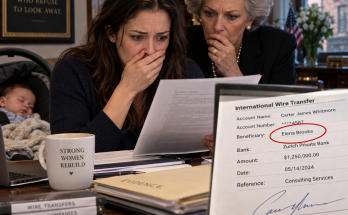
She pulled a printed bank record from the folder.
Every month, Aria sent a payment to another company.
The amounts varied.
Thirty thousand.
Forty-two thousand.
Seventeen-five.
Sixty.
The receiving entity was registered in Nevada through an agent that concealed the beneficial owner.
“What do you think it is?” Martha asked.
“I don’t guess when I can trace.”
“Good answer.”
“I haven’t finished tracing it.”
“Then we find someone who can compel the records.”
Emily looked down at Leo.
“What scares me is the timing.”
“Of the divorce?”
“Yes.”
Mark had announced it just as Emily’s quiet investigation had begun closing around several large transfers.
Two weeks earlier she had requested archived statements from a joint account.
Three days earlier she had discovered that her credentials for one financial portal no longer worked.
Yesterday Mark’s demeanor had been oddly detached.
Then, before dawn, divorce.
“What if he knows I found something?” Emily asked.
Martha rested her forearms on the table.
“If Mark knew exactly what you had, would he have allowed you to walk out carrying that bag?”
Emily considered it.
“No.”
“Then he either doesn’t know or he doesn’t understand how much you know.”
A small relief.
Followed by a larger concern.
Martha rose, walked to an old rolltop desk and returned with a business card.
The cream paper was yellowed slightly at its edges.
HARRISON STERLING
ATTORNEY AT LAW
Emily recognized the surname.
“Harrison Sterling?”
“You’ve heard of him.”
“Everyone has. Didn’t he retire?”
“He tried. Then he discovered retirement involved golf.”
Martha sat again.
“He despises golf.”
Emily turned the card between her fingers.
“Harrison Sterling represented the whistleblower in the Calston pension case.”
“And won.”
“He forced a private equity firm to return forty million dollars.”
“And enjoyed doing it.”
“Why would he take my divorce?”
Martha gave her a cool look.
“Because it isn’t just a divorce.”
At 6:03, Emily’s phone vibrated.
Mark.
Where are you?
She placed the phone faceup on the table.
Another message arrived two minutes later.
My parents are already on their way. Come back before this becomes embarrassing.
Martha read it.
Her eyebrows rose.
“Embarrassing for whom?”
Emily said nothing.
At 6:11:
We need to discuss Leo.
At 6:14:
You cannot just disappear with my son.
At 6:20:
Stop behaving irrationally.
Emily took screenshots of every message.
Martha noticed.
“You’re documenting.”
“I document everything.”
“Then there’s hope for civilization.”
Emily opened a fresh notebook and wrote the date.
4:30 a.m. Mark arrived home.
4:31 approximately. Said “Divorce.”
4:39 packed.
5:02 departed Whitmore Manor.
She continued, noting the texts and times.
The methodical act steadied her.
At 7:08 Mark called.
She let it ring.
He called again.
And again.
At 7:17 an unfamiliar number appeared.
Emily answered.
“Hello?”
Evelyn Whitmore’s voice arrived sharpened by outrage.
“What exactly do you think you’re doing?”
Emily pulled the phone slightly from her ear.
“Good morning, Evelyn.”
“Do not take that tone with me. Mark says you stormed out with the baby.”
“I walked out.”
“You have humiliated this family.”
Interesting, Emily thought.
Not: Are you safe?
Not: Is Leo safe?
Not: What happened between you and my son?
Humiliation.
“I’m sorry you feel humiliated.”
“You will bring Leo home immediately.”
“No.”
Silence.
Emily had rarely used that word with Evelyn.
The effect was remarkable.
“Excuse me?”
“No.”
“That child is a Whitmore.”
“He’s also my son.”
“You are behaving recklessly because you’re tired and hormonal. You have no income, Emily. No home of your own. Do you honestly imagine a court is going to hand an infant to a woman who walks out before sunrise with nowhere to go?”
Martha’s face changed.
She had heard every word.
Emily felt a familiar old reflex urging her to defend herself.
Explain.
Reassure.
Seek approval.
She crushed it.
“My attorney will contact Mark.”
“Your attorney?”
For the first time, Evelyn sounded less angry than startled.
Emily looked at Harrison Sterling’s card.
“Yes.”
“You don’t have an attorney.”
“I will.”
Evelyn lowered her voice.
“Emily, listen carefully. You do not want to make an enemy of this family.”
The sentence chilled the room.
Martha reached silently for her own phone and began taking notes.
Emily kept her voice even.
“Are you threatening me?”
“I am explaining reality.”
“Then explain it through counsel.”
Emily ended the call.
Her hand was shaking.
Martha’s was not.
“That,” the older woman said, “is why you document.”
At 8:02, Martha called Harrison Sterling.
At 8:11, she put the phone down.
“He’ll see us at eleven.”
Emily looked at Leo sleeping in the crook of her arm.
“What did you tell him?”
“Almost nothing.”
“And he agreed?”
“I told him your husband was Mark Whitmore.”
Emily waited.
Martha smiled without warmth.
“Harrison said to bring every financial document you have.”
By ten, Emily had showered and changed into clothes Martha’s niece had left behind. She fed Leo, packed diapers and checked the encrypted drive twice.
Before leaving, she opened her laptop.
There was one thing she wanted to verify.
She logged into an old secure cloud account she had maintained since her accounting days.
Her backup folder was still there.
She entered two passwords and opened the latest copy of the Aria spreadsheet.
Something had changed.
Emily leaned closer.
A transfer had posted at 3:58 that morning.
Thirty-two minutes before Mark walked into the kitchen and said divorce.
The amount was $275,000.
The destination account had never appeared before.
Emily enlarged the transaction details.
Martha came up behind her.
“What is it?”
Emily pointed.
The transfer memo contained only three letters and a number.
RWH-17.
“Does that mean anything?”
“Not yet.”
Emily copied the entry into her notebook.
Then she noticed the authorizing credentials.
The transfer had not been approved by Mark.
It had been authorized under Richard Whitmore’s executive token.
Emily felt the room grow colder.
Mark’s divorce declaration might have been personal.
But at 3:58 that same morning, his father had moved more than a quarter-million dollars through Mark’s secret company.
And if those two events were connected, Emily had not simply walked out of a failing marriage.
She had walked out of something much larger.
Click here to continue reading: PART 3: The Lawyer Expected a Frightened Wife Seeking Alimony Until Emily Opened Her Files and Turned a Divorce Into a Financial Investigation
Before Dawn, Mark Said One Word and Expected Emily to Break, but She Had Already Started Counting Everything He Hid
Part 2 of 24