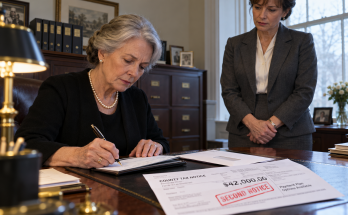
I kept working after Brenda left.
There were contracts to review, invoices to approve, and two calls I had been putting off since the previous week.
I handled each task in the same order I always did.
Read the document.
Check the figures.
Sign where necessary.
Move to the next item.
Routine had always been useful to me.
It gave the mind something to do when the heart had become unreliable.
By noon, I had finished the work that required my attention.
I ate half a sandwich at my desk and left the other half wrapped in its paper.
Then I opened the cabinet beside the window.
The bottom shelf held several old property files, including one marked with the number of the parcel on the county notice.
I pulled it out.
The folder was thicker than I remembered.
Inside were survey documents, tax statements, copies of correspondence, and a faded photograph of the land before anything had been built on it.
The drainage ditch ran diagonally through the picture.
My husband stood near the far edge, his shoulders hunched against the wind.
He was holding the survey level.
I was not in the photograph.
I had taken it.
He had complained that I always photographed him when he looked tired.
I told him that tired was what he looked like most of the time.
He laughed and said I ought to take a picture of myself for once.
I never did.
I sat with the photograph for a long time.
The property had changed over the years, but the land itself had remained familiar.
The ditch had been filled in.
The ground had been leveled.
Buildings had appeared where there had once been nothing but grass and standing water.
The county had divided the records into categories and assigned numbers to things that had never needed names when we first walked there.
My husband had understood the value of that place before I did.
He had not been careless with money.
People sometimes mistook his patience for a lack of judgment, but he knew how to calculate risk.
He simply believed that a difficult investment could be worth keeping if the reason for keeping it was sound.
I had learned to respect that.
I had also learned that respect did not mean agreeing with every decision a person made.
We had argued about the land more than once.
The first time, I wanted to sell because the upkeep was costing us more than we had planned.
He asked me to wait.
The second time, I wanted to sell because an offer came in that would have relieved several other obligations.
He asked me to wait again.
The third time, I stopped asking.
I told myself there were better things to spend my energy on than fighting over a property that had become part of his identity.
That decision had seemed harmless at the time.
I had not understood how much could be hidden inside a decision to leave something alone.
I returned the photograph to the folder.
Beneath it lay an older copy of the deed.
The paper had yellowed around the edges, and the ink on the signature line had faded.
I read the document from beginning to end.
Nothing on the page explained the county's current notice.
Nothing explained Trevor's call.
Nothing explained why a man who had grown up hearing arguments about the property had suddenly become interested in the address recorded on its deed.
I closed the folder.
Then I opened it again.
I checked the parcel number.
Thirty-one, fourteen.
There was no mistake.
I placed the file on my desk and called the county office.
The woman who answered asked for the parcel number and put me on hold while she brought up the record.
I listened to a recording of cheerful music that seemed badly suited to the subject.
When she returned, I asked her to confirm the outstanding amount and whether the payment arrangement had been requested by anyone associated with the property.
She explained what she could.
The amount was correct.
The notice was active.
The payment arrangement was part of the county's standard process.
She did not offer information that wasn't in the file, and I did not press her for anything she could not provide.
When the call ended, I wrote the details on a yellow pad.
Then I drew a line beneath them.
The numbers were straightforward.
The reasons were not.
I could pay the amount.
That was never the question.
The question was why I was paying it from my personal account when Cedarline had the resources to handle ordinary property expenses.
I had given Brenda an answer that morning.
I had said the money should come from me.
But I had not explained why.
Not even to myself.
There were obligations that belonged to a business and obligations that belonged to a family.
Over the years, those categories had become difficult to separate.
I had paid expenses to protect Cedarline's standing.
I had paid expenses to protect my husband's reputation.
I had paid expenses to protect Trevor from learning how far his choices had carried him.
Sometimes one payment served all three purposes.
Sometimes I could not tell which purpose mattered most.
I put the yellow pad into the folder and closed the cabinet.
At two, Brenda came in carrying a stack of documents for my signature.
She set them down, then glanced at the property file.
"You found the old photograph."
"I did."
"He looked happy out there."
"My husband was happy whenever he thought he was right."
She smiled faintly.
"And was he?"
"More often than I liked."
She laughed once, quietly.
For a moment, the office felt ordinary again.
Then she looked at the county receipt beside my checkbook.
"Are you certain you want to handle this yourself?"
"Yes."
"You could have the company pay it and settle the accounting later."
"I know."
"Then why not?"
I considered giving her the practical answer.
I could have told her that separating the expense would make the records easier to follow.
I could have said that I preferred to keep certain transactions out of the company accounts.
Both explanations would have been reasonable.
Neither would have been complete.
"Because I need to know exactly what I am paying for," I said.
Brenda studied me.
"You already know the amount."
"The amount isn't the same as the reason."
She did not argue.
She gathered the papers she had brought and waited for me to sign them.
I worked through the stack, one document at a time.
When she reached for the last page, I stopped her.
"Did Trevor say anything else when he called?"
She looked toward the door.
"Only that he wanted the deed address."
"Did he mention the county?"
"No."
"Did he ask about the property file?"
"No."
I tapped my pen against the desk.
"Did he sound worried?"
Brenda considered the question.
"He sounded impatient."
That was not the same thing.
I knew the difference.
Worry made Trevor talk faster.
Impatience made him speak as if the world had failed to keep up with him.
I had heard both often enough to recognize them over the telephone.
"Thank you," I said.
She left me alone with the file.
I returned the documents to their folders and put the photograph back in its envelope.
Then I checked the clock.
A little before three.
The county office was close enough that I could walk there, and I had already decided I would not ask anyone else to deliver the payment.
I placed the sealed envelope in my handbag.
Before leaving, I opened the desk drawer once more and looked at the checkbook.
There was nothing unusual about it.
Black cover.
Worn corners.
A small tear near the spine.
I had used that same checkbook for years, and I knew the balance in the account without needing to consult a statement.
I was not risking my livelihood by paying the county.
I was risking something else.
My ability to tell myself that every decision I made for Trevor was harmless.
That was what the payment represented, though I had not yet admitted it.
I turned off the office light and walked to the door.
Brenda was waiting at her desk.
"I'll be back later," I told her.
"Do you want me to hold your calls?"
"Only if Trevor rings."
She raised her eyebrows.
"Especially if Trevor rings?"
"Especially then."
I stepped outside.
The damp air touched my face, and the cold found its way beneath my coat.
I crossed the parking lot with the envelope held firmly inside my handbag.
For years, I had treated the property as something my husband had left behind.
A responsibility.
A piece of unfinished business.
A place I had kept because selling it would have felt like admitting that his judgment had been wrong.
Now I wondered whether I had misunderstood the reason he wanted it preserved.
The land was still there.
The deed was still recorded.
The county still expected its money.
And my son was asking questions.
I could no longer pretend those things had nothing to do with one another.
Click here to continue reading: PART 3: Why I Took the County Payment Myself and What the Locked Bank Box Meant to the Promise I Had Kept
The Forty-Two-Thousand-Dollar Notice That Forced Me to Choose Between Protecting My Son and Protecting the Truth
Part 2 of 4