I used to believe that paying a debt was the same as solving a problem.
I was wrong.
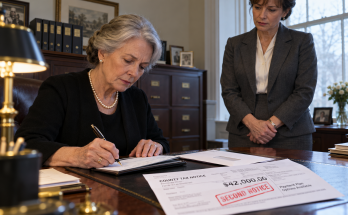
The county sent the notice on a Tuesday, and by the time Brenda placed it on my desk, I had already spent half the morning pretending I didn't know what it meant.
The amount was forty-two thousand dollars.
Printed beneath it was a payment arrangement that nobody in my office had requested.
Brenda waited until I finished reading before she spoke.
"That's the second notice they've sent here."
I looked at the red stamp across the bottom.
"And the one they mailed to the house?"
"That makes three."
I nodded.
There wasn't much else to say.
My office was quiet except for the old wall clock above the filing cabinet. It had been losing time for years, but I had never bothered to replace it.
Some things were easier to leave alone.
I opened the bottom drawer of my desk and took out my checkbook.
Brenda watched me write the date.
Outside, February had turned the parking lot into a patchwork of wet pavement and dirty snowmelt. The sky was the same dull gray it had been since the beginning of the month.
I had lived through enough winters to know that cold didn't always announce itself with a storm.
Sometimes it settled in quietly and stayed.
"Should I put this through Cedarline?" Brenda asked.
I stopped writing.
"No."
She glanced at the checkbook.
"Your personal account?"
"That's right."
I wrote the amount carefully, checking each number before moving to the next.
Forty-two thousand dollars was a great deal of money, even for someone who had spent most of her adult life learning how to make money behave.
Especially when the money was being used to cover a problem that wasn't mine.
Brenda had worked with Howard Pierce for nineteen years before joining me six years ago. Between the two of us, we had developed a way of communicating that required very few words.
She knew when I wanted an explanation.
She also knew when I needed a moment to read a document without anyone watching my face.
That morning, she gave me the moment.
I signed the check.
Then I pressed the blotter against the ink and waited for it to dry.
"He's going to find out," she said.
I slid the check into the envelope provided by the county.
"He'll find the record."
"That's what I mean."
I looked up at her.
"Trevor has a remarkable ability to notice only the things he wants to notice."
She didn't disagree.
That was one of the things I appreciated about Brenda. She never mistook silence for permission to tell me what I already knew.
She picked up the county receipt and turned it toward me.
Her fingernail stopped beside the parcel number.
"Thirty-one, fourteen."
I stared at those numbers.
They meant more to me than they would have meant to anyone reading the notice for the first time.
I had memorized them decades earlier, when the property was nothing but an open field, a drainage ditch, and a stretch of ground that seemed to collect every bit of rain in the county.
My husband had stood out there with a survey level and a thermos tucked beneath one arm.
He had mud on his boots and a pencil behind his ear.
I remembered asking him whether he was certain the land was worth the trouble.
He had looked across the field as if he could already see something standing there.
"Give it time," he had said.
He had always been better at seeing what something might become than what it was.
I had been the opposite.
I saw the cost first.
The taxes.
The repairs.
The interest.
The things that could go wrong.
My husband had never considered that a reason to walk away.
Back then, I thought our differences made us a good team.
Years later, I understood that those same differences could become the very things that kept two people from understanding each other.
I returned my attention to the county receipt.
The parcel number hadn't changed.
The amount had.
And the person connected to the problem had become my son.
"Trevor called on Friday," Brenda said.
I kept my eyes on the paper.
"What did he want?"
"The address listed on the deed."
That made me look up.
"Did you give it to him?"
"No. I told him I would have to check the file."
I set the receipt on the desk.
"Good."
"He said he needed it right away."
"Trevor always needs something right away when he thinks the answer belongs to him."
The words came out more sharply than I intended.
Brenda lowered her eyes toward the envelope.
I felt ashamed.
Not because the statement was untrue, but because I had become so accustomed to defending myself against my own child that I could no longer speak about him without sounding bitter.
There had been a time when Trevor called simply to tell me something funny that had happened during his day.
He would talk too quickly, jumping from one detail to another, and I would listen while stirring a pot on the stove or sorting invoices at the kitchen table.
He had been a boy who wanted his mother to know everything.
Somewhere along the way, that boy had become a man who believed he was entitled to know everything.
I could not tell you exactly when it happened.
There had been no single argument that explained it.
No one conversation after which our relationship became something different.
It had happened in small increments.
A request that became an expectation.
A favor that became an obligation.
A question that was no longer a question because he had already decided what I was supposed to answer.
And each time I objected, I found myself explaining why I had the right to object.
I had helped create that pattern.
I knew it.
For years, I had told myself that I was protecting my son from the consequences of his mistakes.
I had covered expenses, smoothed over difficulties, and quietly paid bills when I thought the embarrassment would hurt him more than the money would hurt me.
I had called it being a mother.
Sometimes it was.
Other times, it was fear dressed up as kindness.
I was afraid of what would happen if I let him fail.
I was afraid he would blame me.
Most of all, I was afraid that refusing him would prove I loved him less than I claimed.
That was the part I had never admitted aloud.
Brenda placed the envelope closer to my hand.
"Do you want me to make a copy for the office file?"
"Yes."
"And the original?"
I sealed the envelope.
"The original goes to the county."
She nodded.
I could hear the soft scrape of her shoes as she moved toward the door.
"Brenda."
She turned.
"The papers we've kept since 1998 are still in the same place, aren't they?"
Her expression changed just enough for me to notice.
"The bank box?"
"Yes."
"They haven't been moved."
"Nobody has requested access?"
"No."
I studied her face.
"Not even Trevor?"
"No."
I let out a breath I hadn't realized I was holding.
"Keep it that way."
Brenda waited a moment before answering.
"Of course."
She left the office with the copy of the receipt.
I remained at my desk, staring at the empty space where the envelope had been.
The check was on its way to the county.
That part was simple.
The rest was not.
I had just used my own money to address a debt tied to a piece of property that my son apparently believed he had a right to investigate.
He had asked for the deed address.
He had not asked me why the county was involved.
He had not asked whether I knew about the forty-two thousand dollars.
He had not asked whether paying it would create a hardship for me.
Perhaps he assumed the money was available.
Perhaps he believed the land was already his.
Or perhaps he knew something I did not.
I hated that last possibility most of all.
Not because it was the most frightening.
Because it meant I might have underestimated how much Trevor had learned.
I put the checkbook away and closed the drawer.
Then I took the county receipt from beneath my hand and looked at the parcel number again.
Thirty-one, fourteen.
My husband had once stood in that muddy field and told me to be patient.
He had said it as if time would take care of everything.
But time had not taken care of this.
Time had only given the problem more places to hide.
Click here to continue reading: PART 2: The Land My Husband Refused to Abandon and the Questions My Son Had Never Thought to Ask Me
The Forty-Two-Thousand-Dollar Notice That Forced Me to Choose Between Protecting My Son and Protecting the Truth
Part 1 of 4