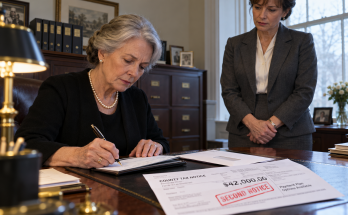
The county office smelled of wet coats and old paper.
A man behind the counter took my envelope and checked the parcel number against the receipt.
He counted the documents before looking at me.
"You're paying the full amount today?"
"Yes."
He turned the receipt toward the light, checked the figures, and entered the payment into his system.
I watched his hands move across the keyboard.
There was nothing personal about the transaction.
The county had a balance due.
I had brought a check.
He processed it.
When he handed me the confirmation, I checked the date and the amount before folding it into my handbag.
The whole thing took less than ten minutes.
I had expected to feel relieved.
Instead, I felt as though I had just made a decision whose consequences I had not yet seen.
Outside, the pavement shone beneath the gray afternoon sky.
I stood on the steps and read the receipt again.
Forty-two thousand dollars.
Paid.
The word was simple.
The meaning was not.
I put the paper away and returned to the office.
Brenda looked up when I entered.
"All taken care of?"
"The county has its payment."
She nodded.
I hung my coat over the back of my chair and sat down.
For a while, neither of us spoke.
Then I opened the desk drawer and took out a small notebook.
It was not the kind I used for business.
The cover was plain, the pages unlined, and the first several sheets contained notes in my handwriting from years earlier.
I had kept it in the drawer because I did not want it mixed with the company records.
Brenda glanced at it.
"Is that related to the property?"
"Yes."
She waited.
I opened to a page near the middle.
There was a date written at the top.
1998.
Beneath it, I had recorded a short list of documents and a note reminding myself that the originals were to remain in the bank box.
I read the note twice.
Then I closed the notebook.
"Has anyone else asked you about the box?" I said.
"No."
"Has anyone asked you about the papers from that year?"
"No."
I looked at the notebook in my hands.
"All right."
Brenda had the good sense not to ask what I was looking for.
She had worked with enough private records to understand that a person could keep a document for decades without being ready to explain it.
At five, I finished the last of my work and went home.
The house was quiet.
I left my handbag on the hall table and went straight to the kitchen.
There was a mug beside the sink from that morning.
I washed it, dried it, and returned it to the cupboard.
Then I stood at the counter, listening to the refrigerator hum.
My husband used to come into the kitchen at this hour and ask what we were having for dinner.
He rarely offered to cook.
He did, however, have a remarkable talent for appearing just as I was finishing and asking whether he could help with anything.
I would hand him a plate or ask him to set the table.
He would do it without complaint.
We had our routines.
We had our arguments.
We had things we understood without needing to discuss them.
And we had things we never discussed because one of us was afraid of what the other might say.
I had always believed the latter belonged to the ordinary failures of marriage.
Looking back, I was less certain.
I made tea and carried it to the dining room.
The notebook remained in my handbag.
I could have left it there.
I could have eaten dinner, watched television, and gone to bed without looking at it again.
Instead, I brought it to the table and opened it beside my cup.
The notes from 1998 were brief.
Dates.
References.
A few words about copies and originals.
Nothing that would mean much to a stranger.
To me, they marked the beginning of a promise.
I remembered the circumstances surrounding that promise, though I had spent years trying not to examine them too closely.
There had been documents that needed to be preserved.
There had been reasons not to leave them where they might be casually discovered.
My husband had insisted that keeping them secure was necessary.
I had agreed.
At the time, I believed I understood what I was agreeing to.
Perhaps I had understood only enough to do what he asked.
I closed the notebook and placed it beside my plate.
Then I called Brenda.
She answered on the second ring.
"Everything all right?"
"Yes."
I heard the faint rustle of paper at her end.
"I wanted to confirm that the bank box is still registered the same way."
"It is."
"And the documents are still sealed?"
"Everything is as it was."
I paused.
"Have you checked recently?"
"Not since the last time you asked me to verify the inventory."
"When was that?"
"Several months ago."
I looked down at the notebook.
"Please don't open anything. I only want confirmation that the box is secure."
"Understood."
"And if Trevor calls tomorrow, don't discuss the property with him."
"I won't."
After we ended the call, I sat at the table until my tea went cold.
The bank box had become a place in my mind as much as a place in the world.
I knew where it was.
I knew what it contained.
I knew who had helped arrange for the papers to be kept there.
What I did not know was whether keeping the documents hidden had protected anyone.
Or whether it had merely delayed the day when someone would have to answer for them.
The next morning, I arrived at the office earlier than usual.
Brenda had already turned on the lights and placed my correspondence in a neat stack.
I thanked her and went through the mail.
There was a letter from the county acknowledging the payment.
There were two invoices.
There was a request for a meeting from a supplier.
Nothing from Trevor.
I should have been pleased.
Instead, I found myself checking the telephone whenever it rang.
At ten, Brenda brought in a folder and set it beside my hand.
"I thought you might want to look at this."
It was the property file.
I looked at her.
"Why?"
"Because the deed address Trevor asked about is listed here."
She opened the folder to the relevant page.
The address was typed in the usual place.
Below it was the parcel number.
Thirty-one, fourteen.
I read both lines.
Then I looked at the older document beneath them.
The same address appeared there, but the date was different.
I could not explain why that mattered to me.
It simply did.
I placed the two pages side by side.
Brenda remained silent.
I compared the numbers, the signatures, and the dates.
Everything appeared consistent.
Yet I could not shake the feeling that I was looking at a record that told only part of the story.
"Has Trevor seen this?" I asked.
"Not through me."
I closed the folder.
"Keep it here."
She took a breath.
"Do you think he's looking for something specific?"
"I don't know."
That was the truth.
I had theories.
I had suspicions.
I had the memory of a promise made years earlier and the knowledge that my husband had been unusually determined to preserve certain documents.
But I did not have an answer.
Not one I could defend.
At lunch, I took the notebook from my drawer and read the 1998 entry again.
The handwriting looked unfamiliar in the way old handwriting sometimes does.
The letters were mine, but the person who had written them seemed more confident that she was doing the right thing.
I wondered what she would say if she could see me now.
Would she tell me I had protected my family?
Or would she ask why I had spent so many years protecting a secret without asking who paid the price?
I had no answer for her.
I returned the notebook to the drawer.
Then I called Brenda into my office.
"Tomorrow, I want you to confirm the box details one more time."
She nodded.
"And if anything has changed, I want to know before anyone else does."
She looked at me for a moment.
"Has something happened?"
"No."
I glanced at the county receipt.
"Not yet."
That afternoon, I received a message from Trevor asking whether I had a few minutes to speak.
I read it twice.
Then I set the telephone down without replying.
I was not ready to speak to him.
Not because I wanted to punish him.
Because I had spent too many years answering his questions before I understood what he was really asking.
This time, I wanted to know what I was protecting before I agreed to protect it.
Click here to continue reading: PART 4: The Promise I Had Mistaken for Protection and the Quiet Price of Keeping My Family’s Most Difficult Questions Unanswered
The Forty-Two-Thousand-Dollar Notice That Forced Me to Choose Between Protecting My Son and Protecting the Truth
Part 3 of 4