The first thing I noticed the following week was that nobody asked me what I was doing when I came downstairs with my coat on.
It was Wednesday morning, the time I had marked for myself on the calendar.
Michael was at the kitchen counter, looking at his phone. Jessica was packing lunches, and the boys were arguing over whose turn it was to choose the music in the car.
I put my handbag on my shoulder and reached for my keys.
“Are you going somewhere?” Michael asked.
I stopped for a moment.
Then I remembered that he had asked a question, not issued an instruction.
“Yes. I'm meeting my friend for coffee.”
He nodded.
“Okay. Have a good time.”
It was such an ordinary exchange that someone else might have forgotten it before reaching the front door.
I didn't forget it.
For three months, leaving the house had felt like something I needed to explain. There had always been a reason I might be needed, a child who might need collecting, a meal that needed preparing, or a task that could not wait until somebody else was available.
Now I walked outside without offering a list of reasons.
The morning air was cool, and the pavement was damp from rain during the night.
I drove to the café where my friend had agreed to meet me. She was already sitting beside the window, holding a cup between both hands.
“You look different,” she said when I sat down.
“Different how?”
“Like you slept.”
I laughed.
“I suppose I did.”
She studied me for a moment, then smiled.
We talked about ordinary things first. The weather, a neighbor who had planted tomatoes too early, and the price of groceries.
I found myself enjoying the conversation without checking my phone every few minutes.
When it buzzed against the table, I looked at the screen.
It was a message from Jessica.
The boys are asking if you can read with them tonight. No pressure if you're busy.*
I read it twice.
Not because I didn't understand the words, but because I was getting used to the difference between being asked and being assigned.
I typed back that I would be happy to read with them after dinner.
Then I put the phone away.
My friend had noticed.
“Good news?”
“Jessica asked if I would read with the boys tonight.”
“And you want to?”
“Yes.”
“Then that's nice.”
I stirred my coffee.
“It is. I think that's what I've been trying to explain to myself. I don't mind helping. I mind feeling as though my time belongs to everyone except me.”
My friend nodded.
“You're allowed to enjoy helping when it's your choice.”
I looked out the window at a man walking a small brown dog along the sidewalk.
For years, I had been the person who remembered birthdays, carried extra tissues, brought food when somebody was sick, and stayed behind to wash dishes after everyone else had gone home.
I had thought those things were simply what love looked like.
I still thought they were part of love.
But I was beginning to understand that love did not require me to remain available every minute of every day.
After coffee, my friend had an errand to run, so we said goodbye in the parking lot.
I drove to the library.
There was no particular book I needed. I wanted to browse, sit somewhere quiet, and decide what I felt like doing without consulting anyone.
I found a book about small gardens and carried it to a chair near the windows.
The photographs showed narrow courtyards, pots of herbs, and little patches of flowers tucked beside apartment doors.
One picture reminded me of the garden behind my old house near Hudson.
I had spent years tending that garden. I knew which part of the yard received the first morning sun and where the soil stayed wet after rain.
I remembered the lavender that grew beside the steps.
I remembered my old blue watering can, its handle worn smooth where my hand held it.
For a moment, the memory hurt so sharply that I closed the book.
Selling that house had seemed practical at the time. Michael and Jessica needed help, and I had wanted to be closer to my grandchildren.
I had told myself that a house was only a building.
I knew better now.
A house was also a collection of choices made over many years. It was the place where I had decided where the chair belonged, which flowers to plant, and how quiet I wanted the bedroom at night.
I couldn't bring that house back.
But I could stop treating my own preferences as though they were unimportant simply because I had moved somewhere else.
I reopened the book.
Before leaving the library, I wrote three things in my notebook.
I enjoyed coffee without checking my phone.*
I liked having a morning that belonged to me.*
I miss having a space where I decide what goes where.*
I read the lines before closing the notebook.
None of them told me whether I should rent the apartment.
They did tell me something about the life I wanted.
When I got home, the boys were doing their homework at the dining table.
Owen looked up.
“Grandma, are you going to read with us tonight?”
“If you still want me to.”
“We do.”
Caleb pushed his workbook away.
“Can we read the funny book?”
“If you finish your homework first.”
He groaned as though I had asked him to carry a refrigerator upstairs.
Owen laughed.
I went to my room to put away my handbag.
The closet door caught on one of the boxes inside. I pulled it open carefully and moved the box farther back.
The space still wasn't entirely mine.
There were old holiday decorations on the top shelf and several boxes of Michael's papers stacked along one side.
But I could see the empty section where I had hung my clothes.
I took off my coat and hung it there.
It was a small thing, but I had learned to notice small things.
That evening, I read with the boys after dinner.
Owen sat close enough that his shoulder pressed against mine. Caleb kept interrupting to explain what he thought the characters should have done.
I let him finish.
When we reached the end of the chapter, Owen asked for one more.
“Not tonight,” I said. “We can continue tomorrow.”
He made a disappointed face.
“Just one short one?”
“Tomorrow.”
He looked at me, then closed the book.
“Okay.”
Nobody argued with me. Nobody told me that I had plenty of time or that reading one more chapter wouldn't hurt.
I kissed the top of his head and put the book on the shelf.
Later, Jessica came into the kitchen while I was rinsing my cup.
“Thank you for reading with them,” she said.
“You're welcome. I enjoyed it.”
She dried her hands on a towel.
“I wanted to tell you something. I've been thinking about the schedule.”
I turned off the tap.
“What about it?”
“I think we've been treating the schedule as though it solves everything. But it doesn't change the fact that you still live here, and you still need your own space.”
I waited.
“I know we've talked about your room,” she continued. “I went through the closet today. Some of those boxes are mine, and some are Michael's. We should move them.”
“That would help.”
“I can sort them this weekend. You shouldn't have to keep your things squeezed into one corner.”
I felt grateful, but I didn't want to turn the offer into another promise that would disappear beneath the next busy week.
“Thank you,” I said. “I'd like that.”
She nodded.
Then she hesitated.
“Are you still thinking about the apartment?”
“Yes.”
Her eyes dropped to the towel in her hands.
“I understand why.”
I had expected her to ask me not to leave.
Instead, she said, “I don't want you to feel that you have to stay because we need help with the children.”
I looked at her carefully.
“That's part of what I needed you to understand.”
“I know.”
There was no dramatic apology. She didn't suddenly become a different person.
She was still the woman who sometimes avoided difficult conversations until they became unavoidable.
But she was standing in the kitchen, asking me to tell her the truth, and that mattered.
“I love the children,” I said. “I love you, and I love Michael. I want to be part of their lives. But I also want to wake up and know that I can decide what my day will look like.”
“You should be able to.”
“I should have been able to say that sooner.”
Jessica shook her head.
“I think we should have asked sooner.”
For a moment, neither of us spoke.
Then she folded the towel and put it beside the sink.
“I'll talk to Michael about the boxes.”
“All right.”
I went upstairs with my notebook under my arm.
The apartment information sheet was still tucked between two pages. I took it out and looked at the rent, the deposit, and the number for Mrs. Parker.
The possibility of moving had not become less real simply because the house had grown more comfortable.
If anything, I was beginning to understand that I could make the decision without being driven by hurt.
I could stay if staying became a choice I genuinely wanted.
I could leave if I decided that having a place of my own mattered more.
Neither decision would erase my love for my family.
I put the information sheet back into the notebook.
Then I wrote one more sentence.
I want my next decision to come from what I need, not only from what other people need from me.*
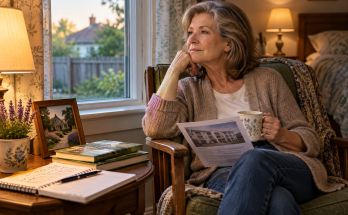
I closed the notebook and placed it beside the photograph of my old garden.
For the first time since moving in, I did not feel that I had to reach a decision immediately.
I could take my time.
That, too, was a kind of freedom.
Click here to continue reading: PART 18: The Closet and the Boxes
I Had Spent Three Months Making Myself Useful in My Son’s House, Until One Ordinary Sunday Dinner Changed What I Could Bear
Part 17 of 20