On Monday morning, I moved the suitcase away from the bedroom door.
I had been stepping around it for weeks.
At first, I had kept it there because I wanted to be ready to leave.
Later, I left it there because I could not decide what to do with it.
Now I carried it to the foot of the bed and opened it.
The clothes inside were folded neatly.
My photographs were wrapped in a soft scarf.
The blue ceramic bowl was tucked into a towel.
My husband's old watch lay in its small box beside the notebook.
I took everything out.
One item at a time, I put things where they belonged.
The clothes went into the dresser.
The photographs went on the narrow shelf beside the window.
I placed the bowl on the dresser, where I could see it.
The watch went beside the lamp.
When the suitcase was empty, I folded it and slid it into the closet.
There were still boxes belonging to the family on the upper shelf.
I did not move them.
I did not need to turn every small irritation into a battle.
But I wanted the things that mattered to me to have a place.
I sat on the bed and looked around the room.
It still wasn't the little house near Hudson.
The window faced a different direction.
The morning light fell across the floor in a different shape.
I could not hear the old pipes knock when the heat came on, and there was no garden outside to check after a night of rain.
But the room had become a little more familiar.
It held my photographs, my bowl, my watch, and my books.
It held the notebook in which I had begun telling myself the truth.
For now, that was enough.
Downstairs, Michael was packing lunches.
He looked up when I entered the kitchen.
“Morning.”
“Good morning.”
He pushed a lunch container toward me.
“Could you check whether Caleb's sandwich is in this one? I can't remember which bag is his.”
I checked the label.
“This is Owen's.”
“Thanks.”
He reached for the other container.
“Caleb's is the one with the green lid.”
“I'll remember that.”
I looked at him.
“Michael, I need to ask you something.”
He stopped what he was doing.
“Sure.”
“Could we sit down tonight and talk about the arrangements for the children?”
He looked concerned.
“What arrangements?”
“After-school care. Weekends. The times you and Jessica need someone to stay with them.”
He set the lunch container on the counter.
“Is something happening?”
“No. I want us to have a plan.”
He watched me for a moment.
“All right.”
“I don't want anyone to be caught by surprise when I have other plans.”
He nodded.
“That makes sense.”
“And I don't want the children to think I'm upset with them when I say I can't do something.”
“I don't think they would.”
“Perhaps not. But I want us to be clear.”
He put the lunches into the bags.
“Let's talk tonight.”
I nodded and poured myself some tea.
The conversation had been brief.
Still, I felt better having asked for a specific change instead of waiting for everyone to notice what I needed.
At dinner, Jessica joined us at the table.
The boys were talking about a game they wanted to play after finishing their homework.
Clare was reading something on her phone.
Michael looked around the table.
“Mom and I want to talk about the schedule after dinner.”
Owen looked up.
“Did we do something wrong?”
“No,” I said immediately.
Michael answered at the same time.
“No, buddy. This isn't about you.”
Owen looked relieved and returned to his food.
We finished dinner without discussing it.
Afterward, the boys cleared their plates, and Clare carried the water pitcher to the kitchen.
Michael waited until the children had gone to the family room.
Jessica closed her laptop and joined us at the table.
I had brought my notebook downstairs, though I had not written anything in it.
I placed it beside my cup.
Michael looked at it.
“Did you make a list?”
“Just a few things I wanted to remember.”
He nodded.
I took a breath.
“I want to start by saying that I love being part of this family.”
Jessica looked at me.
“I know,” she said.
“I love the children, and I like being here for the ordinary parts of their lives. I don't want either of you to think that I regret moving in.”
Michael leaned forward.
“Okay.”
“But I need to be honest about what has been difficult.”
Neither of them interrupted.
“I have been doing so much of the childcare that we have all begun treating it as automatic. I don't think any of us sat down and decided that should happen. It just became the routine.”
Jessica nodded slowly.
“I can see that.”
“When you need help, I want you to ask me. I may be able to help, and sometimes I will be happy to. But I need to be able to say no without it becoming a question of whether I belong here.”
Michael looked down at the table.
“I shouldn't have said what I said on Sunday.”
The words came quietly.
I felt my shoulders relax, though I tried not to show it too quickly.
“No,” I said. “You shouldn't have.”
He nodded.
“I was frustrated, but that wasn't fair to you.”
Jessica folded her hands.
“I should have spoken up too.”
I looked at her.
“I would have appreciated that.”
She accepted the answer without defending herself.
For a moment, none of us spoke.
Then Michael asked, “So what do you want the schedule to look like?”
I opened my notebook.
“I don't have every detail figured out. But I would like certain times to be mine.”
“Such as?”
“I want some mornings free to do what I choose. I want to be able to make plans on weekends without assuming I have to cancel them if you need a sitter.”
Jessica nodded.
“We can work with that.”
“And I want us to arrange childcare for the times when you both have plans.”
Michael rubbed his chin.
“We'll have to look at the costs.”
“Of course.”
“We can't afford a sitter every time we go out.”
“I understand that.”
I waited until he looked at me.
“But the answer cannot always be that I will do it.”
He sat back.
“All right.”
Jessica picked up her phone.
“I can check what the after-school program costs. One of the boys' classmates goes there.”
“That would be a good place to start,” I said.
Michael took out his own phone.
“I can check my work schedule for next month.”
We spent the next half hour discussing the practical details.
Some afternoons, I could collect the boys if I was free.
On other days, they would need to use the after-school program or arrange another ride.
For weekends, Michael and Jessica agreed to ask me in advance whenever possible.
I made it clear that asking did not mean I had already agreed.
They both understood.
At least, they said they did.
I knew that changing a habit would take more than one conversation.
Still, we had moved from vague expectations to something we could actually discuss.
When we finished, Jessica closed her notebook.
“Thank you for talking to us.”
“I wanted to.”
Michael stood and pushed his chair in.
“I'll try to do better.”
I looked at him.
“I hope you do.”
He gave me a small, uncertain smile.
I returned it.
There was no dramatic reconciliation.
No one embraced across the table.
We had simply said some difficult things and agreed to make a few changes.
That was more useful than pretending a single apology could repair everything.
Later, I went upstairs and opened my notebook.
I wrote down the schedule we had discussed.
Then I turned to a fresh page.
I wrote three questions.
What do I need to feel comfortable here?
What choices do I still have?
What would I want if nobody else had an opinion?
I looked at the questions for a long time.
The first one was becoming easier to answer.
I needed privacy.
I needed time that belonged to me.
I needed to be asked instead of assumed.
I needed the freedom to help without being made to feel that refusing one request meant refusing the family.
The second question was harder.
I had sold my house.
I could not simply turn around and move back into it.
I had savings, but I needed to understand what I could afford and what kind of living arrangement would make sense for me.
I could look at apartments.
I could ask my friend what the area near her was like.
I could find out whether there were small places to rent within a reasonable distance of Michael's house.
I did not have to choose any of them immediately.
The third question was the hardest of all.
What would I want if nobody else had an opinion?
I had spent so many years considering what other people needed that I sometimes struggled to hear my own preferences.
I knew I wanted to remain close to the children.
I knew I wanted to be part of their lives.
But I also wanted mornings without obligations.
I wanted to read a book without listening for someone calling my name.
I wanted to cook because I felt like cooking, not because dinner had become my responsibility.
I wanted to sit in a room where my belongings were not temporary guests.
I wanted to feel that I could close a door without having to explain why.
Those wishes did not make me selfish.
They made me a person who had reached seventy-two and still had a life to live.
I closed the notebook.
Then I took the small framed photograph of my old house from the shelf and looked at it.
The photograph showed the front steps, the garden, and the window beside which I used to sit with my coffee.
The garden looked untidy in the picture.
A patch of weeds had grown beside the path, and one of the flowerpots was tilted.
I smiled.
I had spent years thinking I needed to keep everything in order.
Now I remembered that the house had never been perfect.
It had simply been mine.
I placed the photograph back on the shelf.
I did not know whether my next home would be an apartment, a rented cottage, or another small house.
I did not know whether I would remain with Michael for a few more months or decide that a different arrangement was better.
But I no longer believed I had to make the decision in a single afternoon.
I could gather information.
I could ask questions.
I could think about money and distance and the practical details of daily life.
I could love my family while considering a future that did not depend on living under the same roof.
The next morning, I woke before the others.
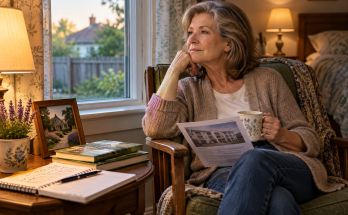
I made tea and sat beside the window.
The house was quiet.
I heard the refrigerator hum and a bird call from somewhere outside.
I held the warm cup between my hands.
For the first time in months, I did not spend the quiet minutes preparing myself to be needed.
I simply sat there.
When the sun reached the edge of the windowsill, I opened my notebook and wrote one final sentence beneath the questions.
I do not have to know where I will live next to begin deciding how I want to live.
I read it once.
Then I closed the notebook, finished my tea, and went downstairs to start the day.
Click here to continue reading: PART 13: I Started Looking at Small Apartments Without Telling Anyone, Because I Needed to Understand My Options Before I Could Make a Decision About My Family
I Had Spent Three Months Making Myself Useful in My Son’s House, Until One Ordinary Sunday Dinner Changed What I Could Bear
Part 12 of 20