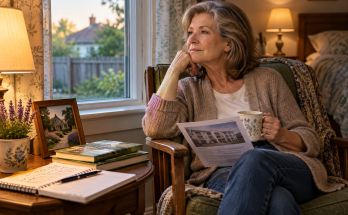
I didn't leave that morning.
I want to be honest about that.
I had packed my suitcase, arranged my photographs, and placed my husband's watch somewhere safe, but I still hadn't walked out the door.
Part of me was waiting for Michael to come upstairs.
I imagined him standing in the doorway, looking uncomfortable.
Perhaps he would tell me that he had spoken harshly the night before.
Perhaps he would say he hadn't meant for me to feel unwanted.
I didn't expect a grand apology.
I would have settled for a sentence that showed he understood what he had done.
But the house continued as though nothing had happened.
Michael went to work.
Jessica left with her own list of things to do.
The boys returned from school that afternoon, and I helped them settle in.
Owen complained about a spelling assignment.
Caleb couldn't find the notebook he needed.
Clare came home later and went straight to her room.
I prepared a simple dinner.
I watched the boys.
I wiped the counter.
By the time the evening was over, I had done everything I usually did.
That was the trouble with routine.
It could carry you through a day without asking whether you still believed in what you were doing.
I kept thinking about the way Michael had spoken to me.
Not because I had never been criticized before.
I had been married long enough to know that people sometimes said things they regretted.
I had raised a child and made mistakes of my own.
I knew that families could be impatient with one another.
But Michael hadn't been angry about a single task.
He had described my place in his home as though I had come there to provide a service.
And when I failed to accept that description without question, he had reminded me that I could leave.
I began to wonder whether that was how he had seen me all along.
Had I mistaken his request for help as a request for companionship?
Had he thought of my move as a practical arrangement while I imagined it as a chance to be closer to my family?
We had never sat down and explained what each of us expected.
I had assumed that affection would fill in the missing details.
Perhaps Michael had assumed my willingness would do the same.
Either way, I had allowed the arrangement to grow without asking whether it was still fair.
The following day, I made coffee and sat alone at the kitchen table.
The house was quiet.
I looked toward the place where we had eaten Sunday dinner.
The dining chairs were pushed neatly beneath the table.
The tablecloth had been removed.
There was no sign of the evening before.
I wondered how easily an ordinary room could hide an unpleasant memory.
Then I began remembering the small moments that had bothered me before the argument.
They had seemed too minor to mention at the time.
When Michael and Jessica wanted an evening together, they usually told me when they were leaving rather than asking whether I was available.
If I mentioned having an errand, Michael would sometimes ask whether I could do it later.
If I said I was tired, he would remind me that the boys needed me.
None of those statements seemed terrible on its own.
I had made excuses for each one.
They were busy.
They were raising three children.
They were trying to balance work and family.
I understood all of that.
But I was busy, too, even if my responsibilities were no longer paid employment.
My time had value.
My energy had limits.
My life had not ended when I sold my house.
I had simply moved into a place where nobody seemed to remember that.
I took my coffee upstairs and opened the closet.
Some of the family's stored items occupied the upper shelf.
I had never complained about the space.
There was enough room for my clothes, and I didn't need much.
Still, I noticed how carefully I had arranged everything to take up as little room as possible.
My shoes were lined up beneath the dresser.
My toiletries fit inside one small bag.
My photographs occupied a narrow strip of wall.
I had made myself easy to accommodate.
Perhaps too easy.
A few days earlier, I had considered visiting an old friend.
I had mentioned it to Michael while he was checking something on his phone.
He had asked whether I could go another day because the boys needed to be picked up.
I had agreed.
I hadn't even asked what time he expected to return.
That afternoon, I had stayed home.
The visit never happened.
I thought about that now.
Not because the missed visit had been especially important, but because it showed me how quickly I had begun treating my own plans as optional.
My family hadn't needed to order me to give everything up.
I had done it gradually.
I had said yes so often that I had stopped noticing when I wanted to say no.
I finished my coffee.
Then I went downstairs and started preparing lunch.
The boys came home from school that afternoon full of news.
Owen told me about something that had happened during class.
Caleb wanted to show me a drawing he had made.
I listened to both of them.
They were innocent of the choices the adults had made.
They hadn't asked me to move into their home.
They hadn't asked me to sell my house.
They hadn't told me that looking after them was my job.
I loved them.
That was the part that made leaving difficult.
I didn't want them to think I was abandoning them.
I didn't want them to believe they had done anything wrong.
I didn't want to become another person who disappeared from their daily lives without explanation.
But I also knew that staying simply because I loved them would not solve the problem between Michael and me.
It might only teach everyone that I would accept anything as long as I could remain close to the children.
I had to find a way to separate my love for them from my willingness to be mistreated.
I wasn't sure how to do that.
For most of my life, I had believed that mothers were supposed to endure more than other people.
We endured because children needed us.
We endured because marriages required patience.
We endured because somebody had to keep a household running.
There was always another reason to put ourselves last.
And sometimes, that was the right thing to do.
But I had begun to wonder when sacrifice stopped being an act of love and became a habit that other people relied upon.
I didn't have a good answer.
I only knew that I was tired of feeling guilty whenever I wanted something for myself.
That evening, Jessica asked whether I could watch the children later in the week.
I was standing near the sink, rinsing a cup.
She spoke in the same casual tone she had used many times before.
I dried my hands.
"I'll have to think about it."
She looked surprised.
It was a small reaction.
A pause.
A slight change in her expression.
But I saw it.
Until then, I had rarely made her wait for an answer.
She asked whether I had something planned.
I told her I wasn't sure yet.
She nodded, though she seemed uncertain about what to say next.
Then she returned to what she had been doing.
The exchange lasted less than a minute.
Still, I felt something shift inside me.
I had said I would think about it.
I hadn't promised anything.
I hadn't apologized for having a choice.
For the rest of the evening, I found myself replaying those words.
It seemed ridiculous that such a small sentence could make me feel both nervous and relieved.
But I had spent months trying to be the easiest person in the house.
Even the possibility of disappointing someone felt like a failure.
I went upstairs before the others were ready for bed.
I opened my suitcase and checked that my belongings were still where I had put them.
Then I sat beside it.
I thought about the house near Hudson.
I remembered the little kitchen, the narrow hallway, and the front steps that needed repairing.
I remembered the first morning after I had moved out, when I had stood in the empty room and wondered whether I was making a mistake.
I had wanted to believe that leaving that house meant moving toward something better.
I had wanted family life to replace the loneliness I had felt there.
Instead, I had discovered another kind of loneliness.
It was possible to live in a busy house, surrounded by people you loved, and still feel as though nobody really saw you.
I had been so afraid of being alone that I hadn't noticed how alone I had become.
The next morning, I made a decision.
Not a dramatic one.
I didn't announce it to the family.
I didn't confront Michael.
I simply decided that I would no longer agree to every request before considering what it meant for me.
If I wanted to go out, I would say so.
If I was tired, I would rest.
If someone needed my help, I would listen to the request before answering.
I would still love my grandchildren.
I would still care about my son.
But I would stop pretending that those things required me to surrender every part of my life.
I took a piece of paper from the dresser and wrote down the names of two friends I hadn't spoken to in weeks.
I placed the paper in my purse.
Then I went downstairs.
The day was beginning.
The children needed breakfast.
There were dishes in the sink, and the kitchen counter needed wiping.
I could still do those things.
I simply wanted to remember that I was allowed to do them because I chose to, not because my place in the family depended on it.
Click here to continue reading: PART 4: I Had Come to My Son’s Home Hoping to Become Part of His Life Again, but I Was Finally Asking What Part Was Left for Me
I Had Spent Three Months Making Myself Useful in My Son’s House, Until One Ordinary Sunday Dinner Changed What I Could Bear
Part 3 of 20