On Sunday morning, I woke before the rest of the family.
The house was still.
I put on my robe and went downstairs.
The kitchen clock was ahead by several minutes, just as it had been since I arrived.
I had mentioned it once.
Michael had said he would fix it.
He hadn't.
It was such a small thing that I had stopped thinking about it.
That morning, I stood beneath the clock and listened to the refrigerator hum.
I wondered how many small promises could go unfinished before a person stopped expecting anything at all.
Then I shook off the thought.
I was tired of turning every object into evidence.
The clock was only a clock.
The problem wasn't the clock.
The problem was that I had spent too long waiting for the people around me to notice what I needed without my having to ask.
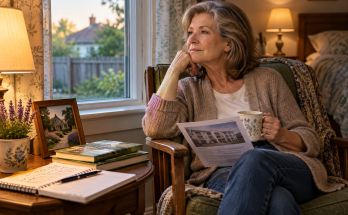
I made coffee and sat at the kitchen table.
My notebook was beside me.
I opened it to a clean page and began writing down practical questions.
Where could I stay if I left?
What would I need to take?
What would happen to the belongings I had brought from Hudson?
How much time would I need to arrange somewhere else to live?
I didn't have all the answers.
Writing the questions down helped me see them as things I could work through, rather than a wall I could never get past.
I had been afraid of leaving partly because I imagined that everything would have to happen at once.
I would need to pack, find a place, explain myself, and somehow make sure the children understood that I still loved them.
The thought had kept me frozen.
But I didn't have to solve every part of my life in one morning.
I could begin with one conversation.
I could ask for help.
I could find out what options were available to me.
I could make a plan before making a final decision.
For the first time, that felt possible.
I called my friend after breakfast.
I told her I was trying to work out my next steps.
She asked whether I wanted to come over again sometime during the week.
I said I would.
We agreed to speak later about the details.
I put the phone down and felt a small sense of relief.
Then I heard footsteps on the stairs.
Michael came into the kitchen.
He looked at the coffee pot and asked whether there was any left.
I poured him a cup.
He sat across from me.
For a few seconds, we drank in silence.
I had imagined having this conversation with him many times.
In my imagination, he always began by apologizing.
In reality, he looked tired.
He asked whether I was still upset about the dinner.
I set my cup down.
"Yes," I said.
He seemed surprised that I had answered so directly.
He said he thought I had taken his words the wrong way.
I waited for him to explain.
He said he had been trying to make clear that he and Jessica needed help with the children.
I told him I understood that.
Then I reminded him that I had been helping every day.
I had changed my routine around the boys.
I had taken care of meals, school needs, and the afternoons when he and Jessica wanted time to themselves.
I wasn't saying those things to make him feel guilty.
I wanted him to understand that I had not been sitting in his house waiting to be given a purpose.
I had been doing work that mattered.
Michael leaned back.
He said he had never asked me to do anything I couldn't handle.
I felt my hands tighten around the cup.
That was not what I had been trying to explain.
The question wasn't whether I could physically manage the children.
The question was whether he believed I had a right to choose when I did it.
"I can help," I said. "But I need to be asked. And I need to be able to say no."
He looked at me for a long moment.
Then he said he didn't understand why everything had become so complicated.
I felt a sadness that was different from the anger I had felt at dinner.
I had hoped that if I explained myself clearly enough, he would finally see the situation as I did.
But he was still looking at the problem from the same side.
To him, I had been helping.
Now I was refusing.
He didn't seem to understand that the arrangement had changed long before I began saying no.
I could have continued arguing.
I could have listed every afternoon I had stayed home, every meal I had prepared, and every time I had set aside my own plans.
But I didn't want to turn our relationship into a list of debts.
I wanted my son to treat me with consideration because I was his mother and a person, not because I could prove that I had earned it.
So I took a breath.
"I'm not asking you to agree with everything I say," I told him. "I'm asking you to respect that my time belongs to me."
He looked down at his coffee.
For a moment, neither of us spoke.
Then he said he had things to do.
He stood, carried his cup to the sink, and left the kitchen.
I watched him go.
The conversation had not gone the way I hoped.
There was no apology.
No sudden understanding.
No promise that everything would change.
But I had said what I needed to say.
I hadn't shouted.
I hadn't insulted him.
I hadn't begged him to understand.
That mattered to me.
I finished my coffee and washed the cups.
Then I went upstairs and opened the suitcase.
I checked my clothes.
I checked my photographs.
I checked the small towel wrapped around my husband's watch.
The blue ceramic bowl remained safely packed in its box.
I placed the notebook on top of everything.
I wasn't packing because I had decided to leave that day.
I was making sure that, if I chose to leave, I wouldn't be starting from nothing.
There was a difference.
I could prepare without making a final decision.
I could consider my future without treating the possibility of change as a betrayal of my family.
I closed the suitcase.
Then I sat at the desk and looked at the photograph I had kept on the dresser.
It showed Michael as a boy, standing beside me in front of our old house.
He had one arm around my waist and a grin that made his eyes almost disappear.
I remembered the day the photograph had been taken.
He had wanted to go inside because he was hungry.
I had asked him to wait a moment longer.
He had complained, but he had stayed beside me.
I held the photograph carefully.
I still loved that boy.
I loved the man he had become, too, even when his behavior hurt me.
Love did not disappear simply because someone disappointed you.
But love could not make every decision for you.
I placed the photograph in the small bag with the others.
Then I went downstairs.
The boys were playing in the living room.
Caleb was building something with blocks.
Owen was trying to convince him that the structure needed another level.
Clare sat nearby, reading.
I watched them for a moment.
They looked comfortable and safe.
I wanted them to keep feeling that way.
I wanted to remain part of their lives.
But I couldn't promise that staying in the house was the only way to do that.
I sat beside Caleb and helped him find a piece that would fit.
He handed me a red block.
I placed it where he pointed.
He smiled and returned to his work.
It was a small moment.
An ordinary one.
I held on to it because I wanted to remember that leaving a household, if I eventually chose to leave, would not mean that my love for those children had ended.
I could be their grandmother from somewhere else.
I could call them.
I could visit when it was possible.
I could remain interested in their lives without being responsible for every hour of their days.
I didn't know exactly what that future would look like.
I only knew that I needed to allow myself to imagine it.
That afternoon, I returned to my room and sat beside the suitcase.
For the first time, I wasn't waiting for Michael to decide whether I belonged in his house.
I was trying to decide what kind of life I could accept for myself.
I had no final answer yet.
But I had begun asking the right question.
Click here to continue reading: PART 9: I Began to Understand That Being Welcome in My Son’s House Was Not the Same as Being Treated Like Someone Whose Time and Feelings Mattered
I Had Spent Three Months Making Myself Useful in My Son’s House, Until One Ordinary Sunday Dinner Changed What I Could Bear
Part 8 of 20