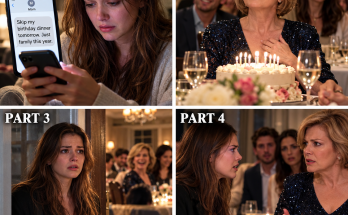
A month after Mom’s birthday, she called on a Sunday afternoon.
Her voice had the careful tone she used when she had rehearsed something.
I noticed immediately.
“What happened?”
“Nothing.”
“Mom.”
She sighed.
“Can you stop knowing my voice?”
“No.”
“Fine.”
I waited.
“I want to ask you something about Maisie.”
Every protective instinct sharpened.
“What?”
“I want to talk to her about the birthday message.”
My stomach tightened.
“She already knows enough.”
“I know.”
“Then why?”
Mom was quiet.
“Because I think she knows your version.”
I almost reacted badly.
Mom heard it.
“That came out wrong.”
“Yes.”
“I don’t mean your version like it isn’t true.”
“Good.”
“I mean she knows what happened from you.”
I waited.
“And she knows I apologized.”
“Yes.”
“But I’ve never really told her what I did.”
That was different.
“Why do you want to now?”
Mom answered slowly.
“Because she’s old enough to understand more.”
“She’s six.”
“I know.”
“And because…”
Her voice broke slightly.
“I don’t want the family story to become that Grandma used to be mean and then got better.”
I sat down.
“What do you want it to be?”
“The truth.”
“That is the truth at six.”
“Part of it.”
I listened.
Mom continued.
“I want her to know I loved her even then.”
My body tightened.
Dangerous territory.
Because saying love existed did not erase the behavior.
Mom seemed to understand.
“And I want her to know love was not enough.”
There.
That mattered.
“I don’t want her growing up thinking if someone says they love her, she has to tolerate whatever they do.”
The words landed deep.
I had spent years teaching exactly that.
Mom said:
“If she ever hears the story when she’s older, I want her to know I didn’t ask everyone else to make me look better.”
I stayed quiet.
“Do you think I should?”
That question surprised me.
Not “I’m going to.”
Do you think I should?
I answered honestly.
“I don’t know.”
“Okay.”
“Let me think.”
“Okay.”
No pressure.
The next person I talked to was the counselor.
Not because I needed permission.
Because I wanted perspective.
She asked:
“What benefit does Maisie get?”
Good question.
“Honesty.”
“Potentially.”
“Understanding repair.”
“Yes.”
“Seeing an adult own harm.”
“Yes.”
Then she asked:
“What risk?”
I knew.
“That Mom uses Maisie to relieve guilt.”
“Exactly.”
I sat with that.
The difference between accountability and confession mattered.
Adults often told children “the truth” because adults wanted emotional relief.
That was not fair.
“How do I tell?”
“Ask your mother what she needs from Maisie afterward.”
I understood.
If the answer was forgiveness, reassurance, absolution, comfort—too much.
I called Mom.
“What do you need her to say?”
Mom became silent.
“After you tell her.”
“I don’t know.”
“Think.”
She did.
Finally:
“Nothing.”
Good.
“What if she gets angry?”
“I accept it.”
“What if she says she doesn’t want to see you for a while?”
Mom’s breathing changed.
“That would hurt.”
Not the same as refusal.
“But?”
“I would accept it.”
“What if she asks why I kept bringing her around after?”
Mom was quiet.
“I would tell her you didn’t at first.”
Good.
“What if she asks why Grandpa didn’t stop you?”
“Then your father answers for himself.”
Good.
I exhaled.
“Okay.”
“Okay?”
“You can talk to her.”
Mom cried.
Immediately.
I smiled.
“You are already failing the no-emotional-burden rule.”
She laughed through tears.
“I’ll get it together.”
The conversation happened at Mom and Dad’s townhouse.
Not because the location was symbolic.
Because Maisie wanted to sleep over.
We sat in the living room.
Dad was there.
I was there.
Mom.
Maisie.
Marcus stayed in the kitchen by choice.
Close enough.
Not involved unless needed.
Mom began simply.
“Do you remember the message you saw about my birthday?”
Maisie nodded.
“The one Grandma bad.”
Mom smiled sadly.
“Yes.”
“That one.”
Maisie looked at me.
I nodded.
Mom continued.
“I want to tell you something important.”
Maisie curled her legs beneath her.
“When you were a baby, I loved you.”
Good start.
“But I did not treat you like someone I loved.”
Maisie frowned.
Mom’s eyes filled.
She kept going.
“I was used to Mommy doing a lot for our family.”
Maisie looked at me.
“She was used to helping me, Grandpa, Aunt Brinn, Uncle Kyle.”
“And me baby.”
“Yes.”
“When you were born, Mommy had less time for us.”
“Because baby need things.”
“Exactly.”
Maisie nodded as though this was mathematically obvious.
Mom continued.
“And instead of understanding that, I got angry.”
“At baby?”
“Yes.”
The word cost her.
I could see it.
She said it anyway.
“That was wrong.”
Maisie stared.
“Why mad at baby?”
Mom inhaled.
“Because I was selfish.”
Same word as before.
No decoration.
“I wanted Mommy’s attention.”
Maisie frowned deeply.
“But Mommy my mommy.”
“Yes.”
Mom’s voice cracked.
“You’re right.”
“And you Grandma.”
“Yes.”
“Different.”
“Yes.”
There it was.
The distinction Mom had failed to understand.
Different relationships did not compete unless adults made them.
Mom continued.
“I thought Mommy changing meant I was losing something.”
“Did you?”
Mom looked at me.
Then back at Maisie.
“No.”
“Then silly.”
Dad coughed to hide a laugh.
Mom smiled.
“Yes.”
“Very silly.”
Maisie’s expression became serious again.
“You say go home.”
“Yes.”
“Mommy cry.”
“Yes.”
“Baby me cry?”
“I don’t know.”
Maisie looked at me.
“You cried because hungry.”
She nodded.
Reasonable.
Then she asked Mom:
“Why no call after?”
The room changed.
That was a question even I had not expected.
Mom looked at me.
I stayed silent.
Her answer.
“Because I was embarrassed.”
Maisie frowned.
“What embarrassed?”
“When you know you did something wrong and don’t want to admit it.”
“Like hiding broken cup.”
“Exactly.”
Mom smiled faintly.
“I knew I had been cruel.”
“So you no say sorry.”
“No.”
“Why?”
“Because saying sorry meant admitting Mommy had a right to be angry.”
That was brutally honest.
I felt tears rise.
Mom continued.
“And I wanted to think she was the problem.”
Dad looked down.
Maisie stared at Mom.
Then:
“But Mommy not problem.”
“No.”
“Baby not problem.”
“No.”
“Then you problem.”
Mom laughed once through tears.
“Yes.”
“I was the problem.”
No collapse.
No request for reassurance.
Good.
Maisie thought.
Then looked at Dad.
“You problem too?”
Dad’s eyes widened.
Direct hit.
He leaned forward.
“Yes.”
“Why?”
“Because Grandma said something wrong and I did not tell her to stop.”
“Why?”
Dad rubbed his hands together.
“Because I didn’t like arguments.”
Maisie looked confused.
“So?”
I almost laughed.
Exactly.
Dad smiled sadly.
“So I stayed quiet.”
“Quiet bad?”
“Sometimes.”
“When?”
Dad thought.
“When being quiet lets someone get hurt.”
That was good.
Maisie looked between them.
“You both sorry?”
“Yes,” they said together.
Then she asked the most important question.
“You do again?”
Mom answered first.
“I hope not.”
Not promise.
Good.
Dad said:
“If we do something wrong, Mommy will tell us.”
Maisie shook her head.
“No.”
Everyone stopped.
“You know yourself.”
The room went silent.
My six-year-old had just corrected the family system.
Mom began laughing.
Then crying.
Not dramatically.
Joyfully.
“You are right.”
Maisie smiled.
“I know.”
Of course.
Mom wiped her face.
“You shouldn’t have to tell me how to behave.”
“Yes.”
I looked away because suddenly I was crying too.
Children did not need to become teachers simply because adults were learning.
That had been my childhood.
Maisie would not inherit it.
Mom seemed to understand the same thing.
She said:
“That is Grandma’s job.”
“Okay.”
Then Maisie asked:
“Can I have cookie?”
Apparently accountability had concluded.
Mom laughed.
“Yes.”
“One.”
“Two.”
Mom looked at me.
I raised my hands.
“Your house.”
Maisie shouted:
“THREE.”
Negotiation ended at two.
Later, after Maisie went upstairs with Dad to choose pajamas, Mom and I remained in the living room.
Marcus still stayed in the kitchen.
Bless him.
Mom looked at me.
“That was worse than I imagined.”
“Because she asked good questions?”
“Because they were simple.”
I understood.
Adults build defenses that survive complicated arguments.
Simple truth goes around them.
Baby needed Mommy.
Grandma was Grandma.
Different.
Why be mad?
Why stay quiet?
Why not know yourself?
No theory.
No excuses.
“I’m glad you did it,” I said.
Mom nodded.
“Me too.”
Then:
“I wanted her to forgive me.”
There it was.
I looked at her.
“I know.”
Mom’s face crumpled slightly.
“I didn’t ask.”
“No.”
“But I wanted it.”
“Of course.”
“Is that wrong?”
“No.”
I sat beside her.
“It would be wrong to make her give it.”
Mom nodded.
“I think she already has.”
“Maybe.”
“But that isn’t the point.”
She looked at me.
“No.”
The point was that Mom had finally learned to carry the discomfort herself.
That was accountability.
Not confession followed by relief.
Not apology as a transaction.
Not “I said sorry, now you must move on.”
Carrying what belonged to you.
The next morning, Maisie came home cheerful.
No emotional hangover.
No fear.
No sudden distrust.
She showed me a bracelet Mom had helped her make.
“Grandma good now.”
I smiled.
“Grandma makes better choices now.”
Maisie corrected herself.
“Yes.”
Then:
“Grandma still silly.”
“Extremely.”
She laughed.
That afternoon, Marcus and I took her to the park.
She rode her scooter.
Marcus and I walked behind.
He said:
“How did it go?”
I told him.
He listened.
Then asked:
“How are you?”
I thought.
“Proud.”
“Of your mom?”
“Yes.”
Then I looked at Maisie.
“And sad.”
“Why?”
“Because she got an apology at six that I needed at twenty-seven.”
Marcus took my hand.
There was no solution.
No need.
Both truths could exist.
I was glad for Maisie.
I grieved for myself.
That grief did not make me bitter.
It made the difference visible.
At the playground, Maisie climbed too high.
I almost shouted.
Then stopped.
She looked down.
“Mommy!”
“Yes?”
“Look!”
“I’m looking.”
She jumped.
Not dangerously.
Still enough to make my heart stop.
She landed.
Laughed.
Safe.
Marcus glanced at me.
“You didn’t tell her to get down.”
“I know.”
“Growth.”
“Don’t.”
He smiled.
I watched her climb again.
Protection was not preventing every fall.
Accountability was not preventing every mistake.
Love was not eliminating every risk.
It was creating enough safety that people could grow without believing one mistake would cost them belonging.
I had spent years learning that with adults.
Now I was learning it as a mother.
That evening, Mom sent one message.
“Thank you for letting me speak for myself.”
I stared at it.
Then replied:
“Thank you for doing it.”
No absolution.
No old hierarchy.
Just two adults recognizing work done.
A few minutes later, Dad texted separately.
“She told me quiet can be bad.”
I laughed.
Then:
“She is right.”
His reply:
“I know.”
I believed him.
The final shift came a week later.
Maisie drew another family picture.
This one included everyone.
Me.
Marcus.
Derek.
Elena.
Sophie.
Grandma.
Grandpa.
Brinn.
Ethan.
June.
Kyle.
Vanessa.
Lauren, inexplicably.
Even Lily.
No labels.
No hierarchy.
No lines separating households.
Just people.
She handed it to me.
“Family.”
I studied the crowd of stick figures.
No one centered.
Not even me.
That once might have frightened me.
Now it felt exactly right.
“Where are you?” I asked.
She pointed near the middle.
A small figure holding two elephants.
“There.”
I smiled.
“Perfect.”
Because she did not need to be at the center either.
She only needed to know she belonged wherever she stood.
Click here to continue reading: PART 35: Years After One Cruel Text Sent Me Home, My Family Gathered Again—and This Time Nobody Had to Earn a Place at the Table
Halfway to My Mother’s Birthday, One Message Made Me Turn Around and Question Everything My Family Had Taught Me About Love
Part 34 of 35