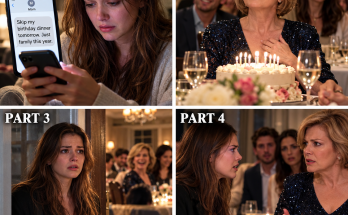
My mother's text arrived while I was stopped behind a line of brake lights on Interstate 5, halfway between Seattle and Portland.
Maisie was asleep in the back seat. At three months old, she could sleep through traffic, rain, and the uneven hum of the heater, provided I didn't make the mistake of stopping for too long. Her cream blanket had slipped below her chin, and one tiny fist rested against her cheek. I glanced at her in the rearview mirror just as my phone buzzed in the cup holder.
I expected a message asking how far away we were.
Instead, Mom had written, “Skip my birthday. We need a break from your kid.”
The traffic ahead began moving, so I drove another mile before I let myself look again. I thought there had to be another message beneath it—some explanation, some awkward attempt at humor, anything that would turn those nine words into something less cruel.
There wasn't.
I had left Seattle before sunrise. The trunk held a portable bassinet, enough diapers for twice the trip, bottles, formula, three changes of clothes, and a wrapped birthday present for my mother that had cost more than I should have spent. I had planned the drive around Maisie's feeding schedule. I had even packed the lemon cake Mom liked because she had complained the bakery near their house had changed its recipe.
And now, after all of that, she wanted me to turn around.
Not because Maisie was sick.
Not because the party had been canceled.
Because my family apparently needed relief from my daughter.
A rest-area sign appeared through the drizzle. I took the exit without thinking, pulled into a space beneath a bare maple tree, and left the engine running. For a while I sat with both hands wrapped around the steering wheel.
The sentence stayed bright on my screen.
We need a break from your kid.
My kid.
Not Maisie. Not their granddaughter. Not the baby.
I looked over my shoulder.
She was still sleeping.
Something about that made the message worse. Maisie wasn't difficult. She cried when she was hungry, wet, frightened, or tired. She woke at inconvenient hours because she was an infant, not because she had devised a campaign against my family's peace.
But they had been treating her presence like a disruption since before she was born.
I knew that. I simply hadn't wanted to put the pieces together.
My name is Jenna. I was twenty-seven when Maisie was born, and by then I had already spent most of my life becoming the person my family called when something needed fixing.
Mom needed money for a property-tax payment? I found it.
Dad needed someone to reorganize travel arrangements? I handled it.
My younger brother Kyle had a business idea and needed “just a little bridge money”? I transferred it.
My sister Brinn had a crisis with rent, a car repair, a credit card, or a relationship? Somehow I became the emergency department.
They thanked me. They told people I was dependable. Mom liked to say I was the one child she never had to worry about.
For years, I thought that was praise.
Only after Maisie came along did I begin wondering whether “dependable” had meant “unlikely to say no.”
Maisie's father, Derek, disappeared from our lives before she was born. There was no cinematic breakup. No screaming in a parking lot. No smashed dishes.
He simply decided he wasn't prepared to become a father.
At first he called less. Then he answered only when I called. Then even that stopped. By my seventh month of pregnancy, his absence had become so complete that I finally stopped expecting an explanation that would make it hurt less.
When I told my parents I intended to raise Maisie myself, Mom stared at me across her kitchen island.
“Well,” she said, “you chose this situation.”
Dad looked at the countertop.
Brinn studied her phone.
Kyle asked whether Derek would at least be contributing financially.
Nobody asked whether I was scared.
I was.
I was terrified.
But the first time I held Maisie, none of that fear changed the simplest fact in the room: she was mine, she was here, and I loved her.
My family responded differently.
They visited after the birth, but there was always an edge to it. Mom complained that my apartment was too small. Brinn held Maisie for ten minutes, took several pictures, then returned her when she began fussing. Kyle joked that babies were “birth control with lungs.”
Dad was gentler, but gentleness without intervention had always been his specialty.
Whenever Mom said something cutting, he found another room.
Whenever Kyle asked me for money, Dad advised me privately to “use my judgment.”
Whenever Brinn treated my time as if it belonged to everyone except me, Dad sighed and said, “You know your sister.”
He wasn't cruel.
Sometimes I wondered whether that had made his silence harder to recognize as a choice.
My phone was still in my hand.
I could have called Mom.
Normally, I would have.
I would have asked whether Maisie had done something. I would have promised to keep her quiet. I might have offered to leave early, bring extra bottles, sit in another room if she cried, or arrange some other humiliating compromise that allowed everyone else to remain comfortable.
The thought made my stomach turn.
Behind me, Maisie stirred.
I watched her face tighten before she released a soft sigh and settled again.
Three months old, and already I was being asked to teach her something about belonging.
I could teach her that when people rejected her, we worked harder for admission.
Or I could teach her that we left.
I typed, “Understood. Hope you have a nice birthday.”
My thumb hovered over Send.
There was a familiar voice in my head warning me what would happen.
Mom would say I was dramatic.
Brinn would say I was making everything about myself.
Kyle would tell me to lighten up.
Dad would call later and ask why I couldn't have handled it differently.
For once, I let all four imaginary voices talk without answering them.
Then I sent the message.
I put the phone facedown.
And I turned the car north.
The first hour back to Seattle felt unreal. Rain swept across the windshield. Trucks hissed past on wet pavement. Maisie slept while I replayed my mother's message until I could have recited it without looking.
I kept remembering other moments too.
Mom refusing to visit one weekend because she was “not up for baby chaos.”
Brinn suggesting I hire a sitter for Christmas even though Maisie would barely be four months old.
Kyle asking whether having a child meant I would become “weird about money.”
Dad telling me privately that everyone “just needed time to adjust.”
Adjust to what?
A baby?
Or to the fact that the person who had always rearranged her life around theirs suddenly had someone else to put first?
That question stayed with me until Maisie woke.
Her cry began as a small complaint and became urgent within seconds. I took the next exit and parked outside a coffee shop. The rain had slowed to a mist.
I climbed into the back seat.
“Hey, bug,” I whispered. “I'm here.”
The moment I lifted her, she pressed her warm face against my chest.
I prepared a bottle while she protested the delay with impressive outrage. Then she drank, one hand opening and closing against my sweater.
Watching her, I felt something inside me become very calm.
She trusted me completely.
That trust was not sentimental. It was a responsibility.
If a room required me to accept her humiliation as the price of entry, then neither of us belonged there.
We reached my apartment after dark.
By then every muscle in my back hurt. I carried the diaper bag upstairs, returned for the bassinet, then made a third trip for everything else. Mom's birthday gift remained in the trunk.
I didn't have the energy to look at it.
After changing Maisie, I set her in her bassinet and sat on the kitchen floor with my back against a cabinet.
That was where Vanessa found me, metaphorically speaking.
She called at 8:17.
Vanessa had been my closest friend since nursing school. She could detect trouble from the way I said hello.
“What happened?”
“Nothing.”
“Jenna.”
I closed my eyes.
My resistance lasted approximately three seconds.
I told her about the drive.
Then I read Mom's message aloud.
Vanessa was silent long enough that I checked the screen to make sure the call hadn't dropped.
Finally she said, “You turned around, right?”
“Yes.”
“Good.”
The word cracked something open.
I began crying.
Not gracefully. Not the quiet tear sliding down one cheek that movies like to use when women are devastated but still photogenic.
I cried until my nose ran and my chest hurt.
Vanessa didn't interrupt.
When I could speak again, I said, “Maybe I'm overreacting.”
“No.”
“You don't even know the whole situation.”
“I know your mother told you she needed a break from her three-month-old granddaughter while you were already driving four hours to celebrate her birthday.”
“She might be overwhelmed.”
“So she could have spoken to you like someone she loves.”
I pressed the heel of my hand against my eyes.
Vanessa's voice softened.
“Jenna, they're angry that your life changed.”
I didn't answer.
“They were used to you being available,” she continued. “Then you became a mother. Now your first responsibility isn't them.”
“That sounds too simple.”
“Simple doesn't mean wrong.”
Maisie began fussing from the bassinet.
I got up.
Vanessa heard her.
“And for the record,” she said, “anyone who needs a break from that baby can send her to me.”
Despite everything, I laughed.
It was brief, but it mattered.
I lifted Maisie and held her against my shoulder.
After Vanessa hung up, I walked around the apartment in the dim light, rubbing Maisie's back.
I thought about the birthday gift downstairs.
The cake.
The gas.
The eight hours I had spent driving nowhere.
Then I thought about all the other invisible costs I had never counted because they came with the word family attached.
Money.
Time.
Apologies I didn't owe.
Silence I maintained to protect other people's comfort.
The strange exhaustion of being useful enough to be needed but never secure enough to feel wanted.
Maisie's breathing slowed against my neck.
I whispered into her hair, “We're not doing this.”
She obviously had no idea what I meant.
But I did.
Mom's birthday passed without another message from me.
That was unprecedented.
Every year since I was old enough to remember, I had called her first thing in the morning. As an adult, I sent flowers. I arranged dinner. I bought the thoughtful gift.
This year, nothing.
At noon, I caught myself checking my phone.
At three, I did it again.
By evening, I realized what I had been waiting for.
Someone to ask where I was.
Someone to acknowledge what had happened.
Someone to say the message had been cruel.
Nobody did.
Not Mom.
Not Dad.
Not Brinn.
Not Kyle.
The silence told me more than an argument would have.
The following Saturday, I bundled Maisie into her stroller and walked around Green Lake.
The air was cold enough to sting my cheeks. Bare branches reflected in the water. Runners passed us in bright jackets, and dogs strained toward every interesting patch of grass.
Maisie stared upward from beneath her knitted hat.
When I leaned over the stroller, she smiled.
Her whole face changed when she smiled.
I stopped walking.
For the first time since Mom's message, I felt something other than anger.
Grief.
But not guilt.
That distinction surprised me.
I could mourn the family I wanted without returning to the role that had hurt me.
Two weeks after Mom's birthday, Thanksgiving was approaching.
My coworkers discussed travel plans. Grocery stores stacked turkeys in freezer cases. Every advertisement seemed determined to show three generations smiling around a table.
My family still hadn't contacted me.
No invitation.
No question about my plans.
Nothing.
I assumed Thanksgiving would be Maisie and me in our apartment. Maybe Vanessa would stop by. Maybe I'd cook something small after Maisie fell asleep.
I was making coffee on the Tuesday before the holiday when Vanessa called.
Maisie was on my shoulder. The coffee had already gone cold once.
Vanessa didn't say hello.
“Before you answer,” she said, “you are forbidden from saying no until I finish.”
“That sounds dangerous.”
“It's Thanksgiving.”
“I know when Thanksgiving is.”
“Lauren and Marcus are going to Montana.”
I shifted Maisie higher against my shoulder.
Lauren was Vanessa's former supervisor and now one of her closest friends. I'd met her twice. She and her husband had money on a scale I found difficult to comprehend, but neither had ever made me feel like I needed to notice it.
“They rented a private lodge,” Vanessa continued. “A few friends are going. Simone and Beth are bringing Cameron.”
“Okay.”
“Lauren invited us.”
“Us?”
“You. Me. Maisie.”
I laughed because I assumed she was joking.
She wasn't.
“Vanessa, I can't afford Montana.”
“You aren't paying.”
“Absolutely not.”
“You promised not to say no.”
“I promised nothing.”
“She arranged the flight.”
“What flight?”
“The flight you're taking with me tomorrow.”
I stared at my kitchen wall.
“Vanessa.”
Then she said the one thing that stopped every objection forming in my mouth.
“Jenna, Lauren specifically asked whether the baby was coming.”
I went quiet.
“She said babies are welcome,” Vanessa continued. “Her exact point was that nobody should spend Thanksgiving alone when there is room at the table.”
Room at the table.
I looked down at my daughter.
For two weeks, I had been learning what exclusion sounded like.
Now someone I barely knew was offering the opposite without making me earn it.
“Are you sure?” I asked.
“Completely.”
I looked around my little apartment—the drying bottles, folded burp cloths, unopened mail, the life I had been trying to hold together alone.
Something frightened me about accepting.
Maybe because generosity without a hidden bill still felt unfamiliar.
Maisie woke and blinked at me.
Then she smiled.
I exhaled.
“Okay,” I said.
Vanessa screamed loudly enough that I moved the phone away from Maisie's ear.
“We'll go.”
What I didn't know yet was that accepting that invitation would expose exactly what my family had been missing.
Not me.
Not Maisie.
Access.
Click here to continue reading: PART 2: At a Snowbound Lodge, Strangers Welcomed My Daughter Without Conditions—and One Quiet Photograph Reached the People Who Had Rejected Us
Halfway to My Mother’s Birthday, One Message Made Me Turn Around and Question Everything My Family Had Taught Me About Love
Part 1 of 35